Witnesses tell an Assembly committee that looming federal cuts would leave state programs adrift
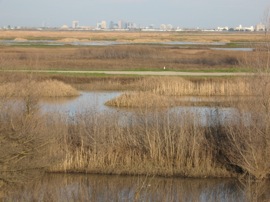
The Yolo Bypass, with Sacramento in the background. (Photo: Craig Miller)
An array of state programs to protect and restore rivers and wetlands is endangered by current plans to cut funding on Capitol Hill. That’s what a string of witnesses told the Assembly Water, Parks & Wildlife Committee in Sacramento this week.
At risk are programs that have leveraged federal money to restore hundreds of thousands of acres of wetlands and wildlife habitat in California, according to speakers for environmental and outdoor groups.
For a nearby example of how federal funds have been used, waterfowl advocate Bill Gaines pointed to the Yolo Bypass, almost within sight of the state Capitol. Gaines, president of the California Outdoor Heritage Alliance, said that over ten years, $5 million in federal money has fueled restoration of 4,300 acres of wildlife habitat. Continue reading Federal Budget Pressure on Rivers, Wetlands→
Bill to require one-third renewable energy sails through state senate
(Photo: Craig Miller)
That next gust of wind you hear may be a collective sigh of relief from the renewable energy industry. By a margin of more than two-to-one, state senators have approved a bill to cement California’s requirement that utilities draw at least a third of their power from renewable sources by 2020.
Report: Big changes needed to avert “widespread environmental and economic losses” in California
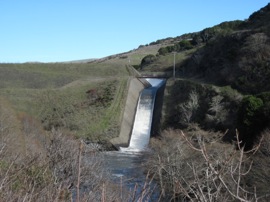
Grand illusion? Water rushes over the spillway at Nicasio Reservoir in Marin County. (Photo: Craig Miller)
A high-profile team of experts is calling for a major overhaul of the way California manages its water. In a 500-page report from the non-partisan Public Policy Institute of California, the authors say decades of well-intended water policies simply haven’t worked, leaving the state vulnerable to major crises, including water shortages, catastrophic floods, decline & extinction of native species, deteriorating water quality, and further decline of the Sacramento-San Joaquin Delta.
“Our system has been dying a death by a thousand cuts,” says co-author Ellen Hanak, an economist and policy analyst at the PPIC. Hanak says that the state’s water management efforts have been “incremental” and “piecemeal,” with little success to show for it. Continue reading What Will Your Water Cost?→
Rooftop solar can make a sizable dent in the West’s renewable energy needs
This week representatives from the federal Department of Energy and Bureau of Land Management wrap up their California barnstorming swing, to gauge public opinion on the topic of siting solar projects. Throughout this often contentious debate, many have claimed that a potentially huge piece of the power solution is being overlooked; rooftop solar.
Acres of flat-roofed commercial buildings in California's Inland Empire. (Photo: Craig Miller)
Fly into Ontario airport in Southern California’s Inland Empire — or just zoom in on Google Earth — and you’ll see hundreds of block-long warehouses. There are acres — probably square miles — of flat, gray roofs sizzling in the San Bernardino County sun. Soon, though, instead of merely soaking up the rays, hundreds of industrial rooftops in Southland cities will harness them to feed the local electrical grid.
Solar panels ready for installation on Ontario warehouse. (Photo: Ilsa Setziol)
Southern California Edison and independent power producers holding contracts with the utility are building 500 MW of solar panels on warehouses and, to a lesser extent, on the ground at other Southern California locations.
Together these projects are expected to produce enough energy to rival a traditional power plant, enough to serve about 325,000 homes. Continue reading Yes in Our Backyard→
This post was originated by our content partners atCalifornia Watch.
Report says driving needs to be more costly to get us out of our cars
By Marie C. Baca
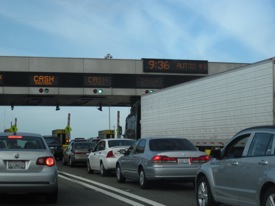
Drivers now pay $6 to cross the San Francisco Bay Bridge during peak traffic hours. "Peak pricing" is one strategy to push commuters to alternative transit. (Photo: Craig Miller)
California faces significant obstacles in complying with a 2008 state law aimed at reducing passenger vehicle usage, according to a report by the nonpartisan Public Policy Institute of California.
The report points to unrealized rail transit investments and resistance to pricing tools like fuel taxes as factors that have slowed reduction in car usage.
The two-year-old SB 375 mandates that California’s major metropolitan areas reduce per capita emissions from driving by 7 percent by 2020 and by 15 percent in 2035. While the primary focus of the bill is a reduction in the greenhouse gases that contribute to global warming, the legislation places a special emphasis on addressing traffic and public health concerns by reducing the number of miles residents drive. Continue reading State Struggling to Reduce Vehicle Emissions→
The head of a major NASA research facility in California is downplaying efforts by a handful of House Republican members to strip the agency’s budget of its climate science funding.
An image from a joint NASA-NOAA satellite project. (Image: NASA-NOAA GOES Project)
Studies reveal huge water withdrawals from aquifers under California’s Central Valley
The New York Times this weekend published a story and useful graphic describing new findings on the intensity of groundwater pumping in California’s San Joaquin Valley.
One eye-opening note from Felicity Barringer’s article:
“…the total loss of groundwater from the Sacramento and San Joaquin River basins in California’s Central Valley from 2003 to 2010 was just under 16.5 million acre-feet — approximately the volume of the Lower Colorado River reservoir, Lake Mead, when it is full.”
Lake Mead is the nation’s largest man-made reservoir (and has not been full for some time).
The wind energy industry faces multiple challenges in California.
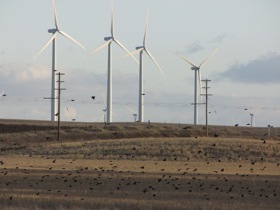
Flocks of birds near wind turbines in Solano County. (Photo: Craig Miller)
It’s hard to find people who are just flat out against wind energy. As with real estate, attitudes seem to come down to location, location, location. That’s why three of the thorniest issues with wind are project siting, transmission (lines for the power produced), and the industry’s turbulent history with birds and bats.
Last fall, even the National Audubon Society, one of the nation’s most stalwart protectors of winged creatures, published a position statement generally favorable toward wind power, calling it a “good news, bad news” proposition. The statement calls California’s Altamont Pass “notorious for killing many raptors, including golden eagles.” A 2003 study by the National Renewable Energy Lab calculated that on average, each turbine in the pass was claiming a bird about once every five years (0.19 birds/turbine/year) — but there are thousands of turbines in the pass, many older models that are more of a danger to birds.
Developers are in the process of “repowering” the pass with newer, larger turbines, less lethal to birds. That may seem counterintuitive but the older, smaller models caused more problems. Since they had lower output, more of them were required. The blades were positioned lower, spun faster, and supported by lattice towers that provided inviting nesting spots, unlike the smooth tubular towers of new turbines.
Altamont is the oldest of California’s four biggest wind energy zones, highlighted on this interactive map.
The Audubon statement concedes that newer turbine designs are becoming more bird-friendly, and finds climate change a bigger threat to avian critters in the long run. The Society went on to call for an extension of the federal Production Tax Credit for wind development, fearing its expiration next year encourages wind developers to rush projects along and “cut corners” on siting.
How much wind energy do we need to make California’s goal of 33% clean electricity by 2020? Whenever I put this question to one of the experts, the answer is always: “It depends.” But under almost any scenario, thousands more windmills will dot the California landscape in years to come.
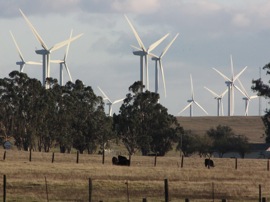
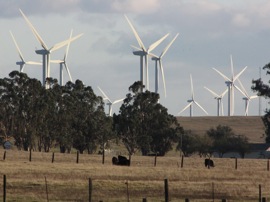
Cattle and wind turbines dot the Solano County landscape. (Photo: Craig Miller)
Those who don’t see them on a daily basis might be surprised to learn that there is already something on the order of 13,000 commercial wind turbines operating in California. Ryan Wiser, who tracks wind energy trends at Lawrence Berkeley National Lab, does a rough calculation that meeting that state-imposed threshold of 33% renewable energy could take 5,000 more, in order for wind to do its share. That’s based on an estimated 10,000 megawatts of new wind power, using the current standard two-megawatt turbine. While most of these will be concentrated in a few major “wind resource areas” (there are currently four big ones in the state), numbers like that almost ensure that wind turbines will become a more familiar feature of the California landscape. Continue reading Wind Farm Forecast: More & Bigger→
A high-ranking California official appeared on Capitol Hill today to defend the right of the federal Environmental Protection Agency to regulate greenhouse gas emissions.
James Goldstene, executive director of the state’s Air Resources Board, told members of a House subcommittee that the EPA’s recently released regulations will not create a “regulatory train wreck.”
Goldstene held up a planned power plant in Northern California to advance his case, saying that the Russell City Energy Plant will stand as an example of how power companies can use the “best available technology” for reducing emissions, as required under a recently issued EPA rule. The plant, to be built on the Hayward shore of San Francisco Bay, is a 600-megawatt plant to be fired by natural gas.
Goldstene’s appearance before the Subcommittee on Energy and Power (part of the Energy & Commerce Committee) was to counter Republican efforts to pull EPA’s authority to regulate greenhouse gas emissions, contained in a bill known as the Energy Tax Prevention Act. Goldstene said passage of the bill into law would “send a stark message…that the U-S isn’t serious about being a leader in the future economy.” It would also upstage a ruling by the US Supreme Court affirming the EPA’s authority to regulate carbon emissions under the Clean Air Act.