Opening California’s “spillway” is not the sort of thing that brings out CNN
This week officials made the uncomfortable decision to place thousands of homes and businesses in harm’s way, in order to avoid an even bigger catastrophe on the lower Mississippi River.
But as the opening of the Morganza Spillway was the subject of national media attention, California’s version had already been deployed a month earlier — and hardly anyone noticed.
The Yolo Bypass may be California’s most ingenious contrivance for flood protection and yet, many people drive over it every day without knowing its purpose.
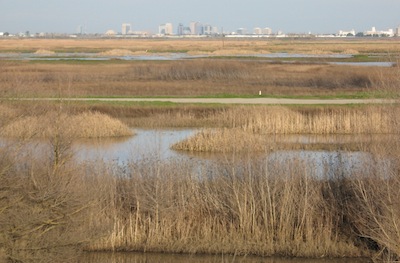
The Yolo Bypass on March 1 of this year. The Sacramento skyline rises in the distance. (Photo: Craig Miller)
The bypass is a 59,000-acre funnel designed to catch the overflow of the Sacramento River and divert it harmlessly downstream, dumping it back into the main channel near Rio Vista. Generally speaking, it works like a charm. And it does so without fanfare because there are nobody lives there. That’s the idea. Continue reading California’s Ingenious Flood Relief Valve→
Oakland’s BrightSource Energy and Environmentalists throw down over a threatened tortoise
What some have billed as the world’s largest solar project in the Mojave came under fire again today. This time a baby desert tortoise led the charge with a cohort of environmentalists. While the tortoise provided a slow-motion picket around downtown Oakland, protestors lined up in front of BrightSource Energy’s corporate headquarters, determined to preserve the Mojave desert and keep solar projects local.
A baby desert tortoise wades among protesters. (Photo: Chris Penalosa)
At risk of habitat loss from the project, the tortoise is becoming the iconic image for preservation of the Mojave. The Bureau of Land Management put the brakes on two-thirds of the Ivanpah solar farm when field biologists found more tortoises than initially expected. Tortoises found on site are being relocated and fenced off, preventing their gradual return. Continue reading Protesters Shell Mojave Solar Plant→
This is the third in a series of dispatches from Sweden, where Ingrid Becker is touring facilities for storage of nuclear waste. These posts preview an upcoming radio series on The California Report.
The panel advising President Obama is recommending the United States “proceed expeditiously” to establish one or more consolidated “interim” sites for storing high-level nuclear waste. Expeditious isn’t a word often associated with the U.S. Department of Energy’s troubled waste siting program. And, commissioners didn’t say where they would suggest putting the spent fuel, but Yucca Mountain certainly wasn’t mentioned in the series of draft reports from the Blue Ribbon Commission on America’s Nuclear Future. What the commissioners did recommend is that a new organization –independent of the Department of Energy — be formed to develop a waste disposal program. The idea didn’t set well with some House Republicans.Continue reading Sweden’s Holding Tank For Nuclear Waste→
So…if Bay Area transit is so good, why don’t more people use it?
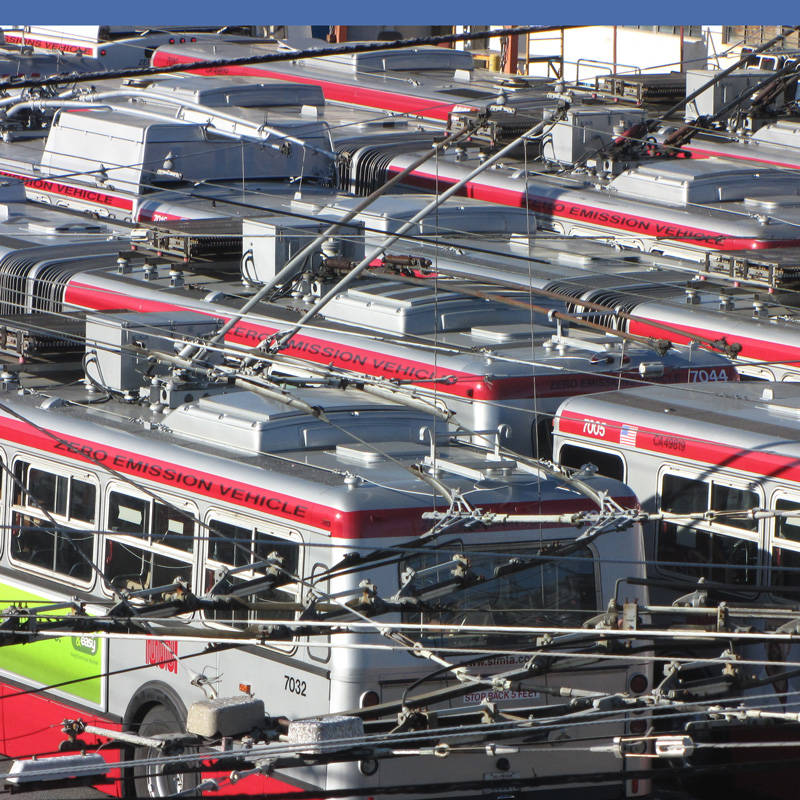
(Photo: Craig Miller)
A new study from the Brookings Institution finds that compared with the rest of the nation, the Bay Area offers pretty good public transportation options.
Among 100 major metropolitan areas, San Francisco-Oakland-Fremont ranks 16th, and San Jose-Santa Clara-Sunnyvale ranks second. Areas were ranked according to how accessible transit is to riders, how long it takes to get to work on transit and how often the systems run during rush hours.
So…if Bay Area transit is so good, why doesn’t anybody seem to take it?
Just one out of ten people in the Bay Area commute by public transportation, according to John Goodwin of the Metropolitan Transportation Commission. He says that number hasn’t changed much over the years, despite huge investments in the system. And the Bay Area isn’t alone in that. A recent study by the Public Policy Institute of California (PPIC) found that between 1990 and 2008, the share of commuters taking transit increased by less than one percentage point, from 5% to 5.5%, despite the construction of 217 new rail stations, and the fact that more than a third of California’s transportation spending since the early 1980s has gone to public transit. Continue reading High Marks but Few Takers on California Transit→
There’s a new sheriff in town, and environmentalists hope they can use that to their advantage. This week, the state chapter of the Sierra Club urged Governor Jerry Brown to reshape portions of the cap-and-trade rule, part of California’s Global Warming Solutions Act, widely known as AB 32.
In particular, the group is calling for tougher restrictions on polluters and stricter standards on carbon offsets.
“We’re asking him to put his own stamp on global warming reduction policy,” said Bill Magavern, director of Sierra Club California. He said the current cap-and-trade rule is too soft on oil companies and other big polluters and does not achieve greenhouse gas reductions in the best way possible. The law is currently in legal limbo, due to an unrelated legal challenge by environmental justice groups. Continue reading Sierra Club Challenges Governor on Cap & Trade→
…where they actually can get a repository built for “high-level” nuclear waste (they think)
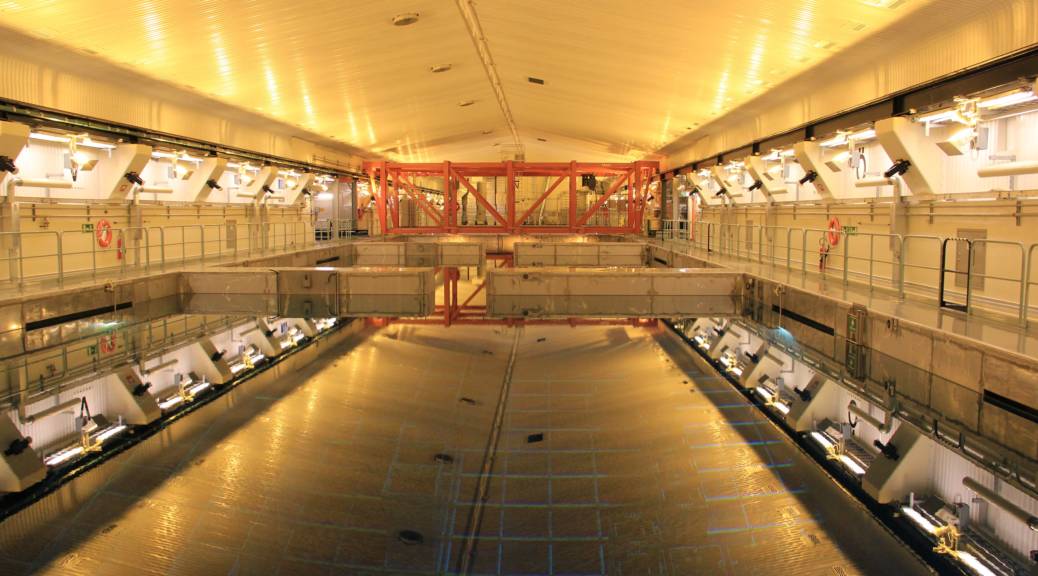
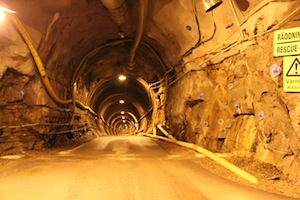
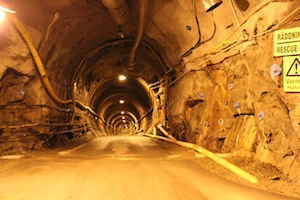
Follow the yellow brick road? The Äspö Hard Rock Laboratory in Sweden. (Photo: Ingrid Becker)
This summer, Climate Watch will launch a three-part radio series on the nuclear waste dilemma. As part of the reporting for that series, The California Report’s senior producer, Ingrid Becker, traveled to Sweden to examine a program touted as a potential model for the world. This dispatch is the second part of her series preview.
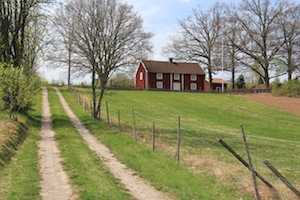
The road to Äspö from Gothenburg, where I arrived from San Francisco, winds through a storybook landscape of small farms, lush forests and brick-red houses. Road signs warning of moose crossings pop up at regular intervals along the highways and back roads.
Traditional wooden houses like this one dot the landscape in Småland, the historical province where the Swedes have built a demonstration laboratory for storing spent nuclear fuel. (Photo: Ingrid Becker)
And so it was a bit jarring to later find myself in a granite cavern, standing face-to-face with giant copper tubes, enormous machinery and a specially designed fuel transport vehicle quaintly named after one of the Viking gods.
The trip, 340 meters (1,115 feet) below ground to the demonstration tunnel takes a full minute in a noisy and slightly bumpy elevator. Before we enter the tunnel, I must strap on a transponder, a safety precaution in case of emergency. At this point I’m asking myself if I should be alarmed, but the attentive public relations officer assures me that since the facility opened in 1995, about 10,000 visitors a year have made this trek. Continue reading Going Underground in Sweden→
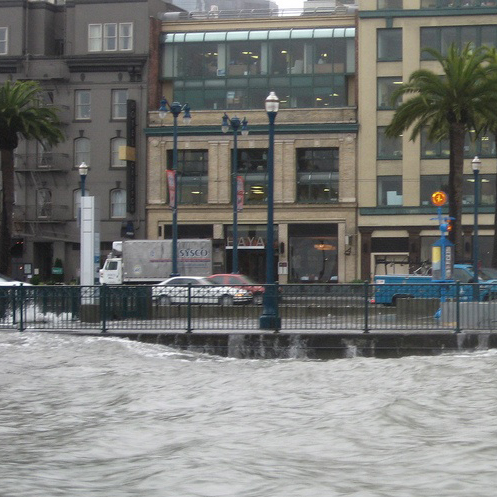
Flooding along San Francisco’s Embarcadero during an extreme high tide in February. (Photo: Heidi Nutters/Flickr)
Even if the world stopped emitting all greenhouse gases today, scientists say, the climate would continue to change, perhaps for centuries, before it stabilized. Since a zero-emissions world is unlikely, to say the least, and considering that global carbon emissions are continuing on their upward trend, finding ways to adapt to what many see as inevitable is getting more and more attention.
The San Francisco Planning and Urban Research Association (SPUR), a local think tank focused on sustainable growth, has just released a 40-page report that outlines the Bay Area’s biggest climate risks and lays out a road map for how communities can start preparing.
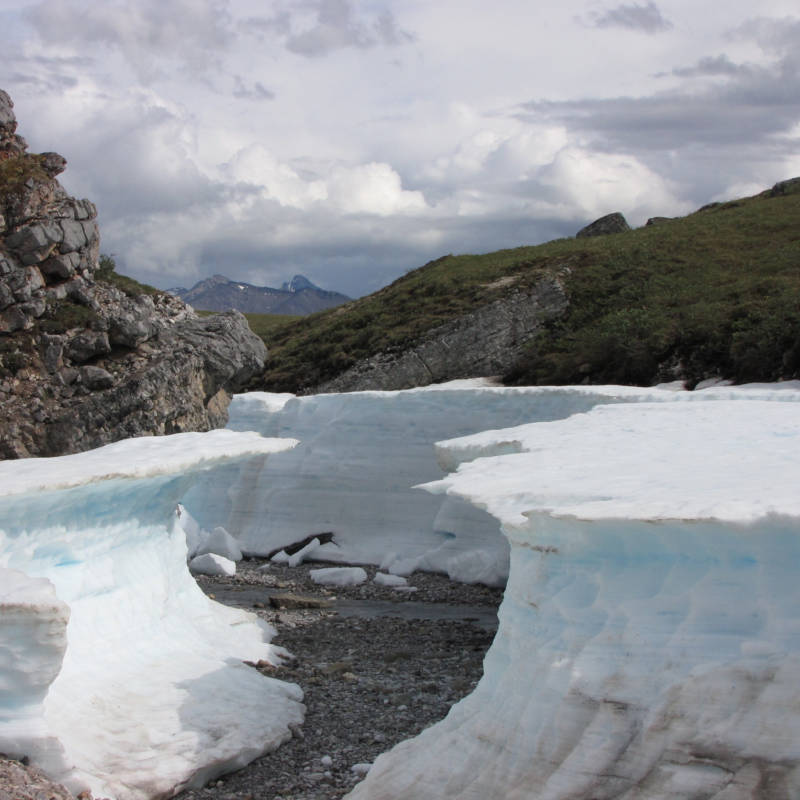
Melting snow and ice near the Arctic National Wildlife Refuge last June (Photo: Gretchen Weber)
Australia’s Chief Climate Commissioner, Tim Flannery, stopped by KQED this morning for an appearance on Forum, the station’s live call-in program. He spoke about the status of international climate agreements and expressed hope for the process, which is not something I came across very often as a reporter at the UN climate talks in Cancun last December.
In the weeks to come, Climate Watch will launch a three-part radio series on the nuclear waste dilemma. As part of the reporting for that series, The California Report’s senior producer, Ingrid Becker, traveled to Sweden to examine a program touted as a potential model for the world. This dispatch from Becker is a preview of the series.
How Sweden is getting some to say, “Yes, in my backyard,” Part 1
The country that brought the world Alfred Nobel and his dynamite, Volvo cars and IKEA furniture is busy touting another invention. The Swedish Nuclear Fuel and Waste Management Company, or SKB, has asked for government permission to build what could become one of the world’s first permanent geologic repositories for spent nuclear fuel.
SKB public relations officer Brita Freudenthal encourages visitors to touch models of the copper canisters at the Äspö Hard Rock Laboratory, where plans are being developed for permanent storage of nuclear waste. (Photo: Ingrid Becker)
I’m in Sweden this month to learn just what this environmentally-conscious nation of nine million people can teach us about managing the radioactive refuse from commercial reactors. While the waste from California’s two nuclear power plants — Diablo Canyon and San Onofre – is piling up in temporary storage containers (with still more at the decommissioned Rancho Seco plant, near Lodi), Sweden is moving forward with a program 30 years in the making, to safely dispose of the spent uranium dioxide pellets that fuel its ten reactors
”I believe it has been a strength that industry has had a clear task to solve the (waste) problem,” says SKB’s Chief Executive Officer Claes Thegerström, in a recent interview for the company website. “When we began, we had right from the beginning a mix of experienced people from the industry. We had outgoing academics and, strong authorities, which allowed us – in contrast to the American way – to own the mission.”
This week I’m in Stockholm where we’ll hear more about the Swedish example during a two-day gathering of social scientists, legal scholars, and industry experts, as well as political and community leaders from Sweden and abroad. Continue reading Sweden’s Nuclear Waste Solution→
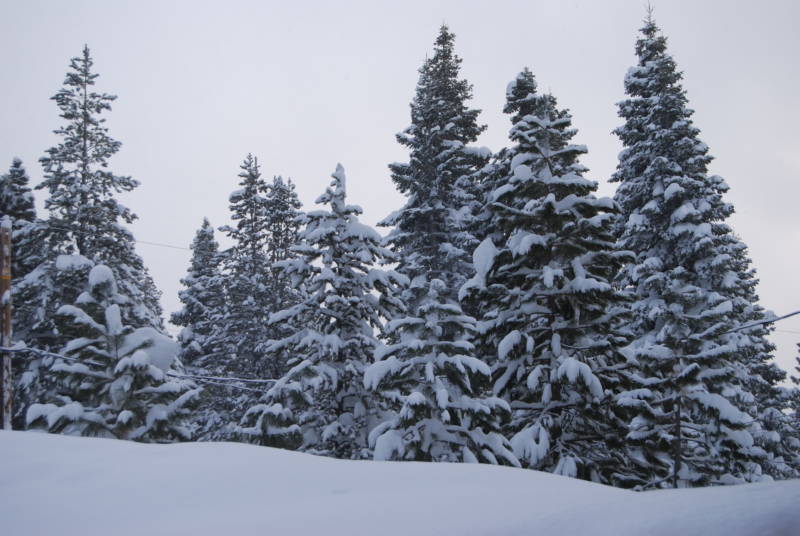
Snowy trees in Truckee, CA, in February 2011. (Photo: Lauren Sommer)
Surveyors from the Department of Water Resources strapped on their skis today and headed out to measure the status of the Sierra snowpack for the fifth and final time this season. As expected, they reported good news for the state’s water supply.
It’s been a big year for the snowpack – the biggest since 1995 – and the snow’s water content is about 180% of what’s “normal” for early May. The spring melt has already begun, so there’s less snow than there was month ago. Historically, early April is when the snowpack is at its peak, as it was this year. And yet, the current water content of the snowpack is still 50% higher than the historic average for April first.
All this water has prompted officials to project water deliveries of 80% of requests from farms and towns served by the State Water Project this year. That’s the highest percentage since 2006. Last year just 50% was delivered.