Category Archives: Government & Business

What’s brewing in Sacramento, Silicon Valley, and beyond

Air Board Hands in its Homework

Issues court-ordered do-over of alternatives to cap & trade

In response to a court ruling (which it’s still appealing), the California Air Resources Board today issued a new analysis of its proposed carbon trading program, weighed against several alternative means of reducing greenhouse gas emissions.
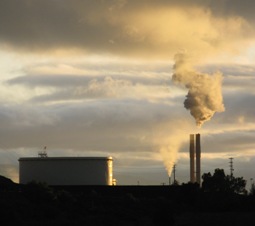
Oil refineries are among California's biggest emitters of greenhouse gases. (Photo: Craig Miller)The fresh look includes the original five options, including cap & trade and the option of doing nothing at all. It does not add any new options but rather seeks to flesh out the other three. The non-trading options include regulating emissions at the source, implementing a straight-up tax on carbon emissions, and a mixed bag of actions. The reworked analysis expands discussion of those three alternatives from a few pages to more than 60. It will be up to the courts to decide whether the extra paper carries enough substance with it to comply with the California Environmental Quality Act. Continue reading Air Board Hands in its Homework
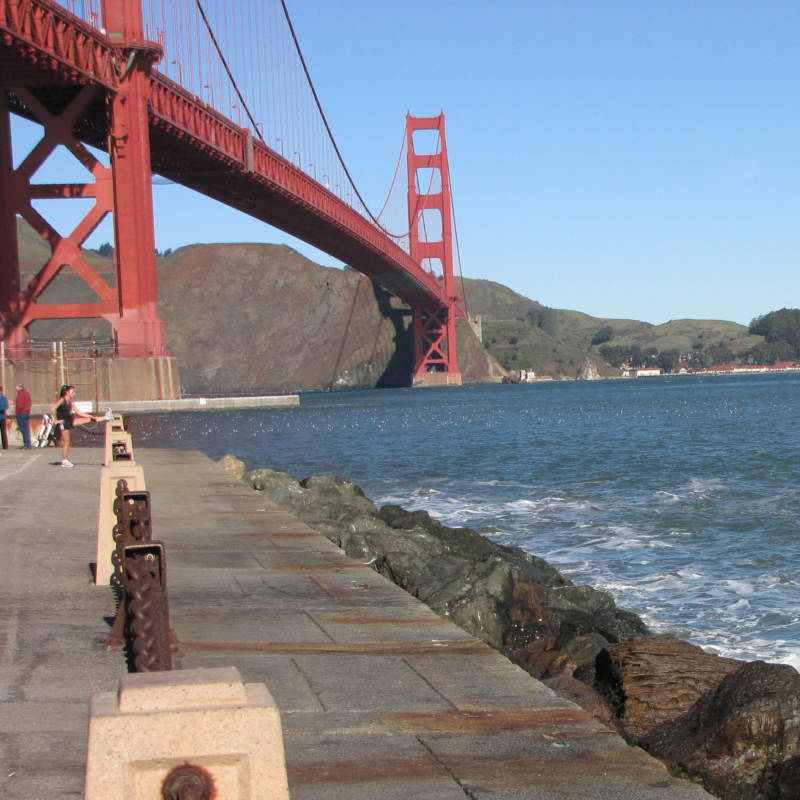
The True Price of Gasoline

It’s even higher than you think

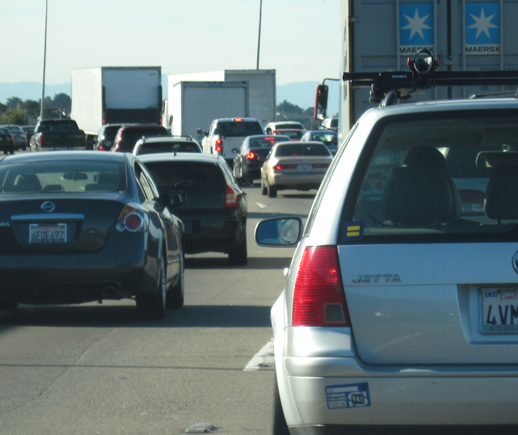
With the price of gas hovering near $4.00 per gallon (still almost a buck more than a year ago, despite the recent retreat), most Californians are already in “station shock.”

But what does gas actually cost? There’s the price at the pump, sure, but what about the hidden costs of pollution in terms of health and the environment?

The Center for Investigative Reporting takes us along on the journey that a gallon of gas makes, from oil field to gas tan, keeping a tally along the way.

California Watch, at the Center for Investigative Reporting is a content partner of KQED and Climate Watch.

San Francisco Tops List of Climate-Friendly Cities

Canadian firm ranks three California cities among the US top ten

(Photo: Gretchen Weber)

The new ranking places San Francisco at number one because of its “political leadership and commitment” in the fight against climate change, according to the study’s author, Boyd Cohen of CO2 Impact, a Vancouver-based carbon offsets company. The city also has a “proactive” university community, lots of active clean-tech investors, and the largest number of LEED-certified buildings per capita in the country, he said.

Two other California cities made the top ten: San Diego in sixth place, and San Jose in ninth. Continue reading San Francisco Tops List of Climate-Friendly Cities

An Assault on Hetch Hetchy Dam from the Flank

Activists take a new tack in attempt to restore a scenic valley in Yosemite

After years of frustration with the frontal assault, activists have shifted to a flanking maneuver to restore Yosemite’s Hetch Hetchy Valley. The group Restore Hetch Hetchy (RHH) says it will challenge the re-licensing of Don Pedro hydroelectric dam, downstream from Hetch Hetchy.

The flooded Hetch Hetchy Valley stores water from the Tuolemne River, for San Francisco. (Photo: San Francisco PUC)

Often compared to Yosemite Valley in grandeur, Hetch Hetchy Valley has been flooded since the construction of O’Shaughnessy Dam in the 1920’s. Water from the reservoir serves the City and County of San Francisco but activists have long argued that it’s not needed, and that the Valley’s original attributes are more valuable. Continue reading An Assault on Hetch Hetchy Dam from the Flank

Visualizing California Climate Change

An engrossing one-stop shop for California’s climate future goes online

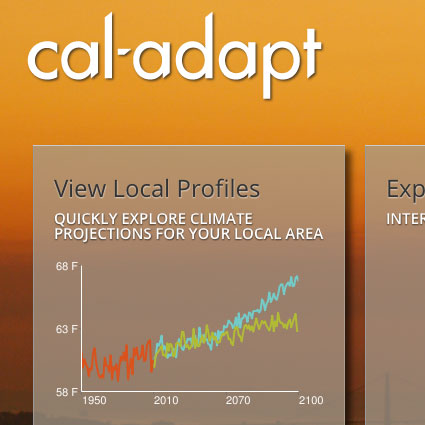
If you’re like me, and you spend a good part of every day thinking about climate change and California, you may have already lost yourself in the treasure trove of climate data and mapping fun that is Cal-Adapt, a comprehensive series of online tools just released by  the California Natural Resources Agency and the California Energy Commission.

And if you’re not like me, it’s still worth checking out.

Built by UC Berkeley’s Geospatial Innovation Facility, Cal-Adapt is designed to aid local and regional planners in preparing to adapt to climate change by providing scientific data from institutions like Scripps Institute of Oceanography, U.S. Geological Survey, UC Merced, and the Pacific Institute, and integrating it with mapping and charting capabilities from Google. The result is an attractive, interactive experience that enables you to view potential future climate-related scenarios for any location in California, and to sort by topics such as sea level rise, wildfire, and snowpack.  Importantly, data sources are prominently displayed. Continue reading Visualizing California Climate Change

Running Drier: The Colorado 50 Years Out

A new federal study says the Colorado River may carry 9% less water by 2060.

The Colorado River is a critical source of water for more than 30 million people throughout the western United States. California alone gets more than a trillion gallons of water each year from the Colorado. But over the years, recurring droughts and the growing demands of urban populations have stressed the river system, which the Bureau of Reclamation now characterizes as “over-allocated.”  In efforts to plan for the region’s future water needs, the agency, in collaboration with Western states, has undertaken a two-year study to look at what lies ahead for the river and the cities, farms, and families that rely on it.

On Monday, the agency released the first interim report of the “Colorado River Basin Water Supply & Demand Study,” which projects changes in the river’s flow under four different scenarios. A model that incorporates predicted impacts of climate change shows a nine percent reduction in the Colorado’s flow within 50 years.  The study also projects more frequent and more severe droughts throughout the system. Continue reading Running Drier: The Colorado 50 Years Out

California Likely to “Suffer Most,” Says Study

Photo: Craig Miller

California is likely to suffer more than any other state from worsening air pollution due to climate change by the end of the decade, according to a new study from the Union of Concerned Scientists (UCS).

The report finds that in 2020, “climate change-induced ozone increases” could result in nearly half a million additional cases of “serious respiratory illnesses” and add more than $729 million to the state’s health care costs. Continue reading California Likely to “Suffer Most,” Says Study

Planting Seeds for a New CA Nuclear Plant

Could California’s next nuke be on the horizon?

Backers of a new Fresno “clean energy park” aim to use nuclear power to clean up salty irrigation water in California’s Central Valley.

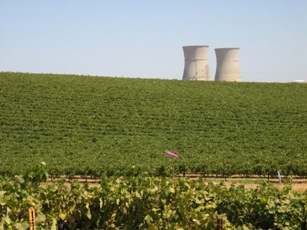
The twin cooling towers of the decommissioned Rancho Seco nuclear power plant. Could the Central Valley see another nuke constructed near Fresno? (Photo: Craig Miller)

They see the state’s 35-year-old moratorium on expansion of nuclear power as a mere speed bump in the road. They wouldn’t be the first. There have been several attempts to challenge the ban over the years – in the courts, in the legislature, and even a couple false starts through the initiative process.

But the idea of simply drawing up plans for a plant and gearing up to build it – without getting permission from the state – that’s a new approach, which I explain in my Wednesday radio feature for The California Report.

Fresno Nuclear CEO John Hutson told me he thinks it would be much more profitable to sell precious clean water to farmers than to generate electricity for the grid. Continue reading Planting Seeds for a New CA Nuclear Plant

What Shade of Green is Your Ride?

New Car Labels Emphasize Emissions and Savings

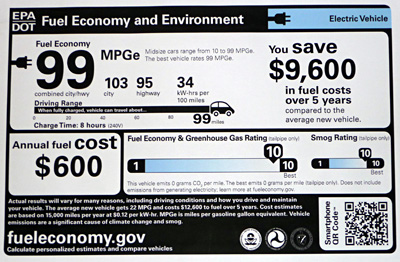
Coming to a showroom near you: a new fuel economy sticker for an electric vehicle. (Photo: Lauren Sommer)

Buy a gas guzzler and you might discover a new form of “sticker shock.”

Cars and trucks sitting on dealership lots will soon have a new fuel economy sticker in the window. Today, the Environmental Protection Agency released newly-designed labels that emphasize environmental performance for conventional and electric cars.

The label might seem familiar to California drivers. In 2008, the state released its own environmental impact sticker for new cars. It rates a car’s smog and greenhouse gas emissions on a scale of one to ten.

The new national label follows California’s lead and incorporates the same rating system. But for the first time, it will also display the annual fuel cost for a vehicle, comparing it to an average vehicle over five years. Continue reading What Shade of Green is Your Ride?

Court: Most of AB 32 May Go Forward

But the Cap & Trade Program Remains on Hold

Friday provided another blip in a confusing court fight over California’s centerpiece climate law, known as AB 32.

A “final” ruling from a Superior Court judge in San Francisco allows most implementation of the 2006 Global Warming Solutions Act to go forward, except for the carbon trading plan known widely as “cap & trade.” Regulators at the California Air Resources Board (ARB) will have to flesh out their prior assessment of alternatives to cap & trade that could also result in reducing the state’s total greenhouse gas emissions.

Analysis of those alternatives is required under the California Environmental Quality Act (CEQA). While ARB officials still insist that their original work was adequate under the law, groups representing an “environmental justice” agenda had sued, claiming that alternatives had not been fully explored. Continue reading Court: Most of AB 32 May Go Forward