All posts by Climate Central

Global Warming May Worsen Effects of El Niño, La Niña Events

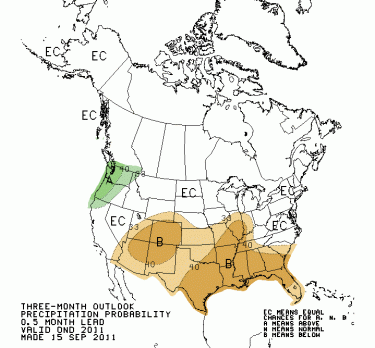
Precipitation outlook for winter 2011-12, showing the likelihood of below average precipitation in Texas and other drought-stricken states.

Does this mean Texas is toast?

By Michael D. Lemonick

As most Californians know, El Niño is a periodic unusual warming of the surface water in the eastern and central tropical Pacific Ocean. Actually, that’s pretty much a lie. Most people don’t know the definition of El Niño or its mirror image, La Niña, and truthfully, most people don’t much care.

What you do care about if you’re a Texan suffering through the worst one-year drought on record, or a New Yorker who had to dig out from massive snowstorms last winter (tied in part to La Niña), or a Californian who has ever had to deal with the torrential rains that trigger catastrophic mudslides (linked to El Niño), is that these natural climate cycles can elevate the odds of natural disasters where you live. Continue reading Global Warming May Worsen Effects of El Niño, La Niña Events

Climate Change and the Phoenix Dust Cloud

Hotter temps could set the stage for more — but the science is complex

On July 5, a massive dust cloud

By Alyson Kenward

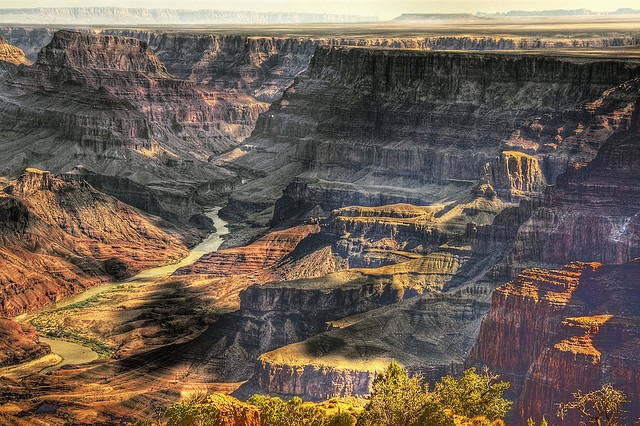
On Tuesday night, a massive dust storm rolled into Phoenix, Arizona knocking out power in much of the city, reducing visibility to nearly zero, and grounding flights overnight. Photos of the 100-mile wide dust cloud swallowing the city circulated yesterday, and the event looked practically apocalyptic. In fact, if the photos weren’t in color, and there weren’t YouTube videos of the dust storm, I would have thought I was looking at old-timey images from the 1930’s dust bowl. Now, a couple days later, lingering dust in the air has triggered allergy-like symptoms for many people. Continue reading Climate Change and the Phoenix Dust Cloud

Forget this Winter: Western Snowpack Shrinking

By Alyson Kenward

A new study finds large losses of springtime snow cover in the West in recent years, raising concerns about water supplies.

Spring snowpack in the West is an essential water resource, particularly in Southwestern states that are prone to summer drought, like California, Nevada, Arizona and New Mexico. (Credit: Wolfgang Staudt on Flickr)

This spring, from the Pacific Northwest and Sierra Nevada, to the Northern Rockies, western mountain ranges were more than just snow-capped – they were buried in the white stuff. In fact, many locations still have more spring snowpack than has been seen in decades.

Head south across the 40th parallel, however, and things are dramatically different. While there is still above average snow throughout the Sierra, a relatively snow-less winter and spring has left much of the Southwest in a drought that has fostered record wildfires. Already local officials are worried there won’t be enough water to get through the summer months ahead. Continue reading Forget this Winter: Western Snowpack Shrinking

Melting Ice Sheets Spur Sea Level Rise

By Michael D. Lemonick

A new study says melting ice sheets will likely be “the dominant contributor to sea level rise in the 21st century.”

A tidewater glacier in Greenland, pictured in 2008. (Photo: Michael Lemonick)

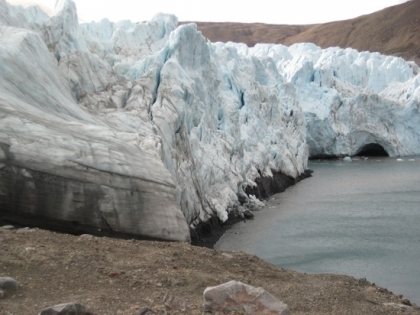
About 110,000 years ago, global sea level began to drop as the planet cooled, and evaporating seawater was transformed into massive ice sheets that covered large parts of the Northern Hemisphere. About 10,000 years ago, the Earth warmed up again. The ice retreated dramatically, and sea level rose. Since then, the planet’s ice, and the level of the ocean have been more or less stable.
Continue reading Melting Ice Sheets Spur Sea Level Rise

The Other Effect of CA’s Clean Air Laws

(Photo: David McNew/Getty Images)

By Andrew Freedman

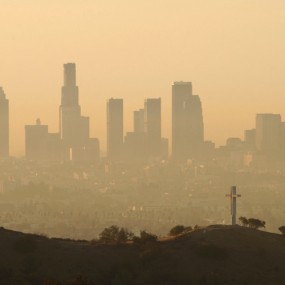
Pollution reduction measures that were aimed primarily at reducing California’s notorious smog problem and improving public health, also helped cut emissions of black carbon — a key global warming agent — according to a new study published Tuesday.

Black carbon, more commonly referred to as soot, is an atmospheric particulate that scientists have shown to be a significant contributor to global warming. It is an attractive target for emissions reductions because relatively cost effective technologies to reduce it already exist, such as diesel particulate filters for trucks, and because unlike carbon dioxide (CO2), which stays in the air for decades to millennia, black carbon only remains airborne for days to weeks. Continue reading The Other Effect of CA’s Clean Air Laws

New Federal Climate Change Plan for Wildlife


Caribou on Alaska’s North Slope

By Andrew Freedman

Calling global climate change “the transformational conservation challenge of our time,” the U.S. Fish & Wildlife Service (FWS) issued a new climate change strategic plan on Monday, which represents a significant shift in the agency’s approach to protecting species. The plan puts a heavy emphasis on the need for the federal government to work closely with state and local agencies, academia, and private groups as climate change alters the suitable habitat for many species across the country.

As the plan notes, climate change is already shifting habitat and threatening species large and small, from polar bears to alpine plants.

“In the history of wildlife conservation, the Service and the larger conservation community have never experienced a challenge that is so ubiquitous across the landscape. Our existing conservation infrastructure will be pressed to its limits — quite likely beyond its limits — to respond successfully,” the plan states.
Continue reading New Federal Climate Change Plan for Wildlife

A Tale of Two Coasts: The East Roasts While the West Shivers

By Andrew Freedman

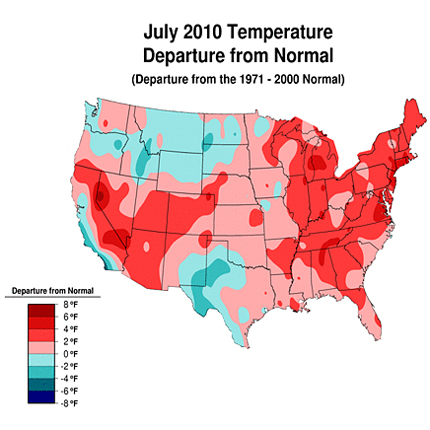
People along the West Coast from Seattle to San Diego, who have shivered through an unusually cool summer, can be forgiven for being just a little bit jealous of residents of the East Coast, where warm temperature records have repeatedly been smashed this summer. During June, July and part of August as well, it seemed that many coastal areas of the West were missing out on summer entirely.

Continue reading A Tale of Two Coasts: The East Roasts While the West Shivers

Heat Records Set in 17 Countries — So Far

This post also appears at Climate Central, a content partner of Climate Watch.

By Andrew Freedman

California’s freakishly cool summer has been bucking a global trend this season. You’ve seen the headlines from Moscow and Pakistan–but that’s just part of the story. 2010 has featured several extreme heat events, as well as record flooding, in many countries worldwide. The number of countries that have set new national records for the warmest temperature recorded — 17 — would beat the old record of 14, provided that all of the new records are verified by meteorological agencies. According to meteorologist Jeff Masters of the private weather forecasting firm Weather Underground in Ann Arbor, Michigan, the countries that have set new records thus far this year comprise about 19 percent of the earth’s surface area. Continue reading Heat Records Set in 17 Countries — So Far

From Russia: More Heat, Less Wheat

This post also appears at Climate Central, a content partner of Climate Watch.

By David Lobell

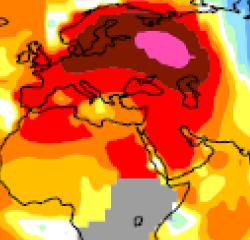
The heat wave in Russia has captured international media attention, breaking temperature records left and right (see figure below). It has also captured the attention of commodity traders. In a typical year Russia produces about as much wheat as the United States, and is among the top exporters of wheat flour in the world. But this year, wheat has been decimated in the areas around Moscow, with yield expected to be 30 percent or so below normal. This week Russia announced they are banning all exports of wheat from August 15 through the end of the year. Since late June, wheat prices on the Chicago Board of Trade have risen by 50 percent, to more than $7 a bushel. Continue reading From Russia: More Heat, Less Wheat

Annual Climate Report Shows a Warming World

This post also appears at Climate Central, a content partner of Climate Watch.

By Alyson Kenward

Global temperatures continued to increase in 2009, and atmospheric greenhouse gas levels also rose, according to a new “State of the Climate Report” from the US National Oceanic and Atmospheric Administration (NOAA). The report, released today as a supplement to the Bulletin of the American Meteorological Society, offers a detailed look at last year’s major weather and climate events, and reviews long-term global climate trends. Overall, it paints a picture of a world that continues its long-term warming trend, albeit with considerable variability from year-to-year.

The report finds that the earth warmed more last year than in the preceding two years, and reiterates the conclusion that the first decade of the 21st century, 2000-2009, was the warmest decade on record, both at the earth’s surface and in the lower atmosphere.

The State of the Climate report attributes many of the significant weather and climate events of 2009 to natural variability. For example, the return of El Niño, a periodic cycle of ocean warming in the tropical Pacific which influences global weather patterns, helped increase global temperatures. It states that El Niño may account for much of last year’s global increase in temperature compared to 2008 — about 0.1 degrees Celsius warmer in 2009.

“Global surface temperatures in 2009 saw a return to near-record levels as the cooling in the tropical Pacific associated with the 2007/08 La Niña event gave way to strengthening El Niño conditions in 2009,” the report states. The average global land and sea surface temperatures for 2009 was about 0.5 degrees Celsius warmer than the average between 1961-1990.
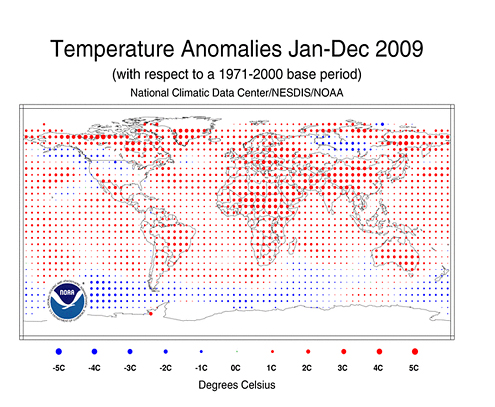

Surface temperature anomalies, Jan.-Dec. 2009. Click on the image to
see a larger version. (Source: NOAA/NCDC)

The abundance of warmer-than-normal water in the Pacific also contributed to the most active storm season there since 1997, while the Atlantic saw a relatively quiet season in 2009.

While NOAA publishes its State of the Climate reports annually, the 2009 version differs from previous years with its focus on a specific series of climate change indicators, such as global average air and ocean temperatures and ocean heat content. Tracking this group of metrics illustrates the long-term trends that are the hallmarks of climate change.

“For the first time, and in a single compelling comparison, the analysis brings together multiple observational records for the range of carefully selected indicators we would expect to change with surface temperatures,” said Dr. Peter Thorne, a co-author of the report and climate scientist at North Carolina State University, in a press release.

Examples of climate indicators investigated by NOAA:

  • Air temperature over land
  • Air temperature over sea
  • Troposphere temperature
  • Sea surface temperature
  • Ocean heat content
  • Sea level
  • Snow coverage
  • Sea ice extent

These indicators are bound to fluctuate from year to year, however. For example, the last decade may have been the warmest on record, but 2009 was not the hottest year ever recorded (though it managed to tie 2006 for the fifth spot since instrumental measurements began in the 1850s). Furthermore, 2009 saw a slight recovery in the extent of Arctic sea ice.

But when each year is lined up next to all the preceding years, NOAA said, these short-term variations are small compared to the clear and significant long-term warming trend.

“Despite the variability caused by short-term changes, the analysis conducted for this report illustrates why we are so confident the world is warming, ” said Dr. Peter Stott, a co-author of the new report in a press release. Stott is the team leader of the Climate Monitoring and Attribution group of the United Kingdom’s Met Office Hadley Centre, which contributed to the NOAA report.

The report itself was authored by more than 300 scientists from every continent and from 160 research groups around the world.

So far, the data for 2010 shows no let-up in sight for warmer than average global temperatures. As this summer drags on, the planet has already recorded its warmest year-to-date, with several record-breaking heat waves in the US, Asia and the Middle East. Along with April and May, June was the hottest such month on record worldwide.

With this year already off to a hot start and on a pace to surpass 2009 in terms of global temperature averages, Stott says the long-term trend sends a clear message: “When we follow decade-to-decade trends using multiple data sets and independent analyses from around the world, we see clear and unmistakable signs of a warming world.”

In addition, the report responds to questions during the past year from critics of climate science who have questioned the veracity of the surface temperature record. “Globally averaged surface temperature anomalies are shown to be robust given the close agreement between independently-derived datasets and strong corroborative evidence across a wide range of other climate variables,” it states, adding that the conclusion that the world is warming does not rest solely upon surface air temperature records. Evidence that the oceans are storing greater amounts of heat, sea levels are rising, atmospheric humidity is increasing, and land and sea ice is melting all point to a warming climate as well.

“If the land surface records were systematically flawed and the globe had not really warmed, then it would be almost impossible to explain the concurrent changes in this wide range of indicators produced by many independent groups,” the report states.