Category Archives: Uncategorized

The Making Of…Hotrods & Tiki Bars

Notch: It’s All About Stance and Style.

My name is Ignacio Gonzales. People call me Notch. I build hot rods and I’ve got a thing for tiki bars. I build tiki bars on the side. I’m always moving around. I’m always twitching.

Born and raised in San Jose. I went to high school and that’s it. As a kid, growing up, I was fascinated with cartoons and movies. Star Wars especially. All my friends were building hot rod models, custom car models. I did that, then wanted to advance from that. So I got complex models – battleships and tanks that had 1,000 pieces. I got way into the details and making things look realistic.

Then I got into Halloween props. I wanted to make a zombie hand coming out of the mud. I’d make a hanger shaped as a hand. And I got flour dough, mixed it together and made it look gory. I put paint on it. That’s how it all started. Being creative.

Whenever I see something with my eyes, I take it apart and reverse engineer it. I’d watch a movie over and over again looking at the props they make and I thought, I want to do stuff like that. Star Wars. That’s where it started. I was blown away.

I wanted to grow up and build those things someday. I got a challenge from one of my friends, she worked for a prop company and she wanted me to make a spaceship. So I said I’d make an 8-foot long spaceship of Darth Vader’s Executioner and I made it without any blueprints or anything. I just looked at the pictures and made it in my garage. I just jump head first in. I don’t look back.

I started working on cars. First I went to work on my own personal car. I got into Volkswagens, heavy on, during school and after school. I tore them apart, put them together, got them running. Along with my friends, we went cruising. It turned into a hot
rod fascination after one car show. I gave away all my Volkswagen stuff, sold it all. I just wanted hot rods.

Nobody else in my family is creative. They all went to college and studied. I wanted to work with my hands. I’m the youngest out of 7. First one born in the United States.

My family are all from Mexico. Legally. They all came over legally.

My dad worked for construction, so I was around wood a lot and hammers and nails. There was a lot of land, so I was free to play wherever I wanted. I was always outdoors doing stuff. There were fields everywhere. We had dirt bikes and motorcycles. We made huts and had rock wars. We rode our bikes, made ramps and jumped. It’s all developed now. There’s no open spaces. It’s all houses.

I started working at a body shop, I’d say ’90 or ’91. It was one of my first jobs. I worked for Apple when I was a kid, assembling
stuff. I wish I could’ve kept that job. It was a good paycheck.

But then I started at a body shop just doing clean up. I scraped gum off the shop floor and pulled cars in and out. Anything they wanted me to do. Sweeping all day. I picked up real quick on body work, paint and prep. I learned everything about restoring a car there.

I went to a hot rod show and I was blown away by American hot rods. So, I’m going to work my hardest to own one. In the beginning, I worked at a body shop, learned the trade of metal work and repairing cars. Just doing paint, body work, suspension.

Then I got my first job at a hot rod shop. It started at Rods and Louvers. Then Moonlight Hot Rods. It was awesome. Making parts from nothing. We had to make each piece. So we’d chop the car and lower it, make body lines and do custom metal shaping inserts on the sides.

I loved it. Someone brought me an old car and said, “Let’s do some flames.” It was just natural for me.

My first flame job was in a book. It was just a small, little picture but it was my work. I was like, I could keep going. Anybody who wanted graphics would come to me. It was easy. “Did you go to school?” No, I would just look at pictures.

When I was working for a body shop, doing the same thing every day working on brand new cars, I wasn’t really happy. It felt like I was wasting my time. They were brand new 2008 or 2009. It was like I was wasting my artistic talent. When I work on these old cars, I know they’re being cherished. They have a family value. People take care of them as long as they’re around.
So, I feel like when I worked on these old cars, my time’s not being wasted.

So, I’m going to open a hot rod shop. Word of mouth got around. People would bring me work. I’m just going to do it. I took a big pay cut. Owning your own business for the first 5 years is tough.

We’re at my shop. It’s Top Notch Kustoms. Notch, you know, my name Notch. I didn’t even have a shop at the time and they would just call me Top Notch Kustoms. It’s enough room for four cars and other little projects.

It’ll be a little over four years I’ve been here. Started with nothing. All I had was a box of tools, a welder and a plasma cutter. Now I have a lot of tools.

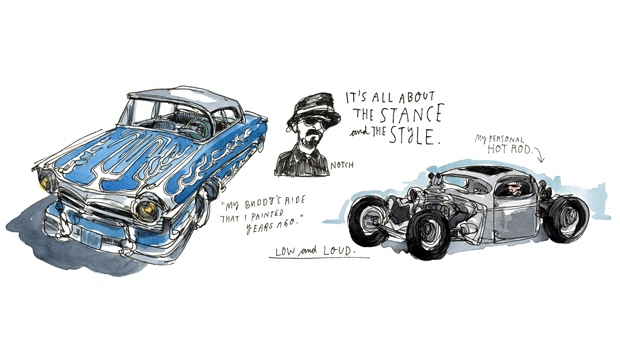
My personal hot rod. It’s a major piece of work. A1935 Ford Pickup that’s chopped, channeled and sectioned. It’s got a Model A frame that’s boxed and it’s got over 170 lighting holes drilled throughout the frame. It’s heavily z’d in the rear and front. It’s got a quick-change rear end. It’s got a Merc-flathead with Kong heads. It’s got a drop-32 front axle with rotorflow shocks. All bare metal.

It’s super low and loud. It’s got to have flow and historical value. It’s all about the stance and style.

I used to always draw as a kid. I remember in 3rd grade, one of my teachers, Mrs. Baldastery said I was going to be a great artist one day. She wrote that in my autograph book. I still have it today. I always look at that. I’m like, she must’ve seen
something. I think I still have it in my toolbox.

From an interview with Ignacio Gonzales for The Making Of… Interview by Charla Bear. Story edited by The Kitchen Sisters.

Illustrations by Wendy MacNaughton.

View the story on Cowbird here.
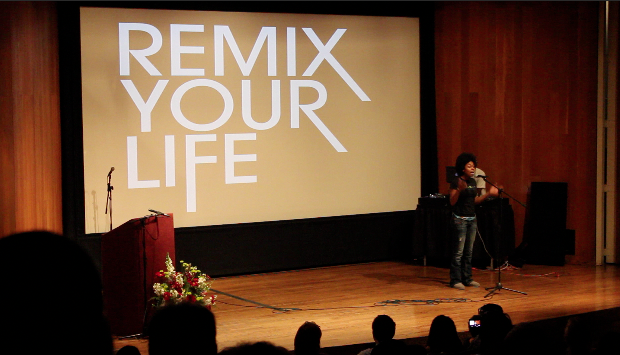
Youth Radio's Remix Your Life

Last night, Youth Radio celebrated the graduates from their Core, Bridge and MATCH programs. It was a beautiful evening full of storytelling, good food, and great music.

The event featured several performances from Remix Your Life,Ā a youth-driven project that uses critical analysis, song-writing, poetry, and recording to help young people “remix” the stories of their lives. Check out the above video of Jaylyn Burns’ performance from last night.

Learn more about the Remix Your LifeĀ here.

The Making Of… a Translation

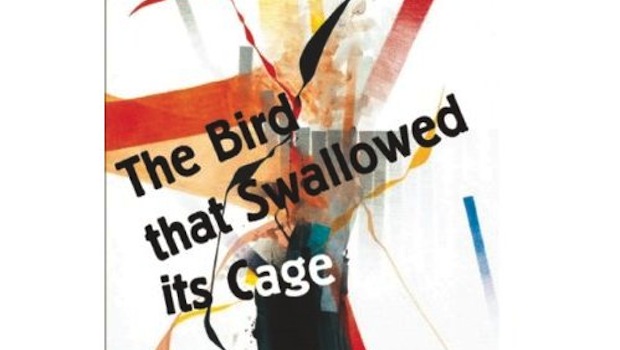
Last week saw the release of The Bird that Swallowed its Cage: The Selected Writing of Curzio Malaparte, translated by our friend and sonic hero, Walter Murch.

Here’s a description of the book from the Counterpoint Press website:

Walter Murch first came across Curzio Malaparte’s writings in a chance encounter in a French book about cosmology, where one of Malaparte’s stories was retold to illustrate a point about conditions shortly after the creation of the universe. Murch was so taken by the strange, utterly captivating imagery he went to find the book from which the story was taken. The book was Kaputt, Malaparte’s autobiographical novel about the frontlines of World War II.

Curzio Malaparte, an Italian born with a German heritage, was a journalist, dramatic, novelist and diplomat. When he wrote a book attacking totalitarianism and Hitler’s reign, Mussolini, in no position to support such a body of work, stripped him of his National Fascist Party membership and sent him to internal exile on the island of Lipari. In 1941, he was sent to cover the Eastern Front as a correspondent for Corriere della Sera, the Milano daily newspaper. His dispatches from the next three years would be largely suppressed by the Italian government, but reverberated among readers as painfully real depictions of a landscape at war.

The film editor, fluent in translating the written word over to the languages of sight and sound, began slowly translating Malaparte’s writings from World War II. The density and intricacy of his stories compelled Murch to adapt many of them into prose or blank verse poems. The result is a body of work never before available to English readers.

Tosca Cafe is hosting a celebration of the book’s release tomorrow night.

Making Waves

outLoud Radio is celebrating its tenth anniversary on Wednesday, November 14 with a celebration and benefit in San Francisco.

outLoud Radio is proud to celebrate its tenth anniversary of empowering creative and talented lesbian, gay, bisexual, transgender, queer (LGBTQ) and allied youth to share their personal stories through radio. By teaching youth about production, documentation, and storytelling, outLoud’s unique programming gives youth the skills and confidence to decide for themselves how they will be represented and literally saves lives.

This inaugural gala event will feature NPR White House correspondent Ari Shapiro in an on-stage conversation with KQED’s Scott Shafer and several of outLoud’s youth producers, followed by an intimate VIP reception. On this anniversary, outLoud is launching a campaign to expand its programming, increase social media and audience impact, cultivate youth leadership, and build on its track record of successful partnerships with StoryCorps, the Public Radio Exchange, KQED, and many others.

Learn more about the event at gala.outloudradio.org

And take a listen to some of the voices from outLoud here:

The Making Of… a Violin

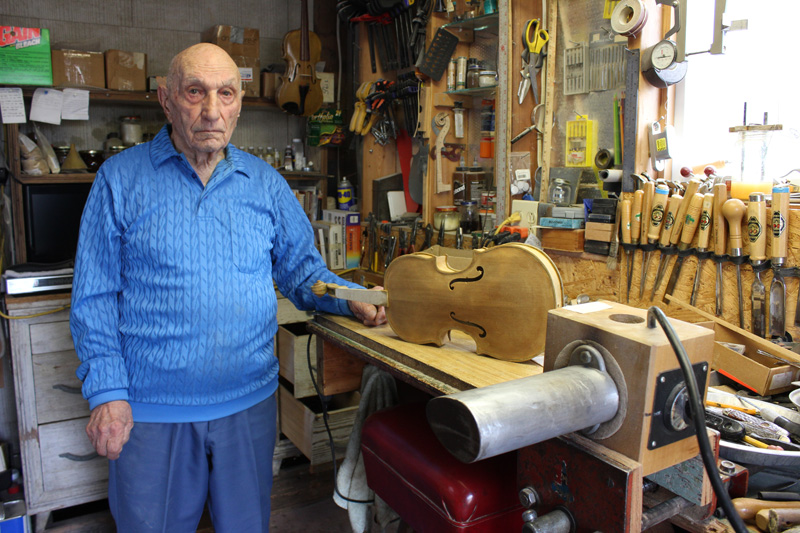
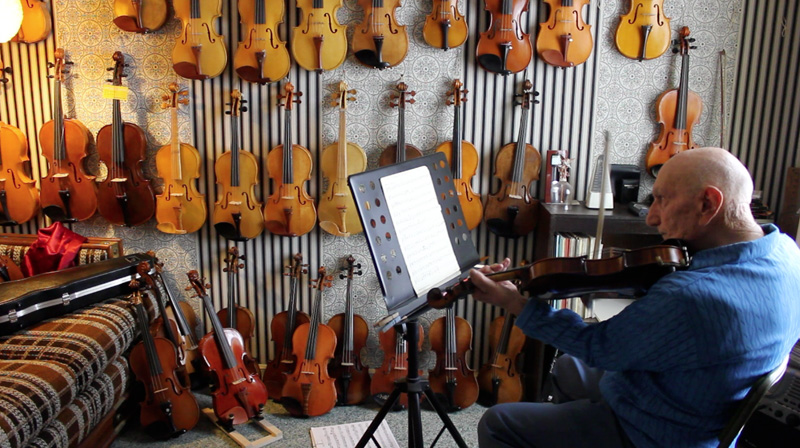
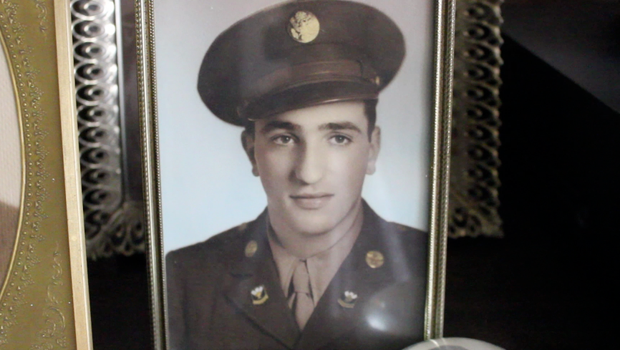
Remo del Tredici began making violins in his 70s. Inspired by his neighbor, a volunteer for AmVets, and the memory of his brother who was killed during WWII, he began giving away his violins to vets.

LISTEN ABOVE to full radio story featuring Remo del Tredici, Bill Roberts, Robert Martin, & and Earl Annecston heard on The California Report, KQED
Produced by The Kitchen Sisters & Lisa Morehouse with Nathan Dalton

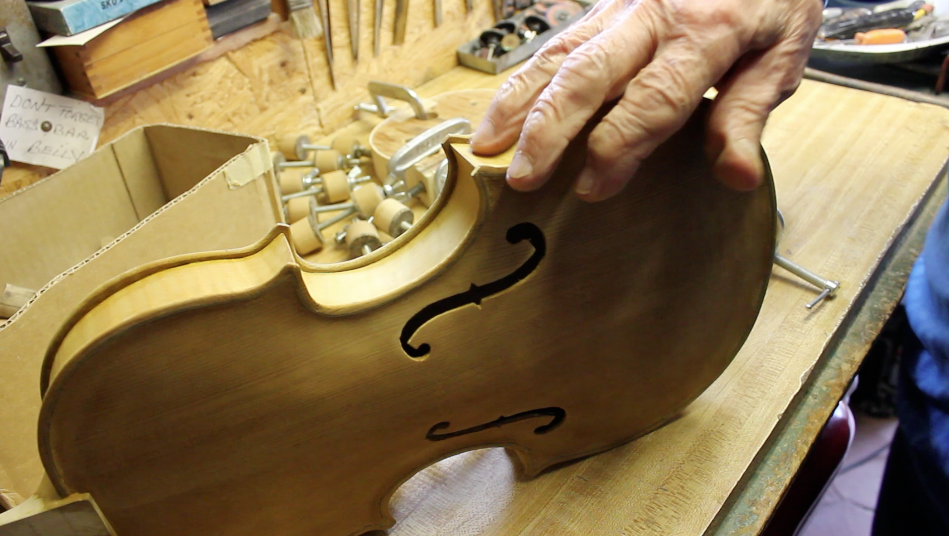
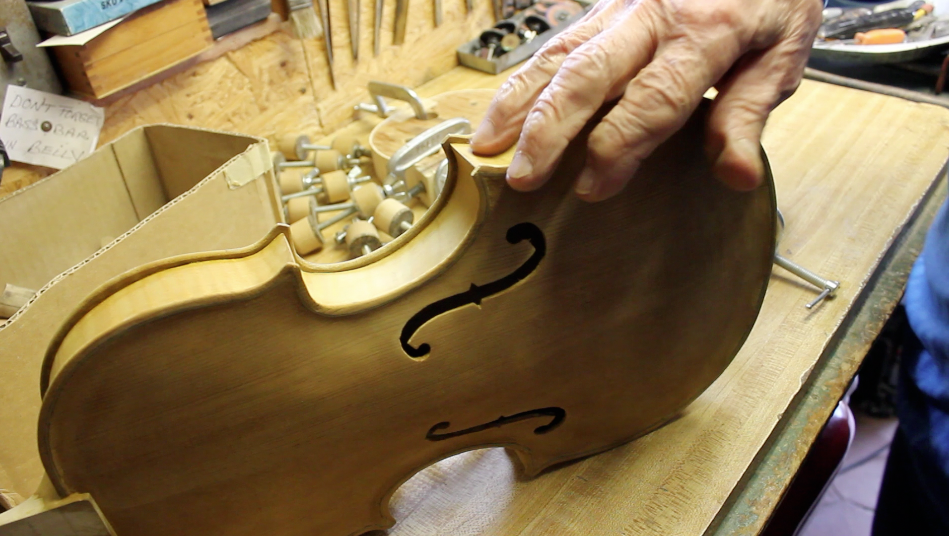
ā€œSee my name in there? It says Remo Del Tredici, San Francisco, 2009.ā€ In a workshop, set behind a modest stucco house in San Francisco’s Sunset district, 92-year-old Del Tredici points at his signature, written on the inside of a violin. “See those necks hanging up there? Out of a block of wood that’s what I carve, no nails, no screws.ā€

Remo picks a violin up off his workbench. ā€œThis is curly maple,ā€ he says tapping on the belly. ā€œI can make one in a week if I work eight to ten hours a day. Then the varnishing will take another week.ā€

Bill Roberts used to live down the street from Del Tredici. ā€œI saw Remo loading up someone’s trunk with a bunch of violins,ā€ Bill says,Ā ā€œand I wondered, what’s this guy doing? Where did all those violins come from?ā€ The two men became friends and Bill soon found out.Ā Over the last fifteen or so Remo has been making violins — more than 100 of them. And giving them away.

ā€œYou walk into Remo’s practice room and you see 30, 40 violins that he’s made.ā€ Bill volunteers with AmVets at the War Memorial Building in San Francisco. “This light bulb goes off in my head,ā€ he remembers. ā€œViolins for Vets.ā€

Born in Italy in 1920, Remo came to San Francisco with his family when he was two. His parents gave him a violin when he was a boy, and he took lessons and started to learn to play.Ā When he was fifteen his father died.Ā It was the Depression, and his mother couldn’t afford lessons. ButĀ Remo kept playing throughout high school in a Western band. ā€œTwo violins, a guitar and a guy on washboard,ā€ he laughs. They performed at Veterans Hospitals around the Bay Area, like the one on Clement Street in the Richmond district. “One night in 1937,” Remo remembers, “we were playing at a Vet’s Hospital in Palo Alto. Coming back home we were riding in a four door sedan with no top on it. And there was a car stalled and the driver ran into the back. We all flew out. I woke up in the hospital. One fellow got killed.”

That’s when Remo quit. ā€œI didn’t touch the violin again until I reached my 70s.ā€ After high school, Remo worked in a bakery and a market. ā€œI learned how to clean chickens and fillet a fish!ā€ Then, for 45 years, he worked on automobiles, specializing in electrical carburation and fuel injection. ā€œIt’s in my genes, I guess. My father used to make homemade root beer, resoled out shoes, maybe I took after him. I guess everyone is born to do something, somewhere. I always liked to tinker.ā€

In 1996, Remo pulled his old violin out of the closet and tried to play. ā€œI was terrible, terrible!ā€ he laughs, so he started taking lessons. ā€œBoy I really wanted to learn and see what I could do at my age.ā€ It came into his mind one day while he was playing, ā€œGee I wonder if I could make one? I’ve always been making a lot of things, let’s try a violin.ā€ He taught himself with books, and by ordering violins off of eBay, taking them apart and studying the minute variations in wood thickness. He built so many that he started giving them away to schools and other students at the Community Music Center in San Francisco where he takes classes.

In August 2012, Bill invited Remo to an AmVets luncheon at the War Memorial Building to share his story and craft. Remo brought along eleven violins. ā€œBill Roberts is the one who instigated it,ā€ remembers Remo, ā€œand I said, ā€˜Sure!’ Let’s take these violins here and bring them down there and give them to any veteran that would like to play around with it or learn it sincerely.ā€

ā€œThere were thirty-five or so veterans in the room and they were enthralled,ā€ says Bill. ā€œSome of these vets hadn’t touched a violin since high school. Everybody wanted a violin.ā€

Earl B. Annecston, an 86-year-old vet who served in the Navy during World War II and the Korean War was at the meeting and received one of Remo’s violins. ā€œI always wanted one, don’t ask me why. It was just something that was in the back of my mind, and here he was giving them away and I thought ā€˜Gee it would be nice, you know.ā€™ā€

Remo was in the Coast Guard, and his brother Walter was in the Air Force, stationed in Italy during WWII. ā€œFrom there he went on bombing missions across the Adriatic Sea,ā€ Remo remembers, ā€œand the plane was hit. It caught on fire. He and two others were the only ones to get out of the plane. To this day we don’t know how he died. Whether he made it all the way down with his parachute or was executed. I don’t know how he died.ā€

At his workshop, Del Tredici shares a fine point of violin construction, as he fishes for a tiny piece of wood rolling inside a violin. ā€œThe sound post is a little piece of wood inside,ā€ he says. ā€œThe French call it the ame, the soul. It’s the soul of the violin.ā€

Robert Martin also received a violin that day and is visiting Remo in his workshop. ā€œIs this incredible or what? Every one of them made from scratch.ā€ Martin, who served in the Air Force from 1959 to 1963, plans to start lessons soon. ā€œI got to know Bob Martin, one swell of a guy,ā€ Remo says. ā€œHe’s very happy to get a violin. And that’s what it’s all about. I’m glad to make them, so I give them away, donate them.ā€

Earl Annecston takes his violin off the wall and plucks the strings. ā€œAnybody that can make something like that,” Earl says, “I think it’s just a piece of himself that he gave. He wanted to give them to people that have served. What else can you ask from a person? When they give a present, they give a piece of themselves.ā€

SPECIAL THANKS
Remo del Tredici, Bob Martin, Bill Roberts, Earl B. Annecston, Helen Wong at AmVets, Community Music Center San Francisco, Julia McEvoy, Victoria Mauleon, Ceil Muller.

MUSIC
Megragjak A Tuzet, by Csokolom
The Fate of Ellen Smith, by Green Baily
Rigoletto, Act III, by Giuseppe Verdi, performed by Thomas Harper, Michael Halasz, Slovak Radio Symphony Orchestra
Prelude and Yodel, by Penguin Cafe Orchestra

International Orange

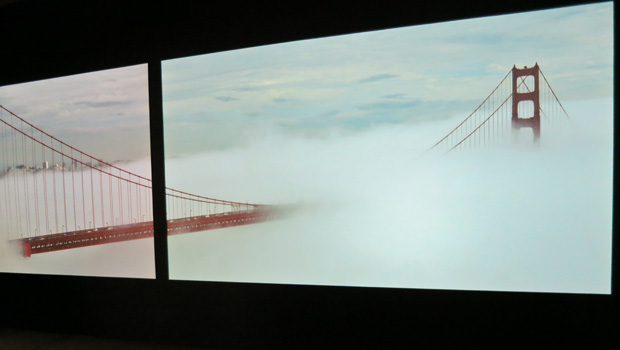
International Orange, the exhibit at Fort Point celebrating the 75th Anniversary of the Golden Gate Bridge closes this Sunday, October 28.

We made a visit to the exhibit during its opening weekend and spoke to David Liittschwager, Bill Fontana andĀ many of the artists who created pieces inspired by the bridge.

David Liittschwager used the exhibit to continue his One Cubic Foot project. Listen:

Sound artist Bill Fontana went underneath the bridge to create a live sound and video installation. Listen:

This weekend there are a series of closing events featuring guided tours, live music, food carts, and even a scavenger hunt with prizes created by some of the artists.

Go toĀ www.international-orange.org for more information. And while there take a listen to K-BRIDGE, the virtual radio station created for the exhibit.

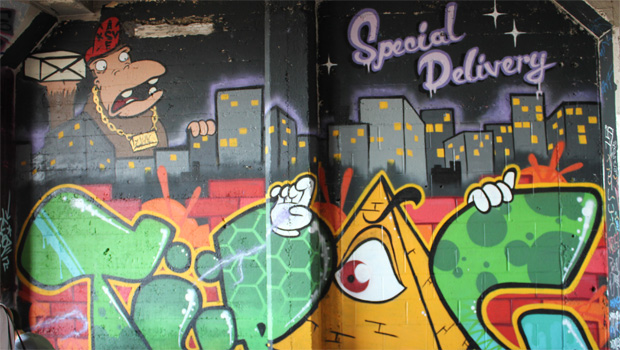
Special Delivery 2012

The setting: an abandoned ink factory in West Berkeley that’s been an epicenter of Bay Area street art over the past decade, slated to be refurbished into an office building.

But as luck would have it, the firm that recently purchased the building happened to be headed up by an art enthusiast who sits on the board of theĀ Oakland Museum of California. He noticedĀ that much of the extraordinary graffiti in the factory was done by artistsĀ also exhibiting at the Museum.

He invited Endless Canvas, the Bay Area graffiti culture blog and zine, to round up some of the artists to restore their pieces and host a week-long exhibit open to the public.

The exhibit included three stories of art (over 36,000 square feet of space) from more that 45 Bay Area artists. Take a look at some scenes in the video above.

The Silent History

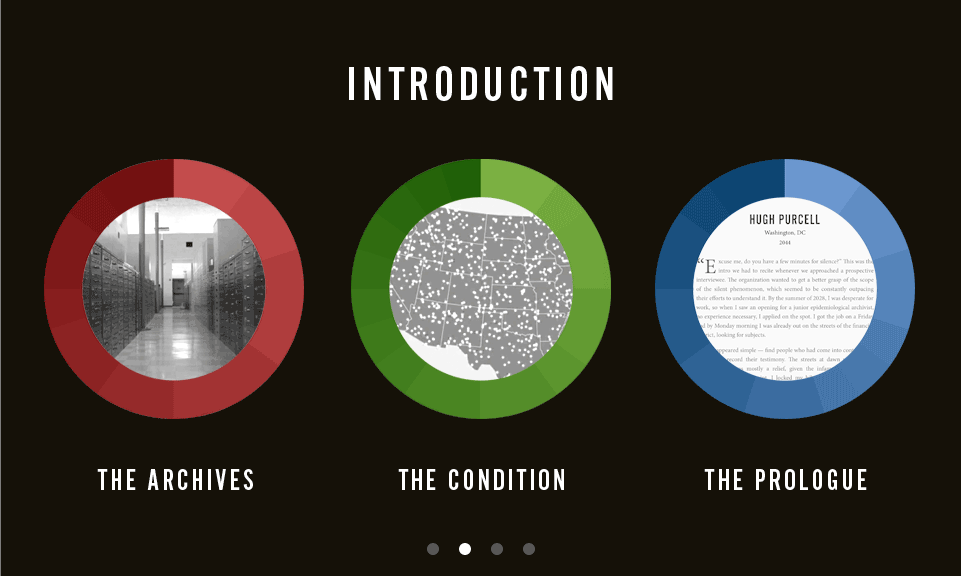
McSweeney’s editor Eli Horowitz recently told us about a new project he’s working on that launched earlier this month. A “strange novel/app thing” called The Silent History:

The Silent HistoryĀ is a novel, written and designed specially for iPad and iPhone, that uses serialization, exploration, and collaboration to tell the story of a generation of unusual children. The app is available as a free download from the App Store; the text itself can be purchased within the app by volume or as a whole.

Check out the teaser video above featuring the voices of Miranda July and Ira Glass.

Learn more and download the app atĀ www.thesilenthistory.com.