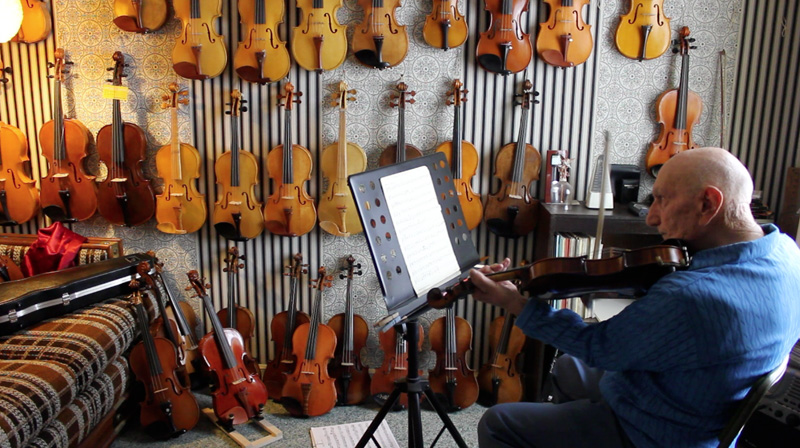
Remo del Tredici began making violins in his 70s. Inspired by his neighbor, a volunteer for AmVets, and the memory of his brother who was killed during WWII, he began giving away his violins to vets.
LISTEN ABOVE to full radio story featuring Remo del Tredici, Bill Roberts, Robert Martin, & and Earl Annecston heard on The California Report, KQED
Produced by The Kitchen Sisters & Lisa Morehouse with Nathan Dalton

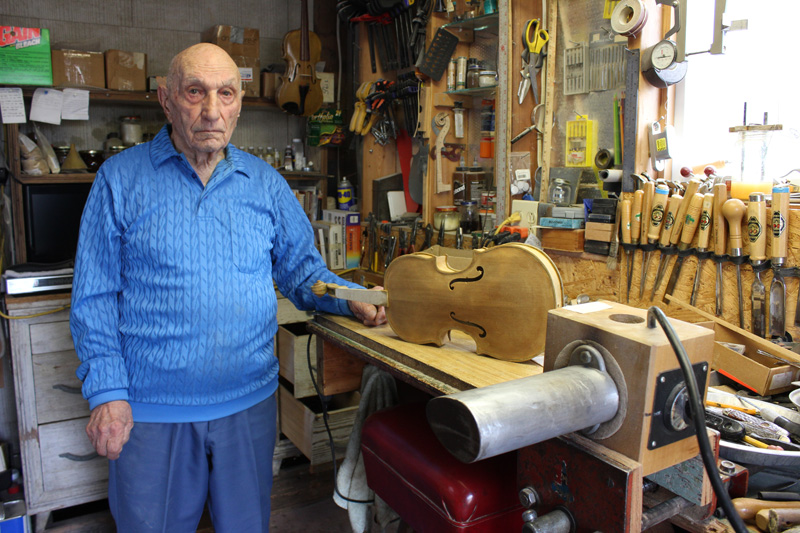
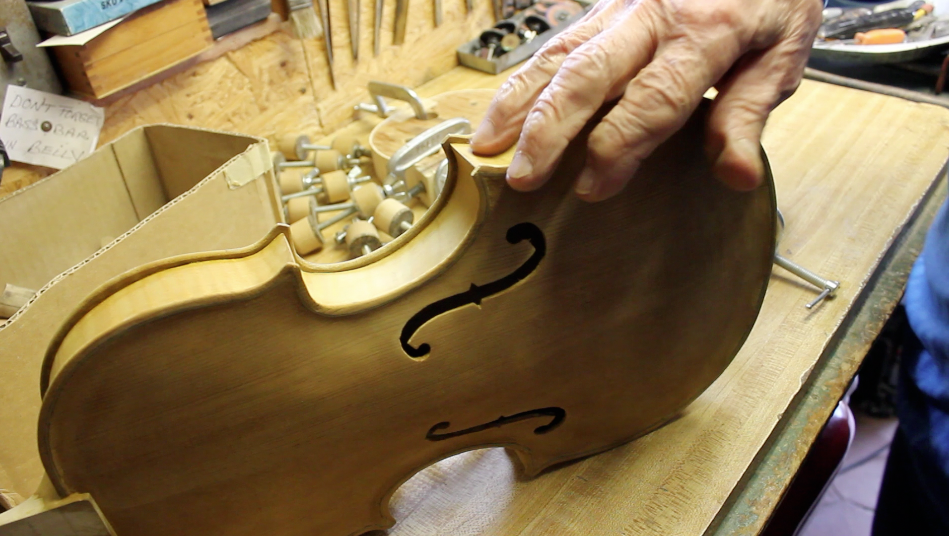
“See my name in there? It says Remo Del Tredici, San Francisco, 2009.” In a workshop, set behind a modest stucco house in San Francisco’s Sunset district, 92-year-old Del Tredici points at his signature, written on the inside of a violin. “See those necks hanging up there? Out of a block of wood that’s what I carve, no nails, no screws.”
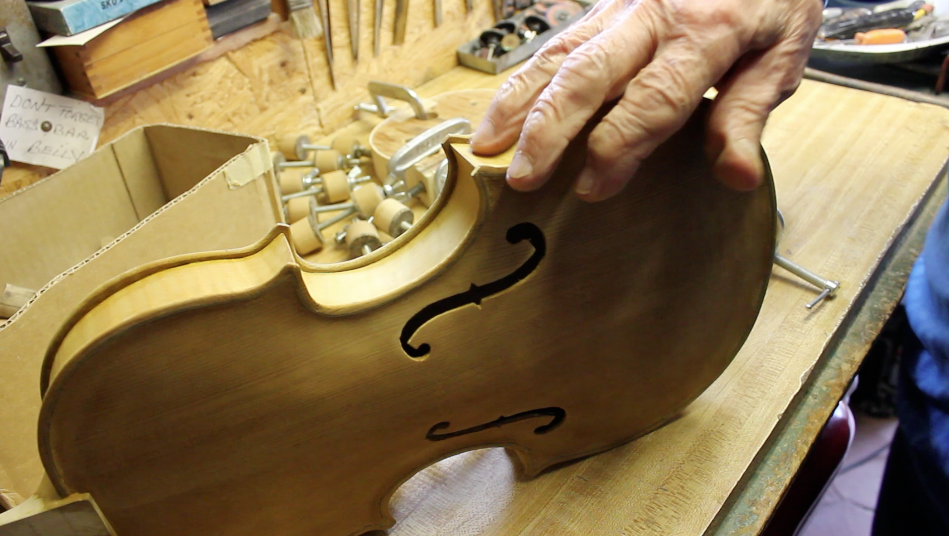
Remo picks a violin up off his workbench. “This is curly maple,” he says tapping on the belly. “I can make one in a week if I work eight to ten hours a day. Then the varnishing will take another week.”
Bill Roberts used to live down the street from Del Tredici. “I saw Remo loading up someone’s trunk with a bunch of violins,” Bill says, “and I wondered, what’s this guy doing? Where did all those violins come from?” The two men became friends and Bill soon found out. Over the last fifteen or so Remo has been making violins — more than 100 of them. And giving them away.

“You walk into Remo’s practice room and you see 30, 40 violins that he’s made.” Bill volunteers with AmVets at the War Memorial Building in San Francisco. “This light bulb goes off in my head,” he remembers. “Violins for Vets.”
Born in Italy in 1920, Remo came to San Francisco with his family when he was two. His parents gave him a violin when he was a boy, and he took lessons and started to learn to play. When he was fifteen his father died. It was the Depression, and his mother couldn’t afford lessons. But Remo kept playing throughout high school in a Western band. “Two violins, a guitar and a guy on washboard,” he laughs. They performed at Veterans Hospitals around the Bay Area, like the one on Clement Street in the Richmond district. “One night in 1937,” Remo remembers, “we were playing at a Vet’s Hospital in Palo Alto. Coming back home we were riding in a four door sedan with no top on it. And there was a car stalled and the driver ran into the back. We all flew out. I woke up in the hospital. One fellow got killed.”
That’s when Remo quit. “I didn’t touch the violin again until I reached my 70s.” After high school, Remo worked in a bakery and a market. “I learned how to clean chickens and fillet a fish!” Then, for 45 years, he worked on automobiles, specializing in electrical carburation and fuel injection. “It’s in my genes, I guess. My father used to make homemade root beer, resoled out shoes, maybe I took after him. I guess everyone is born to do something, somewhere. I always liked to tinker.”
In 1996, Remo pulled his old violin out of the closet and tried to play. “I was terrible, terrible!” he laughs, so he started taking lessons. “Boy I really wanted to learn and see what I could do at my age.” It came into his mind one day while he was playing, “Gee I wonder if I could make one? I’ve always been making a lot of things, let’s try a violin.” He taught himself with books, and by ordering violins off of eBay, taking them apart and studying the minute variations in wood thickness. He built so many that he started giving them away to schools and other students at the Community Music Center in San Francisco where he takes classes.
In August 2012, Bill invited Remo to an AmVets luncheon at the War Memorial Building to share his story and craft. Remo brought along eleven violins. “Bill Roberts is the one who instigated it,” remembers Remo, “and I said, ‘Sure!’ Let’s take these violins here and bring them down there and give them to any veteran that would like to play around with it or learn it sincerely.”
“There were thirty-five or so veterans in the room and they were enthralled,” says Bill. “Some of these vets hadn’t touched a violin since high school. Everybody wanted a violin.”
Earl B. Annecston, an 86-year-old vet who served in the Navy during World War II and the Korean War was at the meeting and received one of Remo’s violins. “I always wanted one, don’t ask me why. It was just something that was in the back of my mind, and here he was giving them away and I thought ‘Gee it would be nice, you know.’”
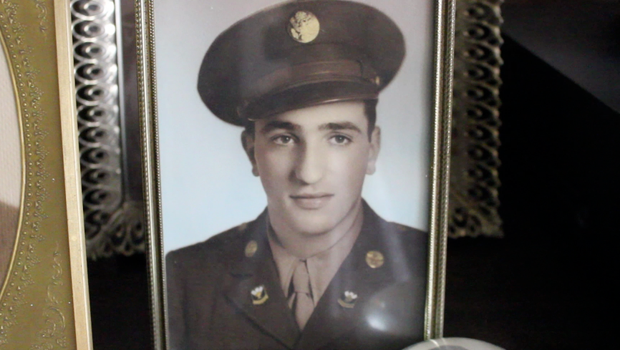
 Remo was in the Coast Guard, and his brother Walter was in the Air Force, stationed in Italy during WWII. “From there he went on bombing missions across the Adriatic Sea,” Remo remembers, “and the plane was hit. It caught on fire. He and two others were the only ones to get out of the plane. To this day we don’t know how he died. Whether he made it all the way down with his parachute or was executed. I don’t know how he died.”
At his workshop, Del Tredici shares a fine point of violin construction, as he fishes for a tiny piece of wood rolling inside a violin. “The sound post is a little piece of wood inside,” he says. “The French call it the ame, the soul. It’s the soul of the violin.”

Robert Martin also received a violin that day and is visiting Remo in his workshop. “Is this incredible or what? Every one of them made from scratch.” Martin, who served in the Air Force from 1959 to 1963, plans to start lessons soon. “I got to know Bob Martin, one swell of a guy,” Remo says. “He’s very happy to get a violin. And that’s what it’s all about. I’m glad to make them, so I give them away, donate them.”
Earl Annecston takes his violin off the wall and plucks the strings. “Anybody that can make something like that,” Earl says, “I think it’s just a piece of himself that he gave. He wanted to give them to people that have served. What else can you ask from a person? When they give a present, they give a piece of themselves.”
SPECIAL THANKS
Remo del Tredici, Bob Martin, Bill Roberts, Earl B. Annecston, Helen Wong at AmVets, Community Music Center San Francisco, Julia McEvoy, Victoria Mauleon, Ceil Muller.
MUSIC
Megragjak A Tuzet, by Csokolom
The Fate of Ellen Smith, by Green Baily
Rigoletto, Act III, by Giuseppe Verdi, performed by Thomas Harper, Michael Halasz, Slovak Radio Symphony Orchestra
Prelude and Yodel, by Penguin Cafe Orchestra