Anyone who has been involved in the Bay Area indie rock scene over the past decade probably knows George Chen. He’s booked countless shows, played in tons of bands, and released dozens of records on his Zum imprint.
Last year, Chen turned his gaze to comedy. He began performing standup, started a multimedia comedy show called Talkies, and a standup series at Lost Weekend’s Cinecave that morphed into a weekly event.
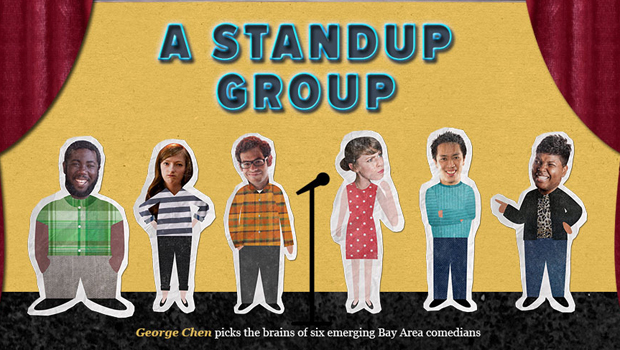
Chen recently interviewed six up-and-coming comics from around the Bay Area for The Bold Italic, covering topics such as day jobs, stage fright, and the Bay Area standup scene:
What’s it like to be a Bay Area comic?
I think you have a little more leniency. The audiences are very smart and they can be challenging, but they get it. I think of SF as a breeding ground for comedy; it’s a place where you can get good.
Read the entire article and watch videos of the performers at The Bold Italic.
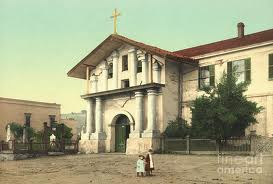
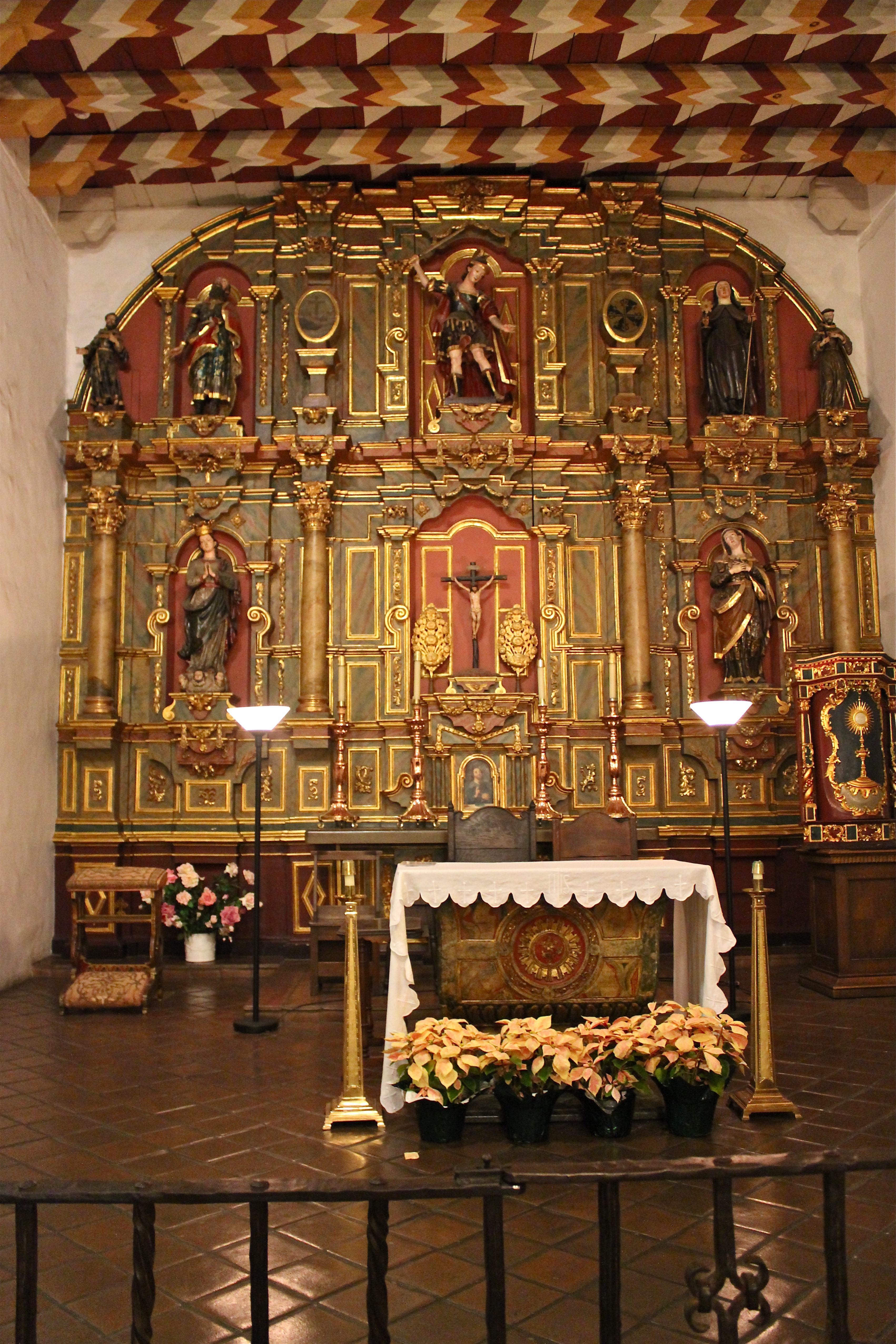
Mission Dolores, San Francisco, established 1776 on El Camino Real.
Traverse the 600-mile trail that connects California’s 21 missions. Peer behind an ornate mission altarpiece that, for more than two centuries, has hidden murals painted by the Ohlone Indians. Uncover the mysteries of Mission Dolores’ ancient cemetery.
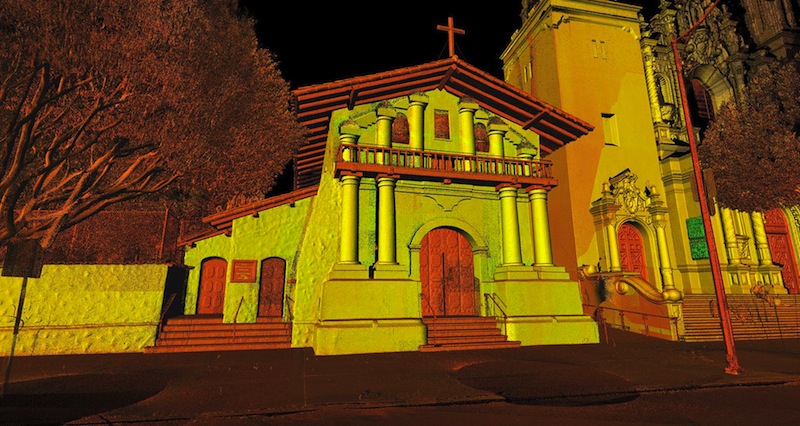
CyArk, a non-profit digital scanning company based in Oakland, is creating the digital El Camino Real, documenting some of the oldest buildings and historic sites in California.
LISTEN
Like Interstate 101
“Some people think the Camino Real means the Royal Road of Jesus in California,” says Andrew Galvan, curator of Mission Dolores, San Francisco. “No. It was the King’s Highway, the King of Spain’s highway.”
Mission Dolores, founded in 1776, is the oldest surviving structure in San Francisco and one of the first sites along the historic El Camino Real to be scanned and documented by CyArk.
“If you step out the front door of Mission Dolores you are on the El Camino Real,“ says Andrew. “It was a public road, like Interstate 101. All the California Missions are connected. Wherever you got on it, the road led you to the Viceroy’s Palace in Mexico City.”
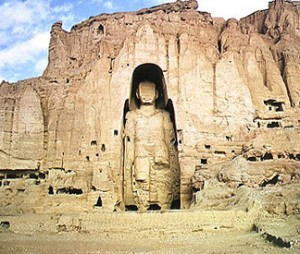
Bamiyan Buddha, 6th Century, Afghanistan. Destroyed by the Taliban, 2001.
CyArk’s Laser Scanning Mission CyArk has digitally preserved over 70 sites around the world from Pompeii in Italy, to Tikal in Guatemala.
“We use a 3 D laser scanner that sends out a pulsed laser beam and captures billions of points of these structures at a rate of about 100,000 points a second,” explains Elizabeth Lee who directs operations at CyArk. These sites are at risk, endangered due to everyday exposure to the elements, vandalism, war, urbanization, poorly managed tourism, catastrophic events, and general neglect.
The non profit organization was founded in 2003 by Ben and Barbara Kacyra after they sold their technology company that had developed the first fully integrated laser 3D imaging, mapping, modeling, and CAD system which is currently used worldwide in architecture, engineering and construction, entertainment and crime forensics.
“It was right at the time that the Bamiyam Buddhas were blown up by the Taliban,” remembers Barbara Kacyra. “There was no 3 dimensional documentation of them. We said, ‘How can we use this technology to help architects, archaeologists, and preservationists get better tools than tape measures and a clip boards and a pencils to go in and document these heritage sites.”
Hidden Mural Revealed
Historic carved altarpiece from Mexico installed in front of mural painted by Indians.
Sometimes new things are revealed during the scanning process. At Mission Dolores, CyArk worked hard to get behind the very ornately carved reredos, a false wall in back of the altar that was made in Mexico and shipped to the Mission by boat in 1796. For more than 200 years, the reredos has obscured a mural that was painted by the Indians when the mission was completed in 1791.
“There’s about a two foot space behind the frame where the statues are today,” says Andrew. “Very few have ever been able to see what’s behind. Using fiber optics they’ll be able to get a little pin wheel and be able to photograph. Then you’ll be able to click on say Saint Joachim with your smart phone and boom! You’ll be able to see behind, floor to ceiling, the mural that the Indians painted here at Mission Dolores.
“It’s not about the sites themselves,” says Barbara Kacyra, “It’s really about the stories. Whether it was Manzanar or Angor Wat, or Pompeii. It’s about the humanness of these sites.”
The History of San Francisco
There are almost 6000 Indians buried in the Mission Dolores cemetery, relates Andy Galvan, whose relationship to the Mission is much more than Museum Curator. Andrew is an Ohlone Indian whose ancestors were some of the first people baptized, married and buried at the Mission Dolores.
“If you walk around and look at the gravemarkers you’re going to read the history of San Francisco,” he says. “The 21 California missions are cultural heritage sites. These are our monuments. The Digital El Camino Real is about digitally imagining, about preservation. But it’s also about interpretation. It’s about what happened at the California Missions.”
Andy Galvan's Ohlone Indian ancestors are buried in the cemetery at Mission Dolores.
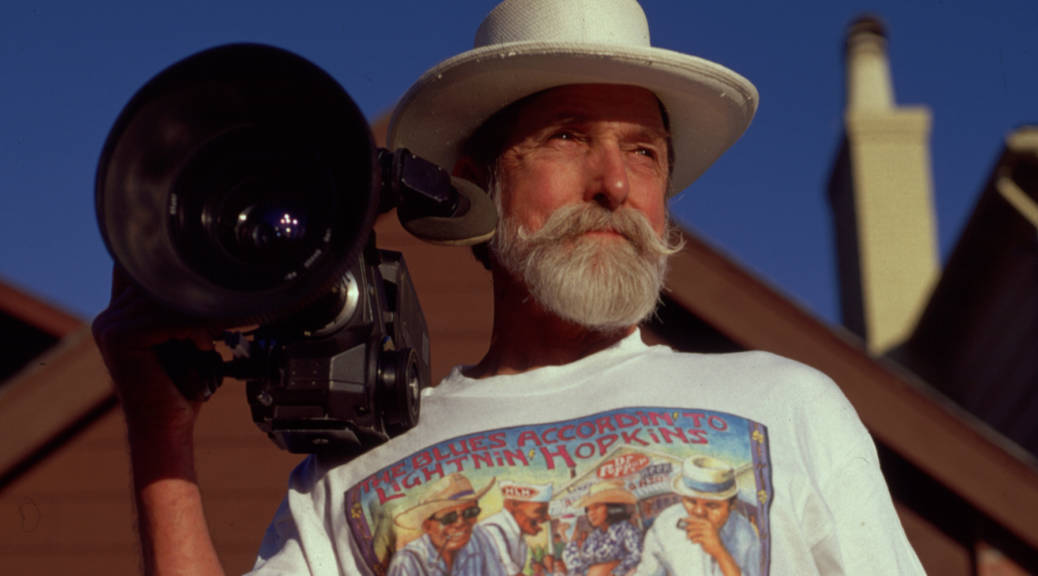
Tonight, the City of Berkeley will designate January 22, 2013 as “Les Blank Day.” The proclamation they wrote in his honor is beautiful and we asked permission to print it on The Making Of… blog:
IN HONOR OF LES BLANK
WHEREAS, Les Blank was born in Tampa, Florida and attended Tulane University where he played football and has lived in Berkeley for more than 35 years, making independent documentary films, and
WHEREAS, with a soft spoken demeanor, an eye for beauty, an insightful mind and great enthusiasm, Les Blank has captured the essence of aspects of American culture, and
WHEREAS, Les Blank, through his respectful, quiet presence, and non-didactic style created films that allow his subjects to reveal their true selves in a unique way, and
WHEREAS, some of the most interesting aspects of our culture have been documented by Les, creating a distinguished body of work of more than forty films over fifty years, all with a respect and love for people, their rituals, quirks, music and their food, including “The Blues According to Lighting Hopkins”, “Dry Wood”, “Chulas Fronteras”, “Always for Pleasure”, “Garlic is As Good as Ten Mothers”, and “Burden of Dreams”, to name a few, and
WHEREAS, Les Blank has received the recognition of being one of America’s finest documentary filmmakers, with retrospectives mounted across the globe and a British Academy Award for “Burden of Dreams” in 1982; Grand Prize, Melbourne Film Festival for “In Heaven There is No Beer” in 1985, the American Film Institute’s Maya Deren Award for outstanding achievement as an independent filmmaker in 1990 and the Edward MacDowell Medal in 2007.
WHEREAS, The City of Berkeley is very proud to have Les Blank as a resident and joins others who have celebrated his contributions to the documentary and honor him for his work that has enlightened so many about America’s rich and diverse cultural legacy
NOW THEREFORE BE IT RESOLVED, that I Tom Bates, Mayor of the City of Berkeley, recognize and honor Les Blank in his hometown of Berkeley, California and do hereby declare January 22, 2013 as Les Blank Day in the City of Berkeley in recognition of his creativity, sensitivity, humanity and enormous contribution to the documentary genre.
As part of The Making Of project we’ve partnered with Zeega, a group of folks who are creating a new online storytelling platform. This brand new tool makes it easy create digital stories combining your own content with media curated from across the web. Video, photographs,words, music can all be easily combined to make a story, right here on our site. You can go to our new STUDIO page and make your own.
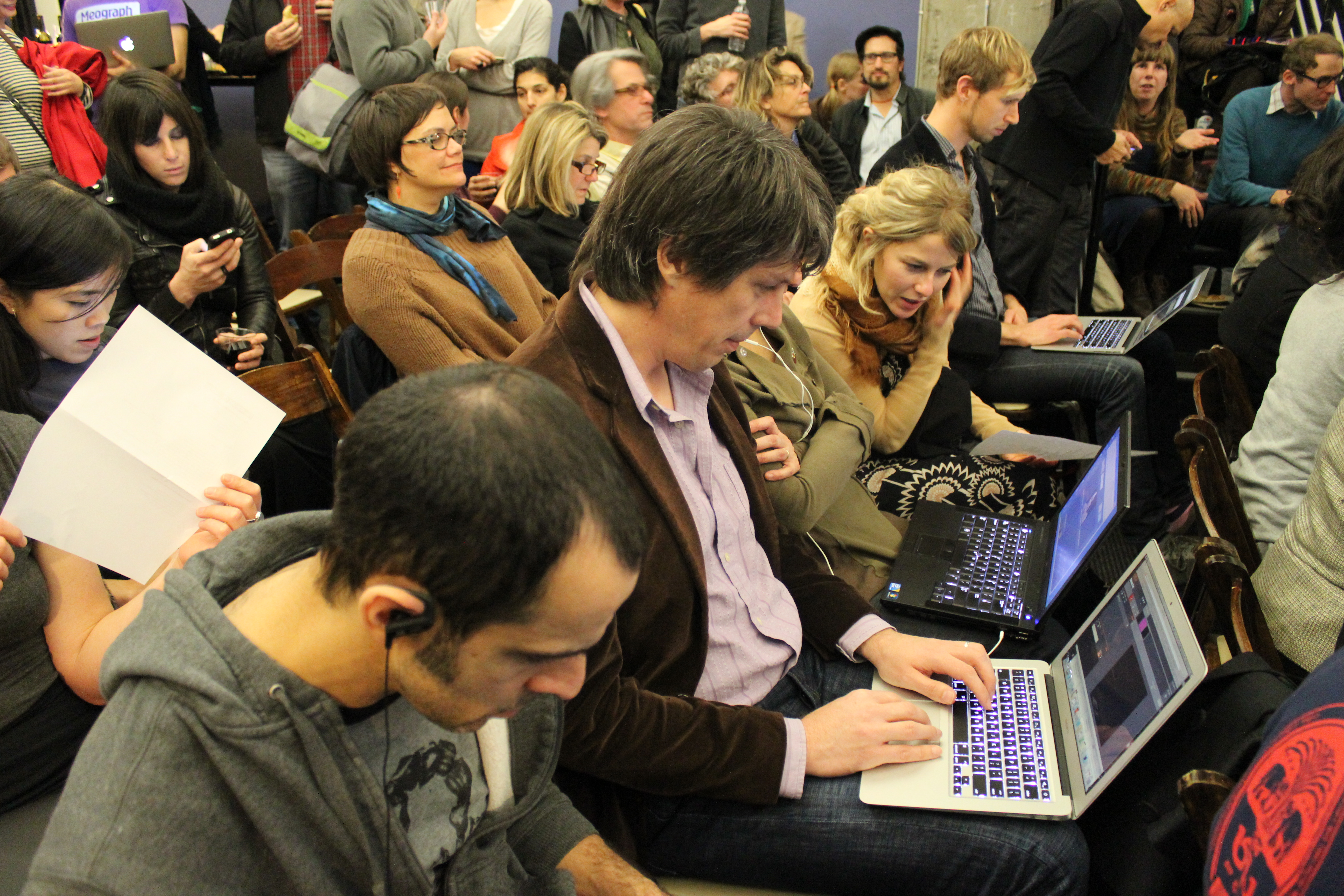
Check our some of the wacky Zeegas made in about 10 minutes by people who came to The Kitchen Sisters’ Making Of.. a Zeega Launch Party at SoundCloud. The assignment was to quickly select an animated .gif from tumblr, add a random piece of music from SoundCloud, and give it a title. Try it. And don’t forget to publish it and tag it with makingofaudiogif.
South of Market in San Francisco, industrial designer Scott Summitt, is blurring the line between medical devices and sculpture. He calls what he’s making the Fairing.
Listen:
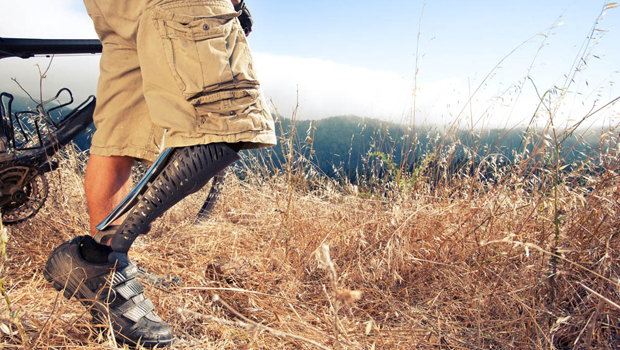
The word fairing typically describes the covering on a motorcycle – the curved shiny part that makes it a sleek, aerodynamic machine. Scott Summit, Director of technology at Bespoke Innovations 3D Systems is pushing the definition—his fairings are for people with prosthetic limbs.
“Typically a prosthetic limb is a very mechanically designed thing. Hardware, exposed nuts and bolts, titanium tube, carbon fiber foot,” says Scott who has designed for Apple, Nike and other Silicon Valley companies.
“The idea here is, how do we give somebody their body shape, their symmetry and turn this into a piece of sculpture that really represents the person, more like jewelry or something they would wear deliberately.”
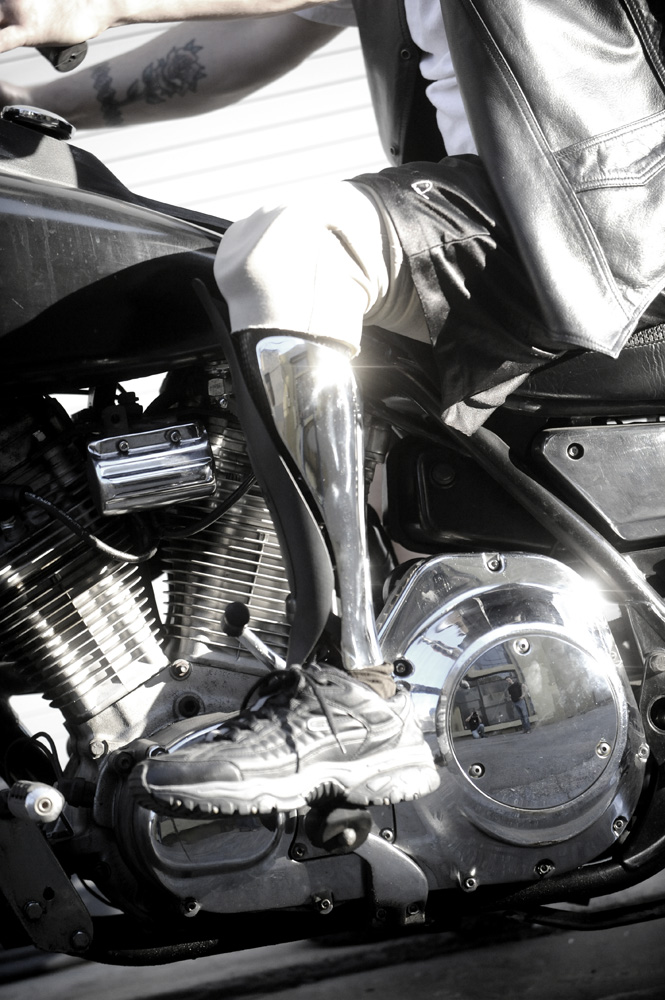
Part Human Part Machine Chad Crittenden is a tester and employee at Bespoke. A lifelong athlete, he lost his leg to a rare form of cancer 10 years ago. “Scott and I will sit down and talk about what I’m going to be doing and how I want it to look,”says Chad (who was the first amputee contestant on the TV reality show Survivor). “The front side of this fairing is the shape of what my shin would be. The backside, the calf shape, I wanted bomber jacket leather.”
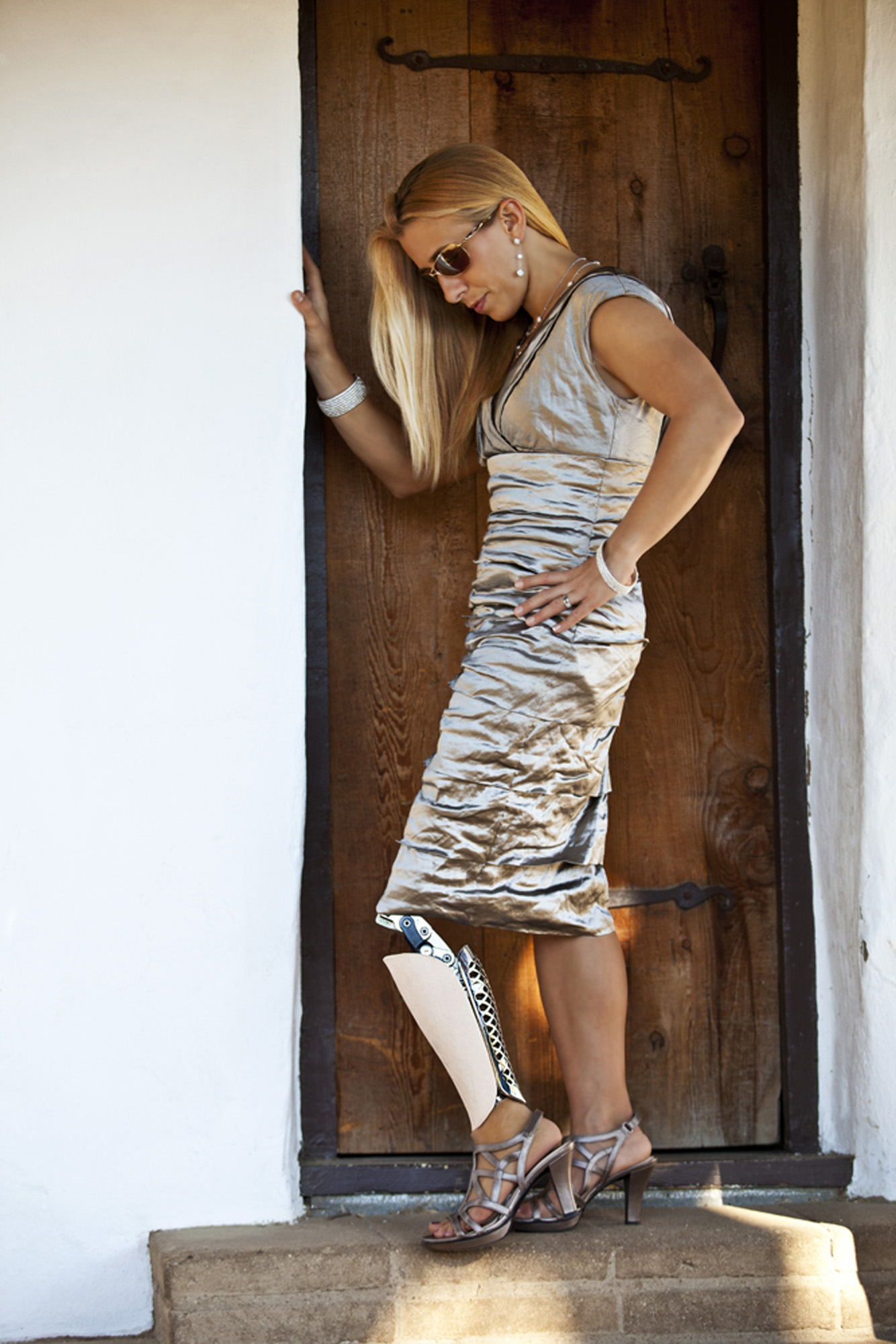
Ironman athlete, Sarah Reinertsen’s leg is amputated above the knee. “I have often felt that I am part human part machine. So I wanted to choose one of the patterns where you could kind of see into the mechanics of the leg.”
Scott and the designers at Bespoke work individually with each person to customize and develop the look of the fairing. Leather, chrome, heavy-duty dishwasher safe plastic – simple or patterned. Some people choose plaid, or snakeskin, or a tattoo. The back covering of Sarah Reinertsen’s fairing is a see- through herringbone design dipped in chrome.
“What’s most important is the functionality,” says Sarah, “but now I can also have it look beautiful, and it’s cool to fill in a pair of jeans and not have it flopping around on the pylon.”
The Idea
The idea came to Scott about twenty years ago when he saw Aimee Mullins at a conference talking about being an amputee and how that shaped the way she goes about her life. Amy showed the audience her sprinting legs made of carbon graphite and the legs she uses for tennis and softball that have shock absorbers in them.
“Here’s this lovely woman,” Scott remembers, “ but she had these legs that were looking so mechanical. And I thought, ‘Wow, why did nobody step up to the plate and make something as sculptural and fluid as the rest of her.’” Scott realized that a major obstacle was the difficulty and expense of producing a custom device per person.
That all changed about five years ago with the technical advances made in 3D printing. “Suddenly you could 3 dimensionally print a part that was durable, completely custom tailored to the body. We can design things that are not mass-produced that don’t see the world as one size fits all.”
Scan, Design, Print
The first step in making a fairing is to scan the person’s “sound side” leg using image-based 3D scanning technology. This takes less than a minute. A 3D computer model is mirrored and superimposed over the prosthetic post.
“If a person is missing 2 legs,” says Scott, “we try to find a surrogate who is the right height, weight, age – a body morphology donor to come in and get scanned. Then we start shaping and sculpting digitally.”
Scott explains that the term 3D printing, is a metaphor. It’s not printing anything in the traditional sense of what printing is. A 3D computer model is sent to the printer and the computer inside this machine slices it up into very thin cross sectional slices. A laser, or an electron beam, or a nozzle creates one layer after another after another. A range of materials can be used–plastics, nylon, metal, ceramics.
Mountains of Failed Products
We walk around the Bespoke 3D Systems loft office looking at tiny plastic robots, gadgets and gizmos – all 3D printed. Small printers, about the size of coffee makers whiz and whirr layering and layering brightly colored plastic.
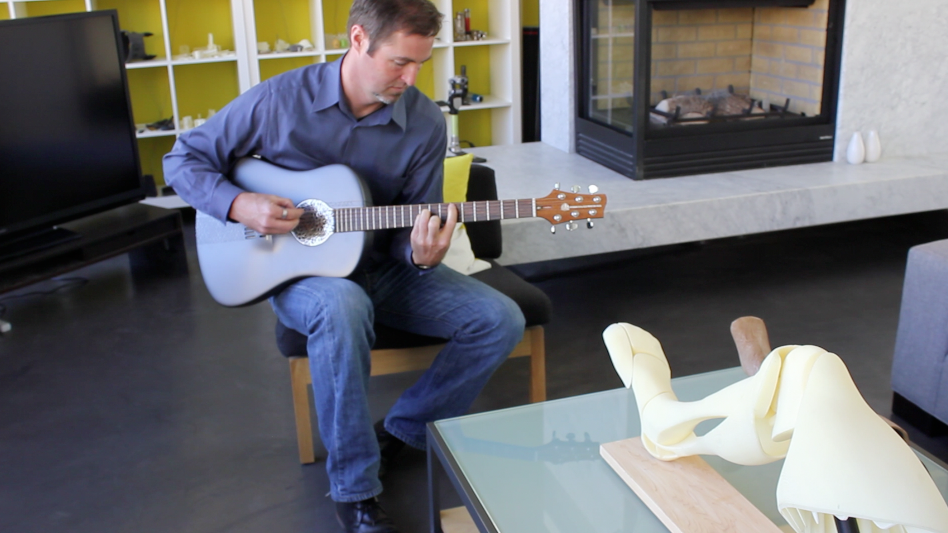
Scott picks up a guitar and begins to tune it. “This guitar was entirely 3 D printed—the body, the sterling silver on the badge, even the stainless steel plate on the neck.
“The technology is new enough that people have no idea of where it can go. We have no idea where it can go. Most of the time we’re experimenting. So we have mountains of failed products. that ‘s kind of what this environment is. A place where you can screw up then get it right the next time.”
Anything is Possible
“I grew up down the peninsula,” says Scott. “My dad was one of the Silicon Valley early guys. He and his collaborators were explorers. They had these new tools—data bases, boolean searches, ascii text files, and the modem – this idea that you can transfer information over a telephone line, a crazy idea. That was exciting to see as a kid, this idea that anything is possible.
“The big goal for the prosthetics, for me anyway, is that one day we’ll be able to go to a developing country, scan the person with nothing more than a camera, 3 dimensionally print a prosthetic leg that somebody could pull out of the machine and walk a way with. Fully structural. Ready to go.”
The Kitchen Sisters invite you to The Making Of… Zeega – A Night of Stories, Invention & Surprise. Thursday January 17, 7-8:30 pm at SoundCloud, 500 Treat Ave., San Francisco. We’re launching Zeega’s new storytelling platform on our Making Of site and hope you’ll come celebrate, find out more about the project and make a Zeega.
Zeega is a new experimental storytelling platform that lets users combine original content with media from across the web to create beautiful, surprising, immersive stories and works of art. Zeega has been holding “Maker Hours” every week in their storefront studio in Cambridge, MA, inviting a community of artists, designers and storytellers come together and invent.
On January 17, Zeega founders Jesse Shapins and Kara Oehler, will present “Zeega Maker Hours West” at SoundCloud’s San Francisco office. Anyone will be able to make Zeegas and contribute them to the project.
Bring your laptop or just come watch, listen and enjoy the food.
A collaboration between The Kitchen Sisters, KQED, AIR, Zeega, and SoundCloud. A Localore Project, funded in part by The Corporation for Public Broadcasting.
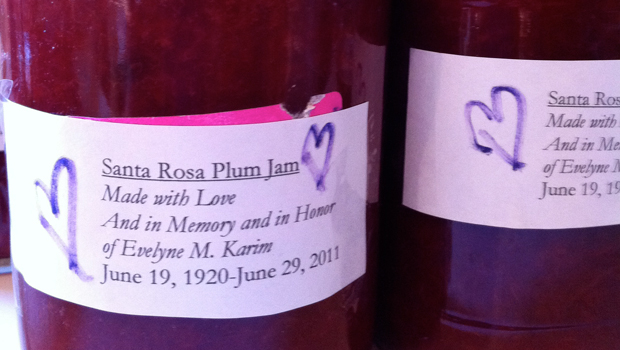
Persis Karim from Berkeley called The Making Of storyline and told us about how her mother inspired her to make jam. We loved her story so much we visited her home and recorded her story underneath her plum tree.
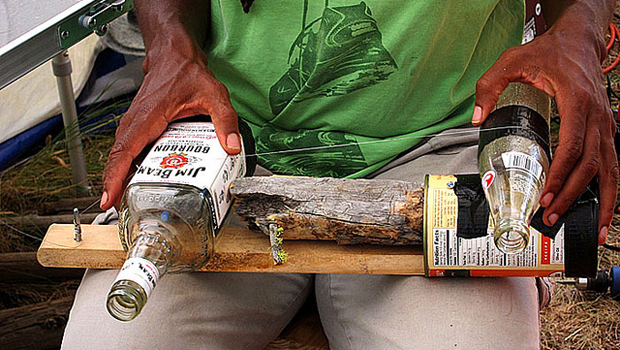
“Cardboard boxes, coffee cans, cookie tins, plastic water bottles…anything I find on the street, I turn into an instrument.” –Marilyn McNeal, musician, educator, and instrument maker
A community project from KQED and the Kitchen Sisters