
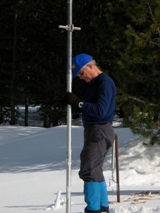
That’s how Frank Gehrke described the somewhat improved numbers in the latest Sierra snowpack survey. Gehrke has been trekking up to the snow courses for decades to do the seasonal surveys. Today, the statewide average for water content in the snowpack came in at 80% of normal for this date.
Northern Sierra locations clocked in a bit better at 84%, southern locations at 77%. These are an improvement over last month’s tally, when the state averaged only 61% of normal–but reservoirs are not filling fast enough to make up for the long, dry winter that preceded this recent string of storms.
Not that the recent rains haven’t helped. Oakland, Long Beach, Riverside and San Diego are among several spots that have now had at least 90% of their normal precipitation–and some local reservoirs have been catching up. But up in the Sierra, where it really counts for the Big Picture, they’re not catching up fast enough. The main holding “tanks” for the state’s two major water supply systems, Shasta Lake and Lake Oroville, are still at 60% and 55% of normal, respectively.
The recent storms have been relatively warm, too, with precipitation falling as rain all the way up to 7,500 or 8,000 feet. This is precisely the condition that climatologists have been warning about. Snow sticks to the mountain and makes its own reservoir, slowly releasing water well into the spring, as it melts off. But rain at those high elevations is double trouble. It runs off immediately into the rivers and also accelerates the snow melt. That means less water for later in the season, when we really need it.
That may be why the Governor didn’t wait around for today’s numbers. He went ahead and declared a statewide drought emergency on Friday, urging urban water users to cut consumption by 20%.
 After the puny amount of precipitation we had in January, you sort of knew this was coming. Sure enough, after the
