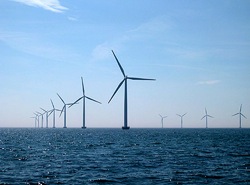
The Nysted wind farm off Denmark. Image: Cape Wind Assoc.
The nation’s first offshore utility-scale wind farm has won federal approval but it was no slam dunk. The Dept. of Interior has approved the 130-turbine Cape Wind project, off Nantucket.
The plan launched such an epic debate that at least one book has been written about it. Today’s nod comes just weeks after a federal advisory panel recommended against approval and doesn’t necessarily mean the project will go forward. Opposition groups have already vowed to go to court.
Permitting for most wind projects in California comes under local jurisdiction but a spokeswoman at the California Energy Commission told me that to her knowledge, no offshore wind projects are currently under review for California. An obstacle often cited is the extreme ocean depths off California, which make construction difficult. Various wave power projects have been proposed for the coastline.
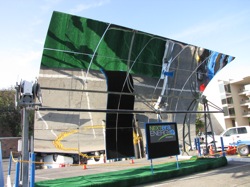
One section of a solar-thermal array on display at UC Riverside. Thousands of these mirrors gather solar radiation to heat a synthetic oil, which drives electrical generation at huge desert facilities. Photo: Craig Miller
Perhaps the most telling moment at the Governor’s Renewable Energy Policy Conference this week, was when the Governor’s own senior advisor on renewables, Michael Picker, asked for a show of hands. How many present, he wondered, actually thought that California would attain its goal of 33% renewable power by 2020. Amid the 370 or so gathered on the campus of UC Riverside, about a dozen hands went up. How many, he asked, thought we’d make it to 33% by 2050? Another dozen or so hands.
Bear in mind that this was a room containing some of the most knowledgeable people on the topic, from government, industry and environmental organizations. These were people invested in getting there, yet most seemed to doubt that we would.
Their pessimism was not entirely shared by the questioner. Picker told me afterward that he expected about 8,000 megawatts of new power to be approved by year-end. That’s approved, not necessarily financed. Solar arrays that generate 250 MW or more are considered large-scale operations.
Meanwhile, developers are pushing to get major projects approved before the year is out. To qualify for federal stimulus dollars, projects have to break ground this year and spend a certain percentage of project costs.
“It’s a hard state to develop in,” said Matt Handel, a vice president with NextEra Energy Resources. The Florida-based company is already a major player in both solar and wind generation in California, and Handel says the stimulus money is essential for two major new projects that NextEra has in mind for the southern California deserts.
“There is hope,” Handel told me. “It is difficult. There are a lot of constituencies out there pulling in different directions.”
Virtually all of those stakeholder groups were present in Riverside, in some form. Local (especially desert) communities, environmentalists, Indian tribes and representatives from federal agencies such as the Bureau of Land Management and National Park Service were there.
Identifying the most appropriate sites for large-scale wind and solar plants has been complicated by more than bureaucracy, said Kim Delfino, California Program Director for Defenders of Wildlife. “The landscape we’re working in is already changing due to the effects of climate change, which presents a challenge as to which areas to protect,” said Delfino in a panel discussion.
Picker says he’s “not so sure” that the state is doing the best possible job of moving projects efficiently through the pipeline (to borrow a metaphor from the fossil fuels era), and he conceded that some developers will be left standing in line as the year-end deadline expires. But he calculated that if, over the next five years, 20% of the biggest projects on the drawing board can get approved, the state should make its 2020 goal.
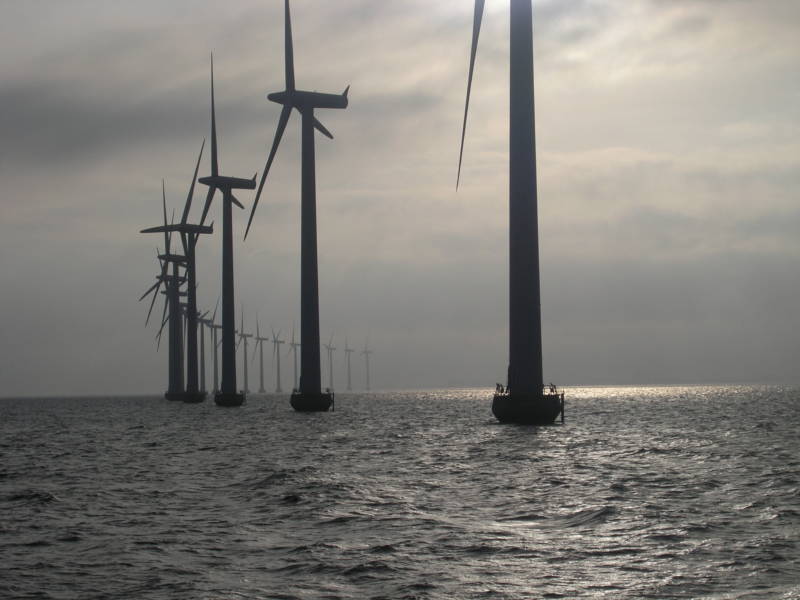
Harnessing nordic winds — The Middelgrunden offshore windfarm off the coast of Copenhagen
Friday on The California Report, Rob Schmitz looks at what we can learn from the world leaders in leveraging wind power.
See the photo on the left? You’re looking at three percent of Denmark’s wind power generation. This is the Middelgrunden wind farm, located in the North Sea, not far from Copenhagen. There, twenty 120-foot wind turbines produce 40 megawatts of wind energy.
I visited Middelgrunden this week in a small boat. Luckily for me, the winds, normally furious at this time of year, were moderate. I went there for a story on how Denmark was able to develop a wind power infrastructure that now produces a fifth of the country’s electric power. This is a larger proportion than any other country on Earth. For the Danes, wind power is big business.
Up until thirty years ago, Denmark was largely an agricultural country. Now, wind power-related exports are on par with agricultural exports. They make up almost 10% of the country’s total exports.
How did Denmark get to this point? The same way Japan became the most energy-efficient country on Earth: the 1970s oil shocks. In the mid ’70s, Denmark relied on oil for more than 90% of its energy. Oil embargoes brought the country to its economic knees. The government quickly instituted “Car-free Sundays,” when Danes were forbidden from driving. Shop owners were asked to turn off their lights outside of business hours. In 1979, the Denmark created its first Ministry of Energy, and it got to work on harnessing what was then considered an alternative energy: wind.
Jutting out into the treacherous North Sea, Denmark has lots of it. By 2020, Denmark plans to rely on wind for half of its electrical supply. And by 2050, the Danish government wants renewables to supply all of the country’s electricity. These are ambitious goals, but Jakob Lau Holst, COO of Denmark’s Wind Industry Association, believes it can be done.
“If you just stick to long-term government investment, you can develop a market for this,”Lau Holst told me today. He told me that much of Denmark’s industry has a hard time doing business in the US because incentives for renewables like wind “are there one year and gone the next. It’s a mixed message to the industry.” It makes one wonder what could be accomplished with more long-term goals–like California’s commitment to 33% renewables by 2020.
Just when we could exhale, assured that the term “Information Superhighway” had faded mercifully into the rear-view mirror–at the signpost up ahead: Your next stop: the “Electron Superhighway.”
That’s the term that Interior Secretary Ken Salazar is using to describe the transmission web that will facilitate the nation’s transformation to clean energy. Some random notes from his (and others’) appearance today before the Senate Energy & Natural Resources Committee:
Salazar:
– 6,000 miles initially identified on BLM lands for new transmission lines on the “Electron Superhighway,” 1,000 on US Forest Service lands.
– Access to land for transmission will be the “Achilles heel” of the plans for a new clean-power grid.
– Oil & gas need to be part of a “comprehensive energy plan,” along with renewables. The US now imports 70% of its oil.
– Seven major onshore leases already approved, auctioning off another 34 million acres along the Gulf Coast this week.
Ron Wyden (D-OR):
– Let’s use the “backlog of deadly fuels” on the floor of federal forests to generate bio-fuels and reduce fire danger at the same time (Energy Act of 2000 apparently excluded forest slash from its definition of “biomass.”)
– Hydrokinetic (wave & tidal) power should be higher on the priority list for energy development.
John McCain (R-AZ):
– The Obama administration “has effectively killed nuclear power in the foreseeable future, for this country” (by its actions regarding Yucca Mountain and reprocessing of fuel).
– Wave & tidal power could potentially fill 10% of the nation’s energy portfolio.
Joanna Prukop, NM Secretary of Energy, Minerals & Natural Resources:
– Wind energy is now price-competitive with natural gas (about 5 cents/KW-Hour currently) and could thrive without federal subsidy. Solar, not so much.
By the way, Salazar will hold a public hearing on energy policy in San Francisco on April 16th. It’ll start at 9 a.m. at UCSF’s Mission Bay Conference Center.
The creators of a new PBS program want your opinions about the future of energy and climate change.
Part online interactive discussion, and part television broadcast, Planet Forward is looking for regular folks as well as experts to submit written and video commentaries making a case for how the United States should deal with its current and future energy challenges.
Hosted by Emmy-award winning CNN reporter Frank Sesno, the television broadcast, which airs April 15, will feature the best online submissions and a panel of scientists, policymakers, and business leaders debating the issues they raise.
Every ballot measure has its fine print and every piece of legislation its earmarks and “ornaments.” Prop 10, officially the California Renewable Energy and Clean Alternative Fuel Act is typical of this time-honored tradition, except in one respect. Usually these quirks can be explained by the people promoting them.
On page 16 of the measure, Prop 10 specifically allocates multi-million-dollar grants to each of eight cities in California. Los Angeles, San Diego, Long Beach, Irvine, San Francisco, Oakland, Fresno and Sacramento (listed in that order) would each get $25 million:
“…for the purpose of capital projects and operating expenses promoting and demonstrating the actual use of alternative and renewable energy in park, recreation and cultural venues, including the education of students, residents and the visiting public about these technologies and practices.”
Seems straightforward enough–except nobody seems to know how these eight cities were chosen. It’s not merely a list of the state’s eight largest cities. It’s close, except that San Jose (#3) is conspicuously missing but Irvine (#17) makes the cut.
John Dunlap, former head of the state Air Resources Board and a paid consultant to the Prop 8 campaign, appeared to be stumped when I asked him for the rationale. His best guess was that they might be locations with significant transportation infrastructure, such as major port facilities. Again, the mystery of Irvine…and Fresno isn’t quite the Rotterdam of the West Coast.
I called the official office of “Yes on 10” and a media representative told me that she thought the cities were chosen for “geographic distribution” but admitted that she hadn’t been asked before. She promised to get back to me with a definitive answer. That was last week. Election Day is tomorrow. If Prop 10 goes down to defeat, it won’t matter. If it passes, it’ll be even more important to have an answer.
In today’s historic passage of the $700 bailout package for the financial industry, Congess also managed to finally extend the alternative energy tax credits that have been held up for months in legislative wrangling. The Senate approved incentives last week, and yesterday lawmakers included them as part of a $150.5 billion add-on package to the so-called “bail out bill” in efforts to gain more House votes for the financial rescue plan. The move will extend the existing tax incentives for the wind and solar industries for that were set to expire at the end of the year.
“The bill extends production tax credits for wind energy projects for one year, and for geothermal, biomass, and other renewable sources for two years.
The solar energy industry won an eight-year extension of the investment tax credit for commercial and utility-scale solar projects, and an eight-year extension of tax credits for residential solar power installations.”
Passage of these incentives is good news for alternative energy advocates who feared the expiration of these credits might harm fledgling wind and solar businesses and initiatives.
Last month, David Gorn reported a story for Climate Watch about what’s going on with large-scale solar installations in California as the state pushes to meet a plan requiring that 1/3 of California’s energy come from renewable sources.
Stay tuned for Monday’s radio report on Quest exploring California’s Proposition 7, which would require more wind and solar energy use in the state.
And speaking of solar power… After months of roadblocks, the extension on tax credits for renewable energy is one step closer to reality after the Senate yesterday approved the $17 billion package with a 93-2 vote. The credits for wind, solar, and energy efficiency projects are part of “The Renewable Energy and Jobs Creation Act of 2008,” a larger tax bill (HR 6049) that has been stalled in Congress as legislators wrangled over how to fund the credits. If they are not renewed, the incentives will expire at the end of this year, undoubtably having a negative impact on future solar and wind innovation and expansion in the United States.
You can read more about of the current situation in a piece by Ben Gemen at E&E Daily, but to access the article directly, you must be a subscriber. For the rest of us, Climate Progess has posted the story here.

 The creators of a new PBS program want your opinions about the future of energy and climate change.