Just as delegates from 193 nations agreed to a voluntary moratorium on geoengineering research last week at the international Convention on Biological Diversity (CBD) in Nagoya, Japan, the US House Science and Technology Committee issued a report outlining how federal geoengineering research could be pursued in the United States. The international agreement to ban the research does not apply to the US, which has not ratified the CBD. (More from The Washington Post and Climate Central.) Continue reading Climate News Roundup→
California’s Proposition 23 has failed at the polls, so now either the “second Industrial Revolution” may proceed or it’s the end of free enterprise as we know it, or we simply move on to the next front in the assault on California’s emerging carbon regulations.
(Photo: Craig Miller)
The $40 million fight over Prop 23 presented two opposing themes: (a) AB 32 will wreck the economy, or (b) AB 32 will save the economy. Both visions for California’s climate law were hyperbolic. It would be fascinating to be able to tap into some parallel universe where it did pass, just to see what would really happen. More than likely some middle ground would prevail, as it will now, in this Universe. Continue reading The Next Battle Front for AB 32→
Voters reject a measure to set aside California’s landmark climate law.
California’s chief air regulator was jubilant: “They didn’t know who they were messing with,” said Mary Nichols, when the first numbers came in from the polls.
Nichols, who chairs the state’s Air Resources Board, was reveling in the 20-point trouncing that voters gave the statewide ballot measure to freeze the state’s greenhouse gas law, known as AB 32. Governor Arnold Schwarzenegger seized the World Series moment and the locale, adjacent to the San Francisco Giants’ ballpark, to take a swing at the oil companies that financed Prop 23: “Less than 24 hrs later, we are beating Texas again,” proclaimed the Governor, who has made the state’s 2006 climate law a tent pole of his legacy. Continue reading Prop 23 Lands With a Thud→
As the world warms, officials at the National Park Service are starting to sweat: No glaciers at Glacier, no Joshua trees at Joshua Tree. These are part of the long-range forecast for the national parks.
A misty Lake McDonald in Glacier National Park; metaphor for the park's murky future? (Photo: Craig Miller)
Last month, in a post from Glacier National Park, I noted that Park Service director Jon Jarvis was not in a mood to mince words, calling climate change “the greatest threat to the integrity of the national park system that we’ve ever faced.”
That assertion was underscored last week in a new report on potential impacts to the parks from climate change. The collaboration by the Natural Resources Defense Council and the Rocky Mountain Climate Organization, attempted to zoom in on specific parks and projected changes ahead for ten national parks in California, as well as impacts on the state’s economy.
Death Valley is already the hottest spot in North America. The highest recorded temperature there is 136 dF. (Photo: Craig Miller)
Some conclusions under a “medium-to-high” emissions scenario, toward the end of this century: Higher temperatures in Joshua Tree National Park would mean the end of, well, Joshua trees in the park. Muir Woods could be as warm, on average, as San Diego has been historically, making it less hospitable to the park’s legendary coast redwoods. Death Valley, already the hottest spot on the continent, could become virtually uninhabitable during the summer, as average temperatures rise by more than eight degrees, Fahrenheit, over average readings from 1961 to 1990. Continue reading National Parks Wrestle with Warming→
Some of the week’s energy, climate, and emissions developments in California, that may have been overshadowed by other news:
Largest Solar-Thermal Project Breaks Ground
Officials broke ground on the first large-scale solar-thermal plant to be built in the United States in 20 years. BrightSource Energy says its $2 billion, 10,000-MW Ivanpah project, located in the Mojave Desert, will be the largest solar thermal project in the world. (More from KQED’s The California Reportand The New York Times)
Prop. 23 Funding
Opponents of Proposition 23 have contributed three times as much money to the campaign as those in favor of the measure that would suspend California’s climate change legislation. As of October 29, the “No” campaign had raised more than $30 million, while the “Yes” campaign had raised just over $10 million, mostly from out-of-state oil refiners Valero and Tesoro. (More from maplight.org, and to see where across the US the money is coming from, check out Climate Watch‘s interactive map that tracks the major funders.) Continue reading Climate News that Went By in a Blur→
California’s greenhouse gas regulators may ease the pain for companies under an evolving cap-and-trade plan.
Photo: Craig Miller
A staff report issued today by the state’s Air Resources Board provides the first details of how a state-run cap-and-trade program would work. As regulators had warned in recent months, it appears that most emissions permits will be given away, at least initially. Environmental groups had been pressing for a “100% auction,” making industry pay for all allowances.
But Jamie Fine, an economist with the Environmental Defense Fund in Sacramento, says it’s not that straightforward. Fine interprets documents released today to mean that most allowances would be given away to begin with, but by 2015, with the gradual expansion of the program, more than half of the permits would be auctioned off. Continue reading Air Board Likely to Give Away Most Carbon Permits→
Federal officials this week launched a new climate change research center, designed to be a hub for studies on the impacts of climate change on the San Francisco Bay and coastline.
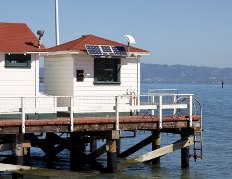
The tidal gauge off of San Francisco's Fort Point is the oldest in North America.
The Ocean Climate Center is housed in a collection of century-old military buildings on the edge of the Bay at Crissy Field. It couldn’t be a more picturesque — and critical — location. Adjacent to the oldest tidal gauge in North America, the center will allow cash-strapped federal agencies to pool resources into climate change research and work with natural resource managers to combat negative impacts on the marine ecosystem and communities along the coastline. Continue reading Center to Study Climate Impacts on Ocean→
Two recent events provide a timely backdrop for this conversation, the water level in Lake Mead, the huge reservoir on the Colorado River, reached a record low — and the National Center for Atmospheric Research released a new report on projected drought impacts, worldwide, described as “possibly reaching a scale in some regions by the end of the century that has rarely, if ever, been observed in modern times.” — Ed.
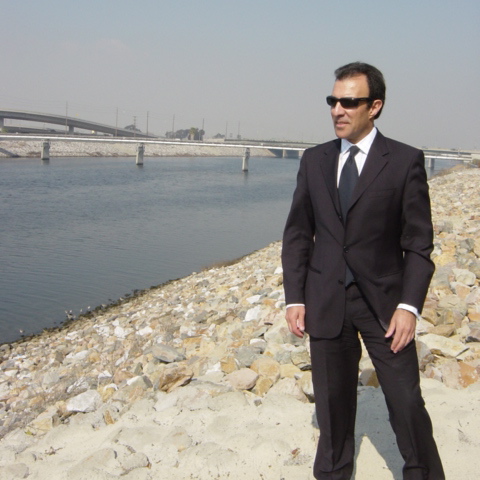
David Nahai on at the Los Angeles River in 2006
David Nahai was CEO and General Manager of the Los Angeles Department of Water and Power (LADWP) from 2007 to 2009. On Nahai’s watch, the utility amped up renewable energy projects and launched new outdoor water restrictions that resulted in Angelenos cutting their consumption by more than 20%. I first met Nahai a decade ago when he and other members of the Los Angeles Regional Water Quality Control Board were grappling with what was arguably the nation’s worst urban runoff problem. Currently he’s a green-tech consultant and advisor to the Clinton Climate Initiative (CCI). I sat down with him in his little corner of a Century City high rise. He started by reminding me that opinions expressed in our discussion were his alone, not those of CCI: Continue reading Water and Power→
In what might signal a final push by Silicon Valley, an environmentally-oriented investor group today released a manifesto from 66 “leading investors” opposed to California’s Proposition 23. The group is said to manage more than $400 billion in assets.
In a conference call with reporters, venture capitalist Alan Salzman called clean technology the “next industrial revolution,” and that “California is at the epicenter.” To prove his point, Salzman pointed to $9 billion invested in “clean-tech” since 2006, in California alone, and he called Prop 23 “antithetical” to the transition that global industry is now undergoing, claiming that 20% of total venture capital funding is flowing to clean-tech, of late. Continue reading Prop 23: No’s Rally, Pros Retreat?→
Couples often remain unhappily married for the sake of the kids. Now they might consider it for the sake of the planet.
Chinese households are outpacing the population by three-to-four times.
Jianguo (Jack) Liu, who directs the Center for Systems Integration and Sustainability at Michigan State University, has been tracking an interesting driver of carbon emissions in China: the explosion of households.
Speaking at the Society of Environmental Journalists‘ annual conference at the University of Montana, Liu said the number of households in China has been growing three-to-four times as fast as the population, which, in turn, is fueling a domestic boom in energy-intensive consumer goods, such as autos, air conditioners and major appliances (though one third of China’s carbon emissions are still due to products made for the export market, with the largest share bound for the US). Continue reading The Carbon Footprint of Divorce in China→