Threatened by Rising Seas, Alaskans Ponder Where to Move

Winning their landmark climate suit against energy companies is just one challenge

Following their appearance in a San Francisco Federal Appeals Court this week, Climate Watch contributor Amy Standen was the only journalist to sit down with members of the Kivalina delegation before their return home.
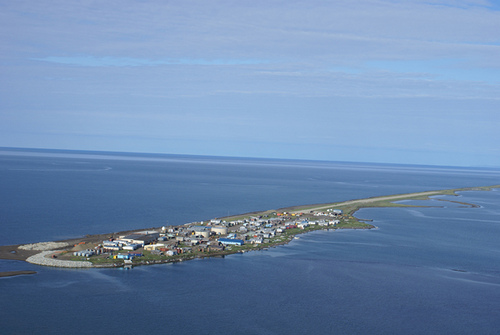
As a group of nine Alaskan natives returns to their coastal village after their day in court, it seems that their plight is about more than getting money to pay for a move to higher ground. It’s an interesting microcosm of the climate conundrum: The past isn’t prologue anymore. History is a faulty crystal ball. How climate change will affect a specific place is anyone’s best guess. And in the case of Kivalina — and likely, many other places — residents’ visions of the future may not line up with those of scientists.

In the past, Kivalina– which lies at the tip of a narrow barrier island off the coast of Alaska – was buffered from storms by a thick layer of ice around its perimeter. But now the ice is melting. Every time a storm hits, many of Kivalina’s 400 residents take shelter in a local elementary school, hoping the waves will spare them. Everyone agrees: The village must relocate. Continue reading Threatened by Rising Seas, Alaskans Ponder Where to Move
Sea Level Suit Returns to San Francisco Courtroom

Alaskan village blames oil & power companies for rising seas

The coastal hamlet of Kivalina, Alaska, is already known for literally making a federal case out of rising sea levels.

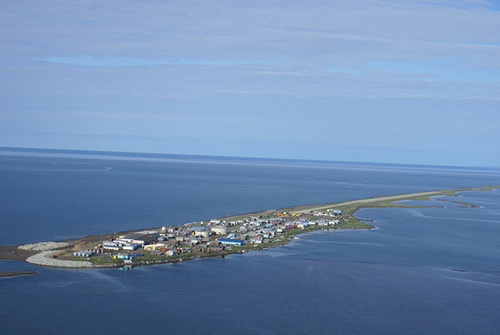
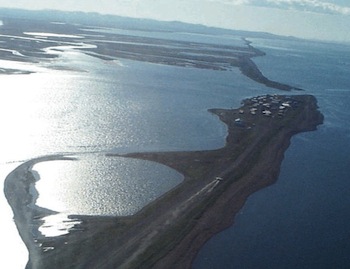
The village of about 400 residents sits exposed on a barrier island in the Chukchi Sea. In 2008, local officials filed a federal lawsuit against about two dozen corporate entities, including ExxonMobil, BP and San Ramon-based Chevron Corp., claiming that coastal erosion was forcing the town to relocate.

Kivalina appears in the distance, on the tip of this barrier island in the Chukchi Sea.

The original case was dismissed — but on Monday, the case lands in San Francisco’s Ninth Circuit Court of Appeals, where the town’s lawyers will again argue that major oil and power companies are responsible for the threatening rise in sea level, as the result of their collective greenhouse gas emissions. The appearance is timely, as only a week ago a major Arctic storm reportedly caused some damage to the settlement. Continue reading Sea Level Suit Returns to San Francisco Courtroom

CA, Capitol Republicans Lock Horns over Tailpipe Regs

Committee calls CA Air officials “unresponsive, ” suggests CA stepping on feds’ toes

Updated Monday, November 28, 2011

For California Air Resources Board (ARB) chair Mary Nichols, pre-Thanksgiving prep meant responding to list of requests from Orange County Republican congressman Darrell Issa and his House Oversight and Government Reform Committee.

As part of its expanding probe into how the newest Corporate Average Fuel Economy (CAFE) standards were set, the letter asked for information about how California came up with its vehicle emissions standards and what role state officials played in developing the newly announced federal fuel economy standard. Continue reading CA, Capitol Republicans Lock Horns over Tailpipe Regs

Huge Transformation Required to Meet California Climate Goals

A new study suggests one word: Electrification

A new study suggests that massive electrification will be required to meet California's 2050 goal for greenhouse has reductions.

Chances are you’ve at least heard about California’s legal requirement to wind back greenhouse gas emissions to 1990 levels by 2020. But the state has a longer-term goal to knock another 80% off that by 2050. Is that even possible?

A new study suggests that it is — but not without a wholesale transformation from an “oil economy” to an “electric economy.”

The study, a collaboration of economists and energy forecasters at several institutions, including Lawrence Berkeley National Lab, three fundamental resets will be required to make that goal: Continue reading Huge Transformation Required to Meet California Climate Goals

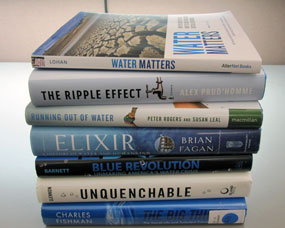
Six Books that Shed Light on Our Water Future

Festive reading? Water fears are fueling a publishing frenzy

 ” credit=”Sarah Terry-Cobo/KQED

Blue is the new black. It’s not the latest fashion marketing campaign, but a realization about natural resources: water is the new oil.

It’s essential to life, it’s becoming ever more scarce and people are already fighting to control its access. In case you had any doubt, just check out Amazon.com’s cascade of books, reports and studies published this year. (When you sort out the ones on Fukushima, there are about 70.)

Here’s a brief look at just a few that have drifted through our offices of late. Continue reading Six Books that Shed Light on Our Water Future

Fast-Forward: What the New Fuel Economy Standard Will Mean to You

Talking turkey: 54.5 MPG = Another $17 in your pocket this weekend

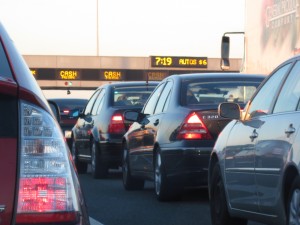
This morning's commute, 405 North, Los Angeles

If we all were driving cars that averaged the newly announced federal standard for fuel efficiency, Californians would save $34.9 million this Thanksgiving weekend. At least, those are the numbers from a report released today In Culver City by Environment California. That $17 per family spells another four holiday pies or a few more lattes on the way home. Put that slice of information on your Christmas list — not for this year but for 2025. Even with the usual exemptions and provisions, the new standard announced by the Obama administration would still effectively almost double the average gas mileage for a carmaker’s fleet in those 14 years. Continue reading Fast-Forward: What the New Fuel Economy Standard Will Mean to You

Analysis Highlights Tricky Business of Carbon Accounting

San Francisco’s carbon footprint as political football

 ” credit=”Craig Miller / KQED

As business and public entities face more pressure to lower their carbon footprints, an entire industry has sprouted to quantify and verify their progress. The whole enterprise can be tricky business, as San Francisco officials are finding out.

Props to The Bay Citizen for looking beyond the claims and doing its own analysis. As John Upton writes in Citizen:

“…some energy experts and environmentalists have raised questions about the city’s calculations. Although San Francisco has taken significant steps to shrink its carbon footprint, these critics said, the numbers are misleading, and the end result is not nearly as green as the city claims.”

Specifically, TBC looked into the claim that the City and County of San Francisco has cut its carbon emissions by 12% since 1990, driven mostly by the shutdown of two gas-fired power plants in the city. The article features a graph that shows its own tracking of greenhouse gas emissions clocking in well below the City’s estimates.

San Francisco was given high ratings recently in at least one independent study, for its “political leadership and commitment” to climate planning.

UN Panel Says More Severe Weather On the Way

But it’s still hard to pin down what, where and how bad

Climate change is likely driving some of the extreme weather events we’ve been seeing and more such weather is on the way, according to a much-anticipated report from the Intergovernmental Panel on Climate Change (IPCC).

“This is a pretty hard-hitting report,” says Chris Field, a Stanford climatologist and one of the co-chairs for the report. “What we can say is that some kinds of extremes are occurring more frequently,”

Some kinds. The UN panel carefully couches all of its findings in terms of probabilities and confidence levels, which vary widely depending on the type of weather event. Hence (italics are mine):

Sea Level Rise: “It is very likely (90-100% probability) that mean sea level rise will contribute to upward trends in extreme coastal high water levels in the future.” Continue reading UN Panel Says More Severe Weather On the Way

California Stakes Out New Ground with its Latest Fuel Standard

The White House proposes a strict new national fuel standard, but California still leads the way

On Wednesday, just as the Obama Administration proposed strict new fuel efficiency standards for 2017-2025-model cars and light trucks, the California Air Resources Board leapfrogged Washington with its own package of regulations designed to further reduce emissions from passenger vehicles.

The proposed “Advanced Clean Cars” regulations package has four components, including a greenhouse gas emissions standard that matches the new federal one, which isn’t surprising since California played a key role in drafting the new federal proposal. Continue reading California Stakes Out New Ground with its Latest Fuel Standard

A Year-Long Sky Journal as Video Mosaic

A motion mosaic of our ever-changing, endlessly fascinating atmosphere

Detail from Ken Murphy's video sky mosaic

About two years ago, Ken Murphy set up a tripod on the roof of San Francisco’s Exploratorium science museum and aimed his video camera at a particular patch of sky. He’s spent the two years since shooting time-lapse sequences from his makeshift observatory and has stitched them together into this wonderful visual tableau.

Murphy, who is a web developer at KQED and a former artist-in-residence at the Exploratorium, says the project grew out of — well — boredom. He became restless with his experimentation with art works using LED lights. He says he was looking for more natural movement. So Murphy went dumpster-diving for parts and cobbled together a computer-controlled camera that would record the same sky segment every ten seconds, around the clock. He says it took two years of shooting to stitch together one full year of images. Eventually he found himself sorting through three million video frames for the mosaic. Continue reading A Year-Long Sky Journal as Video Mosaic