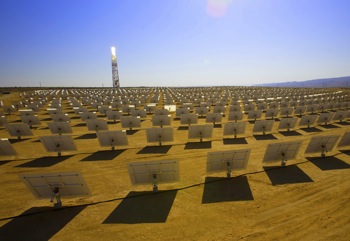
The “33 x 20” series continues Monday on Quest Radio, with the first of two parts on the proposed Solargen project in San Benito County. The reports will be repeated on The California Report weekly magazine.
Well hidden among the coast ranges of San Benito County, there’s a valley where, as one ecologist put it, “the hammer is hitting the anvil.” Mike Westphal of the Bureau of Land Management’s Hollister field office was describing the current tension playing out in Panoche Valley between two environmental goals: the mandate to combat global warming with a transition to renewable energy, and the desire to conserve the habitat of endangered animals, as well as California’s remaining ag land.
As part of our collaborative series: “33 x 20: California’s Clean Power Countdown,” Quest Senior Editor Andrea Kissack and I have been exploring the effort by Solargen Energy to develop Panoche Valley as a utility-scale solar power array (the state defines “utility-scale” as any facility that produces 200 megawatts of electricity or more).
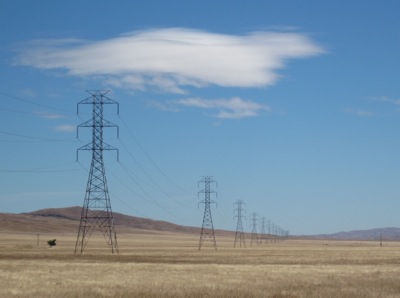
Like many developers, Solargen CEO Mike Peterson is racing to break ground by the end of this year, in order to cash in on up-front stimulus money from the federal government. He says Panoche Valley presents a rare alignment of attributes for solar power: high solar potential (he says 90% of the Mojave), relative proximity to population centers, and existing transmission lines to get the power there. Peterson told me that the lines already in place have enough available capacity to handle his 420 megawatts of solar power, though a spokeswoman for PG&E says that question is still under study.
Meanwhile, some farmers and wildlife advocates have opposed the plan, saying big solar “farms” are better placed on “degraded” land. Ron Garthwaite, who runs Claravale organic dairy, says “This is just not the place to put it. There’s other places which have no ag value and which have less of a natural value where they could put it.”
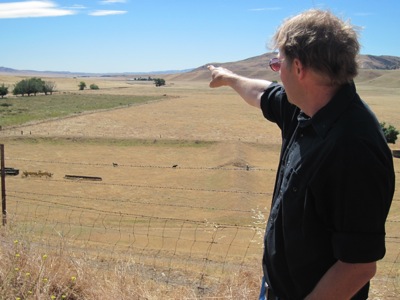
Westphal, whose agency is not directly involved in assessing the project, sees the valley as a rare microcosm for the once unspoiled habitat of the San Joaquin Valley, just over the hill. “What we really need to think hard about is do we want to risk ecosystems to get energy,” he told me, scanning the valley from Shotgun Pass at the north end. “That’s what’s going on here in Panoche Valley is we’re making this equation: how much do we want to risk the continued endangerment or extinction of this ecosystem in order to get more energy? That’s the crux of this conflict here.”
In this video clip, BLM ecologist Michael Westphal gives Craig Miller an overview of the valley, looking south from Shotgun Pass.
Solargen is shelling out for a $1.3 million-dollar environmental impact report, which Peterson says does not include measures such as the two dozen biologists and a detachment of scat-sniffing dogs, trained to track down the droppings of other critters for DNA analysis. The results help determine what species are there. Peterson says the total tab in “preparing and preparing for the EIR” now tops $7 million.
In Part 2 of our Panoche Valley “case study,” Andrea Kissack will have a closer look at the wildlife issues. That report runs next Monday, June 28, on Quest Radio.
As for the Governor’s ambitious goal to have renewable energy sources account for one third of the state’s electrical generation by 2020, Peterson describes the process as “surprisingly harder than you would expect.” He says he ponders how to “get this done in a way that is able to meet the mandates, but also be a good steward to the environment, and try to make people happy. And we won’t be able to please everybody.”
He’s right about that. Dairyman Garthwaite says of the state’s quest for renewables: “Just because somebody in Sacramento says something, doesn’t mean that it can happen–or should happen. I mean there’s all kinds of political things involved in that, there’s lobbyists involved in that. People want to make money.”
Climate Watch intern Chris Penalosa mapped some of California’s larger solar projects in development, below.
View Utility Scale Solar Projects in California in a larger map

 A new book asserts that the very same group of Cold War ideologues who banded together to spread doubt about the link between tobacco and cancer also spearheaded the first efforts to discredit climate scientists as they began warning about the effects of anthropogenic global warming.
 The survey, conducted by Jon Krosnick’s Political Psychology Research Group with funding from the National Science Foundation, suggests that some climate pollsters have been getting it wrong. About three in four respondents to the Stanford poll (74%) acknowledge that the “world’s temperature” is rising, and though they appear to be divided on the cause (with a slight edge to human causation), roughly the same majority (76%) favor federal limits on “the amount of greenhouse gasses thought to cause global warming.” Krosnick summarized some of his findings in an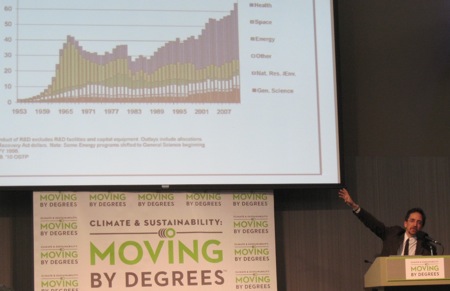

 Biologist William Ryerson, President of the Washington-based