Category Archives: Government & Business

What’s brewing in Sacramento, Silicon Valley, and beyond

Climate News Roundup

A few items in the climate news that caught our eyes this week…

1. CEC approves 250-megawatt solar thermal project in Kern County
The California Energy Commission approved the Beacon Solar Energy project on Wednesday. It’s the first time in 20 years that state energy regulators have approved construction on a solar thermal farm, the Los Angeles Times reports.

2. Geoengineering won’t curb sea-level rise, study finds
A new report from the Proceedings of the National Academy of Sciences finds that geoengineering strategies to combat global warming by blocking the sun’s radiation would not have much of an impact on rising sea levels, unless the efforts are extremely aggressive. (Read more at Nature.com)

3. Earth’s plant growth fell due to climate change, says NASA
After 20 years of increasing growth under warming temperatures, the Earth’s vegetation   saw a slight decrease over the last decade, according to a new NASA analysis.  Scientists reported they were surprised to find that the negative effects of regional droughts outweighed the positive influence of a longer growing season.

4. Another hurdle cleared for the world’s largest solar farm
Federal regulators are one step closer to approving plans for the 1,000 megawatt plant proposed by Oakland-based company Solar Millennium LLC.  The project would be located across more than 7,000 acres in Riverside County. (Read more at The New York Times.)

Feds to States on Global Warming Suit: Back Off

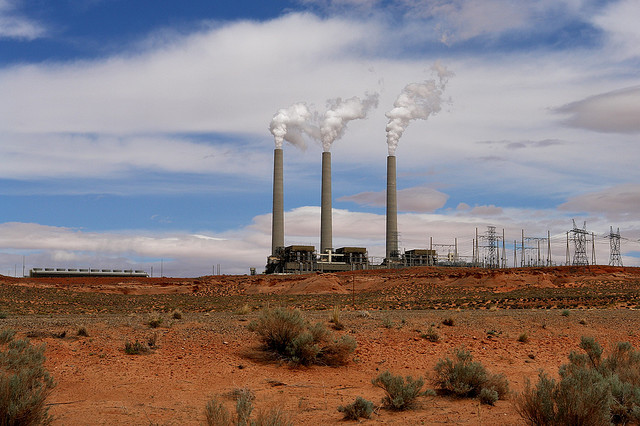
Navajo Generation Station. The place of coal in California’s energy diet is shrinking, but that’s not necessarily true for the rest of the country. (Credit Alex E. Proimos via Flickr)

Bit by bit, the US Environmental Protection Agency is moving to limit the gases that scientists say cause global warming. Over five years, the agency is limiting auto emissions and is also requiring new industrial plants to use improved pollution controls

Sooooo, US Justice Department lawyers argue, California, seven other states, New York City and three land trusts should not be suing major utilities, demanding that they reduce global warming emissions.

In papers filed with the US Supreme court this week, Justice Department lawyers argue the authority to curb emissions that cause climate change belongs to the Environmental Protection Agency and to Congress. Continue reading Feds to States on Global Warming Suit: Back Off

Another Mountain Critter Confronts Climate Change

The San Bernardino flying squirrel is a subspecies of Northern flying squirrel, pictured here. (Photo: US Fish and Wildlife Service)

The San Francisco-based Center for Biological Diversity (CBD) filed petitions with the US Fish and Wildlife Service today to protect four mountaintop species from climate change, including the San Bernardino flying squirrel.  The CBD is requesting that the species be listed as threatened under the federal Endangered Species Act and that critical habitat be designated.

The San Bernardino flying squirrel is a subspecies of the northern flying squirrel. Historically it has thrived in the high-elevation conifer forests of Southern California, in just two locations: the San Bernardino and San Jacinto Mountains.  But according to Shaye Wolf, a biologist at CBD, the species has likely disappeared from the San Jacinto Mountains in the past few decades. Studies indicate that the remaining population is isolated in the San Bernardino Mountains, which is bordered on the north by the Mojave Desert, a formidable barrier to migration. Continue reading Another Mountain Critter Confronts Climate Change

Rebuilding a Buffer Against Climate Impacts

Hear our radio feature on wetlands restoration in San Francisco Bay, to be aired Friday afternoon on The California Report.

As my colleague Paul Rogers reported this week, earth has begun to move in the biggest wetlands restoration ever undertaken on the West Coast. This week I took a brief tour of the Eden Landing Ecological Reserve, near Hayward.

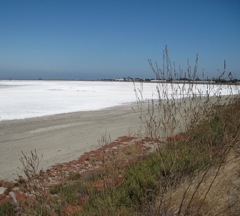
What is and what will be: Hundreds of acres of salt evaporation ponds, in the background, are being restored to tidal wetlands, as seen in the foreground of this scene from Eden Landing in Hayward. (All photos: Craig Miller)

Scanning much of the scene, “Eden” wasn’t exactly what came to mind. Vast, white expanses of salt and gypsum deposits are more reminiscent of Utah than a bay estuary. These are the remnants of a once booming salt harvesting industry.

But fueled partially by federal stimulus funding, bulldozers and backhoes are now reshaping levees there as part of the larger South Bay Salt Pond Restoration Project, which will eventually return 630 acres of abandoned salt flats into tidal wetlands at Eden Landing, and thousands more in an arc around the south end of San Francisco Bay. Continue reading Rebuilding a Buffer Against Climate Impacts

The Overspray from Prop 23

On Monday, US energy secretary Steven Chu became the latest high-profile voice against California’s Proposition 23, the statewide initiative to suspend AB 32, the state’s four-year-old climate strategy.

“AB 32 was a good bill and continues to have California in a leadership role in developing clean energy and the efficient use of energy,” Chu told reporters at a dedication in Menlo Park. “From the middle 1970s California played that role and it would just be a terrible setback.”

Last week the trend was given full voice by Mary Nichols, who, as chair of the California Air Resources Board (CARB), is charged with getting AB 32 fully implemented in the next two years, called Prop 23 a “very serious threat,” not just to the core programs of AB 32, but to an array of regulatory programs that support the state’s attack on greenhouse gases. Continue reading The Overspray from Prop 23

Nichols: No Solo Cap-and-Trade

Cap-and-Trade is a lonely business these days. But according to the state’s top regulator in charge of implementing it, California won’t go it alone.

Air Board Chair Mary Nichols, flanked by Google Green Energy Czar Bill Weihl (left) and PG&E Sr. VP Tom Bottorff, at a panel sponsored by the Silicon Valley Leadership Group. (Photo: Craig Miller)

Mary Nichols, who chairs the state’s Air Resources Board, made the remark in a Silicon Valley panel discussion today. The ostensible topic of the event was renewable energy but it turned into a pep rally against Proposition 23, the statewide ballot measure designed to halt California’s comprehensive climate law, AB 32. Nichols was joined on the panel by executives from Google, PG&E and venture capitalist Vinod Khosla, all of whom voiced strong opposition to Prop 23.

When asked about the cap-and-trade provisions of AB 32, Nichols said: “We won’t launch this program without partners to trade with. It doesn’t make sense for an economy even as big as California, to try to do this all by ourselves.” The comment came days after congressional leaders threw in the towel for the summer, on a federal bill to address climate change and energy security. “To get the kind of leverage that you really need to make this program succeed, the US has got to step in,” said Nichols.

California is part of a nascent regional trading pact known as the Western Climate Initiative. But among the seven US states and four Canadian provinces signed on to the WCI, only California, New Mexico and Quebec are prepared to move forward with a working carbon trading market. Others still lack enabling legislation, and Arizona has overtly pulled out of the carbon trading plan, raising the question of how many “partners” California will have, even with WCI in the mix.

“I don’t expect to be faced with this dilemma,” Nichols told me after today’s event, “but if the worst were to happen and none of these states were able to move forward with their own programs, I think we would think long and hard about whether we would actually start enforcing the program, unless and until we were really confident that our  state had the ability to do it in a way that would not put us at a competitive disadvantage.”

Proponents of Prop 23 contend that full implementation of AB 32 will give other states and nations a competitive edge over California, resulting in “leakage” of jobs and businesses to regions with fewer regulations.

The panel, entitled “Electric Bills and Oil Spills: Will California Continue To Be a Clean Energy Leader?” was held on the Google corporate campus in Mountain View.

Water Bond Shelved Until 2012

(Photo: Amanda Dyer)

From KQED’s  The California Report:

The $11 billion water bond was the product of a tough political compromise last year. Lately, it’s been the focus of a lot of criticism — detractors say it is too filled with pet projects, and it contains too much borrowing for a state in fiscal chaos.

Last night, the Legislature pushed the bond onto the ballot two years from now, a plan to pay for new dams, water conservation, and some changes in the fragile Delta ecosystem. Supporters say the delay isn’t likely to hurt the state’s water needs. But no one can say whether a two-year postponement will allow the proposal to be fine-tuned or killed by its many opponents.

Today’s San Francisco Chronicle has more on the fate of the bond measure, which had been scheduled to appear on this November’s state ballot.

For more on California’s water issues, including an interactive map of where the $11 billion in this bond measure was proposed to go, visit California’s Water.

Whitman Commits on Prop 23 — Sort of

The mystery of whether Republican gubernatorial candidate Meg Whitman does or does not support Proposition 23 would appear to be solved. After weeks of steadfastly refusing to take a stand one way or the other on the ballot measure to freeze the state’s climate law known as AB 32, Whitman conceded on a radio broadcast that “In all likelihood I will vote ‘No’ on Prop 23.” Continue reading Whitman Commits on Prop 23 — Sort of

Poll Shows Support for Climate Law

An expansive new poll on environmental attitudes suggests that despite the recession, Californians are holding fast to their environmental priorities.

Among the findings in the report released this week by the non-partisan Public Policy Institute of California is that support for the state’s climate change strategy remains strong, even in the face of a well-financed campaign against the law known as AB 32. Two-thirds (67%) of the respondents support the 2006 Global Warming Solutions Act, aimed at reducing greenhouse gas emissions in California–about the same level as when PPIC polled the question last year. Continue reading Poll Shows Support for Climate Law