Looking ahead at some of the education technology trends we’ll likely see in 2012, many are already underway.
But here are 12 areas where we believe we’ll see significant adoption and innovation in the coming months.
MOBILE PHONES: Mobile learning is hardly a new trend, but we have now reached the point with near ubiquitous cellphone ownership among adults, and growing ownership among children. More than three-quarters of teens own a cellphone, and about 40% own a smartphone. As such, these mobile devices will help unlock some of the promise of “anytime, anywhere” learning opportunities.
BYOD (BRING YOUR OWN DEVICE): A related trend to mobile learning. More schools will grapple with their policies surrounding students bringing their own devices to school. They do so already, of course, although cellphones in particular are often required to be turned off or stowed in backpacks or lockers. It isn’t just cellphones that are brought from home now either. There are iPod Touches, tablets, laptops, e-readers, and netbooks, and schools will weigh whether or not students will be permitted or even encouraged to bring their own devices to school.
BANDWIDTH ISSUES: The FCC has made broadband access the focus of some of its efforts over the last few years, arguing for its importance to the U.S. economy and education. It’s pushing for better access across the board, but also recognizing the importance of high-speed Internet specifically at schools and libraries. Even those schools with broadband access may find their Continue reading 12 Education Tech Trends to Watch in 2012→
Earlier this month, we covered the Fayetteville Free Library‘s new Fab Lab, the public library’s plans to build a “makerspace” where library patrons could gain hands-on experience using 3D printers and other tools and could take programming and “shop” classes.
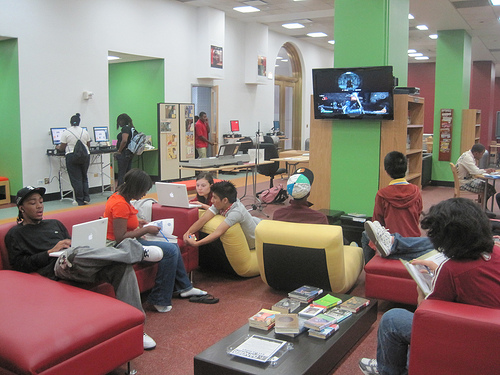
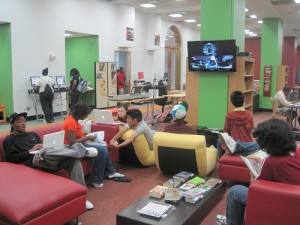
It’s part of a larger movement to rethink and re-imagine what a public library will look like and what functions it will serve. While many people do see libraries solely as book repositories, it’s clear that the library is much more than that. For many, it’s an important community center and a place that offers access to digital tools and media.
It takes people with big ideas — and smart ways to implement them — to make any progress. And that’s the point of the Big Ideas Fest, held December 4-7 in Half Moon Bay, Calif., a gathering of leaders and innovators who will share their thoughts and tactics with educators and all those interested in education innovation.
Lee LeFever, founder and principal of Common Craft. Have you seen Common Craft’s excellent explainer videos? Take a look at this one about augmented reality.
Gerald Richards, Chief Executive Officer of 826 National, the highly respected tutoring and publishing nonprofit that focuses on helping students with expository and creative writing.
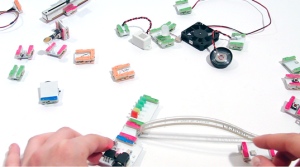
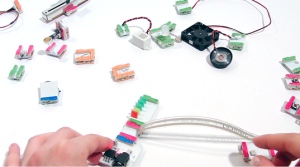
For those looking to tinker with electronics, add buzzers, lights or sensors to an object, or teach kids (or themselves) the basics of circuitry, programming, and micro-controllers, it’s not as hard as you might think.
There are a number of kits available that make such projects relatively easy and accessible. Arduino, for example, offers a fairly simple hardware and software platform for people to get started.
But even with the simplicity of Arduino, there’s still a rather huge barrier to entry when it comes to working with hardware and software at this level — particularly for those with no engineering
background. Despite the openness of platforms like Arduino, the idea of wiring, soldering, and programming can be overwhelming.
As the electronics we use in our daily lives get more complicated, this turning away — in frustration, ignorance, or fear — is increasingly troublesome. We rely more on the very devices that are becoming like “black boxes”: impenetrable. We don’t understand what goes on “under the hood” Continue reading Not Ready to Hack Into Your Smartphone? Start Here.→
Last week, as part of the Imagine Cup award ceremony, Hal Plotkin, the Senior Policy Advisor in the Office of the Under Secretary of Education, praised Microsoft for its commitment to STEM education with its hosting of the global student technology competition. Plotkin encouraged other companies to step up and invest in these sorts of endeavors. As the projects submitted to the Imagine Cup must tackle the UN’s Millennium Goals – poverty, hunger, disease, infant mortality, environmental destruction, and so on – it’s not just good for the U.S. education system, it’s good for the world.
Microsoft is not the only corporation involved in promoting STEM education. Earlier this year, MindShift profiled the Change the Equation non-profit, through which companies like ExxonMobil, Dell and Lockheed Martin have supported science and technology education. Intel says it’s spent over $1 billion on education projects. And just last week, Google announced the winners of its first online global science fair, just one of the many programs that the search engine giant has undertaken to help encourage budding scientists, engineers, and programmers.
Corporate sponsorship and funding is seen as necessary to help boost the programs that oftentimes schools can’t afford. That seems to be particularly true when it comes to student competitions and science fairs, as these sorts of “extracurricular” projects are often on the chopping block when schools look to streamline their budgets.
But what are the implications of having students engaged in corporate-sponsored science? In the case of both the Imagine Cup and the Google Science Fair, participating students were required to use Microsoft and Google products respectively in their projects. Of course, students don’t often have a choice when it comes to the technology they get to use in the classroom. If your school has Windows computers, you use Windows; if your school runs Macs, you use Macs. Continue reading What Role Do Corporations Play in Supporting STEM Education?→
Dale Dougherty, founder of Maker Media (which organizes the annual Maker Faire), O’Reilly Media (publisher of all those great “Missing Manuals”) heralds the virtues of the open web and the history of open-source information in this talk at Open Educational Resources 2011 talk last month.
“The most important educational resource is the student,” he says.
A reminder about this Saturday’s upcoming TEDxSFED event on April 9, when big thinkers and innovators will come together to re-imagine education both in and out of the classroom.
The theme is mashEDup and will highlight new and different approaches to learning.
DALE DOUGHERTY, founder of Make magazine and the creator of Maker Faire.
TONY DEROSE, Senior Scientist and lead of the Research Group at Pixar Animation Studios.
SANDY SPEICHER, IDEO’s Design for Learning domain, which brings human-centered thinking to systemic challenges in education (and author of the popular MindShift post “The School Day of the Future is DESIGNED).”
VICTOR DIAZ, Founder and President of the Board of REALM Charter Schools.
DAVID ORPHAL, history teacher for the past 15 years for 7th to 12th grade students.
ESTHER COOK, Chef Teacher in the Edible Schoolyard kitchen since its inception in 1997.
SUSAN STAUTER, the Artistic Director for the San Francisco Unified School District.
KAREN BROWN, creative director of the Center for Ecoliteracy.
BETSY CORCORAN, co-founder of EdSurge, an educational newsletter and former Executive Editor for technology coverage at Forbes magazine and Forbes.com.
GEORGE WATSKY, writer and performer from San Francisco now based in Los Angeles.
Register for the event and grab your tickets before they sell out!
I’m excited about the upcoming TEDxSF-ED event on April 9. That’s when big thinkers and innovators will come together to re-imagine education both in and out of the classroom.
The theme is mashEDup and will highlight new and different approaches to learning.
DALE DOUGHERTY, founder of Make magazine and the creator of Maker Faire.
TONY DEROSE, Senior Scientist and lead of the Research Group at Pixar Animation Studios.
SANDY SPEICHER, IDEO’s Design for Learning domain, which brings human-centered thinking to systemic challenges in education (and author of the popular MindShift post “The School Day of the Future is DESIGNED).”
VICTOR DIAZ, Founder and President of the Board of REALM Charter Schools.
DAVID ORPHAL, history teacher for the past 15 years for 7th to 12th grade students.
ESTHER COOK, Chef Teacher in the Edible Schoolyard kitchen since its inception in 1997.
SUSAN STAUTER, the Artistic Director for the San Francisco Unified School District.
KAREN BROWN, creative director of the Center for Ecoliteracy.
BETSY CORCORAN, co-founder of EdSurge, an educational newsletter and former Executive Editor for technology coverage at Forbes magazine and Forbes.com.
GEORGE WATSKY, writer and performer from San Francisco now based in Los Angeles.
Register for the event and grab your tickets before they sell out!
For Dale Dougherty, founder of Maker Faire — the personification of the do-it-yourself movement — the future school day combines learning with doing.
Dougherty has spent at least the last decade preaching the invaluable benefits of making things by hand. The reason is simple: you’ll learn more about it — whatever it is — if you make it yourself. Through the Maker Faire events, where thousands of people congregate to celebrate the DIY movement, Make Magazine and Craft website (full disclosure — I worked as the editor of the print version of Craft Magazine a few years ago), Dougherty is drawing out the natural tinkerers and makers in all of us.
His theory applied to education, whether it’s formal or informal, is premised on the same ethos.
“That confidence to learn anything is what education ought to be about,” he says.
So what’s the first step in creating the idea school day of the future?
A third national study found that hundreds of charter schools close the achievement gap but the sector doesn’t do a good job of educating children with disabilities.
After more than ten years of national education policies like No Child Left Behind and Race to the Top, the words accountability and assessment have become synonymous at many public schools with high-stakes testing. The two government programs have attached consequences and rewards to standardized test scores, leading many educators to believe they have to teach to the test. But, as the well-known argument goes, teaching prescribed math and reading content doesn’t help students build the skills like creativity, problem-solving and adaptability they need to adapt in the world outside of school.
The Smarter Balanced Consortium conducted a pilot of their test earlier this year to help participating schools get a sense of what the tests would be like, as well as to evaluate logistical challenges in administering the computer-based test. An Education Week article explains:
The biggest idea that the pilots underscored for many educators was that the key for getting ready for the tests is not just getting the technology ready, but also having students and teachers know the standards.
“I think we have to make sure we are teaching and assessing with intent on the common core,” Henson [a Michigan superintendent of instruction] says. “It is really skills-based. Reading, writing, and listening skills are a huge part of being able to take that test.”
The article indicates that teachers will still be teaching to the test — they’re just hoping the test will measure how a learner thinks, not just what they’ve memorized. That’s the big question, and early studies suggest they will.
One report [PDF] conducted by The National Center for Research on Evaluation, Standards & Student Testing, or CRESST, at the University of California, Los Angeles indicates that the new tests “are likely to represent important goals for deeper learning, particularly those related to mastering and being able to apply core academic content and cognitive strategies related to complex thinking, communication, and problem solving.”
But other education researchers wonder if high-stakes testing in any form can truly measure the skills that not only deepen learning, but turn a student into a life-long learner.
“People often try to figure out what makes a difference in education and they try to find different variables that might explain that difference,” said Brent Duckor, a professor at San Jose State University focusing on assessment. “It’s been harder for people to measure, and put the resources around measuring, the so-called soft skills — let’s call them resiliency, persistence, a sense of caring and engagement with school — and to use those in conjunction with the more typical academic achievement measures.” The benefits of the harder-to-quantify skills aren’t easily disentangled from academic achievement scores, making it hard to prove through tests that alternative teaching and learning styles can achieve measurable outcomes.
This tension arises clearly with one of the hottest topics in education right now – project-based learning. Many educators hope this method of teaching content through inquiry and exploration will implicitly deepen learning and shift it towards the goals outlined in Common Core.
“If we are going to measure something, it’s going to take time and it’s going to take resources and effort,” said Duckor. “And what we’ve seen is a lot less attention on measuring those skills in any rigorous or reliable way.” It would take much more time and money to really develop assessments that measure creativity or resilience, but states have neither the time, money nor political will to do so, Duckor said.
“To the extent that policymakers can go back to the drawing board and say, ‘How could Smarter Balanced find ways to investigate the validity and the reliability of teacher claims,’ we could say there would be an advance,” Duckor said. He’d like to see more alternative methods of assessment used.
School-based accountability, where student achievement and progression is determined by teachers, not a state test, is one such method that’s already been studied by researchers. New York City’s Central Park East Secondary School, a progressive poster child in the 1990s, provides an example of how school-based accountability works.
Central Park East developed systems to assess student work that meet the criteria for authentic assessment that well-known researchers like Stanford’s Linda Darling Hammond have determined to be successful. In a soon-to-be-published article, Duckor and co-author Daniel Perlstein argue that the school evaluated projects by asking students to demonstrate knowledge, understand various perspectives on it, connect it to other learning, make conclusions based on varying sets of conditions and be able to discuss its relevance. Most of these elements were included in subject-based portfolios that students created and had to defend in front of a committee that included teachers, students and outside adults.
But Central Park East’s modelcouldn’t hold up to the strong pressures for standardized testing. “The pressures to develop easily measured and easily routinized forms of assessment, and easily measured and easily routinized forms of teaching and learning, in turn, made the school increasingly less successful and less central to reform,” said Daniel Perlstein, professor of education history at the University of California, Berkeley. There has always been a reform movement pushing for more democratic and socially oriented education in the U.S., but historically those efforts haven’t faired well on tests.
“The American educational system was as successful in the absence of high-stakes standardized, centralized forms of assessments, as it is now, perhaps more successful,” said Perlstein. “There are various forms of accountability and the notion that we have to make accountability an easily measurable test item is one notion of accountability, but by no means the most useful for kids, for teachers or for the society as a whole.”
Perlstein points to other measures of a school’s success. Are parents satisfied with the education their children are receiving? Are students engaged and excited to come to school? Those are measures of accountability that don’t carry much weight when it comes to funding, teachers salaries or national rankings, but might be the most important for encouraging life-long learners.
Moving away from tests as the only means to measure knowledge, both at the school level and on state tests, frees teachers up to teach in more dynamic ways. “It’s a question of whose accountability and for whose good,” said Duckor. “And what infrastructure do we have to support communities that would like to have school-based accountability, but at this point are being measured by somebody else’s yardstick?”
For Perlstein, it comes down to the basic fact that teachers, students and schools have a deep capacity for engaging, thoughtful work, but aren’t often given the credit for their efforts. “In schools across the country teachers are trying to figure out how to do their job better,” said Perlstein. “The systems of accountability we have, rather than helping them do that, typically get in the way of that.”
As tech tools continue to proliferate with new launches and new products, it’s difficult to predict what will stick and what won’t. A recently released report by the New Media Consortium and EDUCAUSE Learning Initiative (ELI) tries to sift through the fads and find the few that will have a real impact on education in the next few years.
What’s worth noting? Sometimes what seemed impossible only a few years ago has already become a new trend. The 2013 NMC Horizon’s Report on Higher Education, which brings together international experts in education and technology, attempts to take the pulse of emerging technologies in higher education and predict where the field will move in the near, middle and far term.
The report points to MOOCs, Massive Open Online Courses, as the big change agent in the higher ed landscape, but it also reaches a little further, bringing 3D printing and wearable technology into the mix.
KEY FACTORS
The panel considered some key factors influencing whether technologies take hold, identifying a move towards “open” content and the ability to share, manipulate, and mold. Even more critical for institutions of higher education is the rise of MOOCs. As more elite institutions align themselves Continue reading Higher Ed Trends: MOOCs, Tablets, Gamification, and Wearable Tech→




 It takes people with big ideas — and smart ways to implement them — to make any progress. And that’s the point of the