You want to see the Pacific Ocean, the Golden Gate Bridge up close and personal, or thrilling views of the San Francisco skyline from the middle of the Bay? We have you covered:
The Beach
The fact that San Francisco sits on the edge of the ocean makes beach-going a natural, although sometimes chilly idea. The journey itself is simple, fun and adventurous. Depending on which beach you want to end up at, you can choose either the L or the N line of the Metro (Muni’s light rail) Both stop at the Embarcadero station (298 Market St., between Spear & Beale) and all the downtown stops. If you take the L, you end up on the south end of Ocean Beach, by the San Francisco Zoo, where the water is fairly wild and it’s mostly frequented by surfers. If you time it right, you can watch some amazing surfing. Get a hot chocolate at Java Beach at the Zoo, take off your shoes and walk down to the water. If the weather’s pleasant, it’s a 2-mile walk North to Judah St where you’ll hop on the N line for your return trip.
To make the journey to the northernmost slice of beach, where you’ll find landmarks like the Cliff House, the ruins of Sutro Baths, and a lovely hike along to Coastal Trail to rare East-facing views of the Golden Gate Bridge, you’ll need to catch the bus —- the 38-Geary leaves from the corner of Union Square (Geary & Powell) and takes a 45-minute journey to get to Lands End. The Lands End Lookout Visitor Center is just down from the corner of 48th Ave. on Point Lobos Avenue. Look for the parking lot on the right and the stunning view of the Pacific.
The Bridge
Crissy Field is a little bit like San Francisco’s front lawn — a great place to look out at the world, walk the dog, and play a little frisbee. Of course, that’s if your front lawn just happens to have a million-dollar panorama of the San Francisco Bay, the Golden Gate Bridge, and the Marin Headlands. Not bad. You’ll also find beaches, cafes with warm drinks, and a flat promenade through tidal wetlands. Bring a sweatshirt and a camera! One of the dozens of amazing local sites overseen by Golden Gate National Parks, Crissy Field (1199 East Beach) is definitely accessible by taxi or public transportation — check their website for a trip planner to help you get there from wherever your find yourself.
The Rock
Also under the auspices of the GGNP, Alcatraz is a traditional tourist spot, but well worth a visit for the views alone. You’ll reach the abandoned maximum-security Federal prison by ferry, since it sits on a rocky outcropping in the middle of the Bay (hence the nickname). The boats leave from Pier 33 (on the Embarcadero), from 8:45am to 3:50pm most days. Pro tips: You’ll need to reserve your tickets to avoid running into sold-out tours. Pier 33 is about a 25-minute walk from the Ferry Building, but here’s a spot you might want to catch a cab or rideshare, since you’ll need to save your legs for the actual island. Lastly, don’t pass up the cellhouse audio tour. It’s included in your ticket price and it’s excellent!
The hills of San Francisco are legendary and those who climb their peaks are rewarded with amazing vistas. That said, you can safely navigate most of downtown SF on foot without needing to bring any climbing gear, save a light jacket to keep off an evening chill. These sights and secrets should mostly be within an easy walk or a short ride.
Walking Tours
Fans of noir fiction and the famous mystery novels starring detective Sam Spade, will love the Dashiell Hammett Walking Tour, which is the longest running literary tour in the nation. It’s led by Don Herron, author of The Literary World of San Francisco and editor of selected letters of Philip K. Dick – a guy who clearly knows his stuff and has been praised not just for dressing in a snap-brim hat and trench coat, but for leading a tour that, according to The Wall Street Journal, “moved like a drunken cat through the streets and back alleys of the Tenderloin. It passed Southeast Asian diners, tawdry hotels, bars without windows, and places where a twenty will buy you more than the weekend’s groceries.” If you find yourself in town early, the tour will be offered on Sunday, May 11, starting at noon, leaving from NW corner outside the San Francisco Main Library (Fulton & Larkin).
Neighborhood to Know: Chinatown
Mutari, wikimedia
If you’d rather amble around under your own recognizance, consider a self-guided walking tour through San Francisco’s Chinatown. Start just north of Union Square at the Dragon Gate (Grant & Bush) and then venture down the bustling, shop-lined streets of the largest Chinese community outside of Asia. You’ll find everything from dim sum palaces to herbal apothecaries, scores of churches and temples, as well as a non-stop visual smorgasbord of architecture and antiquities.
If you still have some steam left once you’ve lost yourself in Chinatown, you can continue on to North Beach and another of San Francisco’s most treasured stomping grounds.
Bottoms Up
There’s no dearth of great hotel bars in downtown San Francisco: There are classics that actually tower over the rest, including Top of the Mark and the Starlight Room (not to mention the aptly named View Lounge at the Marriott Marquis), but here are are few that stand out no matter what floor you find them on.
Beautifully designed and decked out in wood panels and Art Deco details, The Redwood Room at the Clift Hotel (495 Geary) exudes class and a chic sense of humor. The real action is at the back of the lobby where the paintings slide and shift and a DJ keeps the night crowd lively with subdued house music. The bar itself, with its towering mirrored display, is breathtaking.
The Clift’s Redwood Room
Parallel 37 at The Ritz-Carlton (Stockton at California) might best be described as Mad Men set in the woods, with tables and counters fashioned from gorgeous slabs of trees surrounded by low-slung Danish modern furniture. For a more cosmopolitan setting, enjoy the handcrafted cocktails in The Lounge with the skyline for company.
The Clock Bar at the Westin St. Francis (335 Powell St., off Union Square) offers a lovely and easily accessible respite from the crowds in the Square -— as well as a great stiff drink. On your way to this cozy, comfortable spot, make sure to peek at the impressive Viennese grandfather clock that has served as a local meeting spot for over a century.
For those with a sense of humor and a yearning for balmier climes, the Tonga Room at the Fairmount Hotel (950 Mason) offers the full tiki bar experience -— really, who can resist drinks served in coconut shells with umbrellas?
Craft beer is hot right now, and we know where you can find some of the craftiest folks in the world offering to quench your thirst.
Mikkeller Bar SF (34 Mason) opened just under a year ago, but it’s already found a dedicated following. Its 42 taps are flowing with a selection of rare, delectable beers from notable local breweries and around the world.
SF’s Cable Cars
Ding ding! What a cliché! Ding ding! And priced to gouge out-of-towners ($6 for a one-way ride, except early in the morning and late at night). But you know, San Francisco’s hand-crafted, steel-wood-and-glass transit antiques really are unique. There’s nothing quite like hanging on to the side (or hanging out on the rear platform) as that little car crawls up or clatters down San Francisco’s steep, steep streets. From the Powell Street turntable (Powell at Market St.), you can ride from one pole of the city’s retail wonderland–the greater Union Square/San Francisco Centre/Bloomingdale’s sector—to the other—Fisherman’s Wharf and Pier 39 (via the Powell-Mason line) and Ghirardelli Square (via the Powell-Hyde line). If you want to delve into cable car lore, then you need to alight at Muni’s Cable Car Museum, at Washington and Mason streets (both Powell Street routes pass the museum.)
Here are a couple of tips: Take the short California Street line (starts at Market Street outside the Hyatt Regency, goes west up over Nob Hill, turns around at Van Ness Avenue). Or ride after 9 p.m., when the fare falls to $3 and the crowds thin out. The cars run until nearly 1 a.m. every night of the week.
Museums for Everyone
Exploratorium
The Bay Area offers myriad great museums and galleries, and you’ll find them in almost every part of town.
The San Francisco Museum of Modern Art is currently closed due to construction, although you can find events and exhibits from that institution scattered around the city as part of their SFMOMA On the Go initiative.
Another great downtown museum to explore is the Contemporary Jewish Museum (736 Mission St.), just steps away from the Marquis — the most current exhibition looks at Jewish contributions to Mid-Century Modern design. Browse the rotating exhibits, the permanent collection, and make sure to grab a smoked pastrami sandwich at the museum’s deli.
The world renown Exploratorium recently moved to a new, state-of-the-art building on Pier 15 (on the Embarcadero) and is definitely worth a visit for all ages.
Head on down to the edge of the Bay to find another kind of gallery, this one dedicated to sweet and savory treasures from the city’s finest culinary curators. The historic Ferry Building (Market & Embarcadero) hosts Farmer’s Markets on Tuesdays, Thursdays, and Saturdays, but their permanent marketplace boasts a delicious array of artisanal foodstuffs — from hand-roasted coffee to heirloom beans, local cheese to luscious pastries. Easily accessible via BART, Muni, or on foot, the Ferry Building is a stop no self-respecting foodie would want to miss.
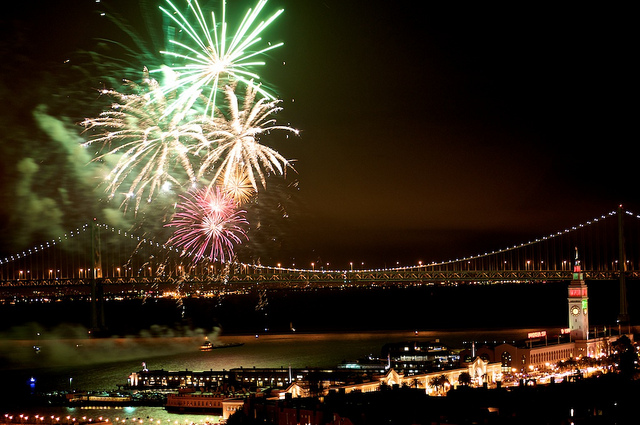
If you happen to be at the Ferry Building close to sundown, stick around and you’ll be treated to a spectacular view of the Bay Lights, a stunning installation of LEDs on the Western span of the Bay Bridge. The thousands of tiny white lights are computer-controlled and cycle through a hypnotic dance of ever-changing designs. Grab a bite at one of the waterside restaurants in the area and enjoy the show.
Giant Steps
Coasttocoast, wikimedia
Also in the shadow of the Bay Bridge, boasting its own array of tasty bites and dazzling lights, AT&T Park (King St., between 2nd & 3rd) is home to the two-time World Series Champion San Francisco Giants. If you are in the mood to take in some National League action with a heaping helping of garlic fries, you are in luck, as the Giants are in town all week, taking on the Atlanta Braves and the Miami Marlins. Check the website for the game schedule and information on ticket. Home games are always sold out, but good seats are usually available through the team’s own ticket resale system. You’re transportation options from Ferry Building include Muni, pedi-cab, or a leisurely stroll along the Embarcadero.
These destinations are over a mile from the Marriott. Some are still very walkable, but others are farther flung and that’s where BART, Muni, taxi or our local “transportation network companies:” Uber and Lyft are probably your best bet.
Telegraph Hill Tour
Perhaps best known for Coit Tower, Telegraph Hill boasts some of the best views of the Bay the city has to offer. Before you go, be sure to download KQED’s Let’s Get Lost smartphone app for interactive tours of the famous New-Deal-era murals at Coit Tower (1 Telegraph Hill Blvd), as well as others around the city. To enjoy the richness of the area, take a tour from SF City Guides and along the way you’ll see some of the neighborhood’s most attractive gardens, as well as cottages that date from the Gold Rush era. If you’re lucky, you’ll see the flock of wild parrots made famous in the Independent Lens documentary “The Wild Parrots of Telegraph Hill.”
Neighborhood to Know: North Beach
Even if you can’t make the scheduled walking tour, you can still enjoy the panoramas of Telegraph Hill and North Beach. Just to the north of the equally fascinating Chinatown neighborhood (see our “In Downtown” guide), you’ll find the historic domain of the Italian-American community. While the neighborhood is now as multi-ethnic as any you’ll find in SF, you’ll still find scores of bakeries, gelaterias, espresso stands, and decadent Italian restaurants. You’ll also find notable literary landmarks such as City Lights bookstore (261 Columbus) and streets named after significant members of the Beat Poets. You can learn more about the West Coast contributions to that movement at the Beat Museum (540 Broadway) or just chill out and watch the Tai Chi practitioners in Washington Square Park.
Castro Walking Tour
There’s a bit of construction happening along Castro Street, the historic heart of San Francisco’s pioneering gay community. Sidewalks are being widened. Rainbow-hued crosswalks are being painted. Still, don’t let a little dust deter you from visiting the cafes and shops that line this energy-filled neighborhood. It’s hard to imagine now, but the neighborhood called the Castro was once a subdued, working class community known as “Eureka Valley.” Take this tour with Foot! Comedy Walking Tours and laugh your socks off while you learn about the neighborhood’s history from the 19th century to the present. Stops include the Castro’s very first gay bar, the surprising controversies that flutter with the iconic massive rainbow flag, and of course the Castro Theatre, which first opened in 1922. As the company’s web site promises, “you’ll have a gay old time.” $30 per person.
Neighborhood to Know: The Mission
Wendy Goodfriend
Sitting right next to the Castro, you’ll find the super-hotMission district. Sunnier than most of the city, this moderately flat neighborhood sports parallel arteries — Valencia and Mission streets — the former packed with upscale restaurants and trendy shops, the latter is still holding on to its everyman roots, but just barely. You’ll find an ever-increasing number of adventurous new spots nestled among the dollar stores and taquerias. If you can’t get the best burrito or small-batch fresh-roasted coffee you’ve ever had, you’re just not trying. And beer is making a big splash at places like Monk’s Kettle (3141 16th St), Amnesia (853 Valencia St), Abbot’s Cellar (742 Valencia St), and outdoor favorite Zeitgeist (199 Valencia St). If craft cocktails are more your thing, you’ll want to search out Trick Dog (3010 20th St) on the emerging 20th Street gourmet corridor right around the corner from the KQED building.
Golden Gate Park
While it’s sometimes compared to another great ubran expense in New York City, Golden Gate Park is 20% bigger than Central Park. Who can argue with that? Okay, it’s not a contest — it’s a treasure trove of amazing natural sights and home to a host of great cultural institutions.
Here are a couple of highlights you might want to consider:
The San Francisco Botanical Garden
San Francisco Botanical Garden
Located in the heart of Golden Gate Park, the San Francisco Botanical Garden (1199 9th Ave) is planted with more than 8,000 plants from around the world, including those rare and endangered plants that are the objects of conservation. Check their website to see what’s in bloom, and don’t miss the “cloud forests” – gardens that have the same conditions as rainforests at high elevations in Mexico, the Andes, and Southeast Asia. There you’ll find some of the garden’s most treasured plants, like the golden fuchsia (Deppea splendens) from Mexico and a type of passion flower called Passiflora parritae native to Andean cloud forests. San Francisco Botanical Garden is one of the only outdoor gardens in the world that can grow these species, largely thanks to Bay Area fog mimicking high altitude cloud cover. Free admission.
The California Academy of Sciences
This recently renovated wonderland of inquiry houses “the oldest scientific institution in the western United States.” Visit the California Academy of Sciences (55 Music Concourse Dr) and you’ll find an undulating living roof, an all-digital planetarium, an aquarium, and a host of rotating exhibits. Check their website for specifics on exhibitions and special events, including an after-hours cocktail party offering Do-It-Yourself workshops with veterans of the Bay Area’s world-famous Maker Faire.
The de Young Museum
Also newly rebuilt, the de Young Museum (50 Hagiwara Tea Garden Dr) is an art-lovers paradise. The permanent collection includes American paintings and decorative art, African and Oceanic art, as well as textiles and photography. Current exhibits include Native American Art recently acquired from the Weisel family, photographs of the Bay Bridge during its original construction, and a show celebrating 50th anniversary of Walasse Ting’s “groundbreaking artist-illustrated book” 1¢ Life. Open Tuesday through Sunday from 9:30 am to 5:15 pm, museum admission costs $10. If you go, don’t miss the chance to ascend to the tower’s observation deck and take in its panoramic 360-degree views of the park (free).
One of the special things about the Bay Area is the amount of land set aside as public parks and open space. About a quarter of the total area of the nine-county Bay Area enjoys permanent protection from development. That’s more than a million acres of protected landscape, including seashore and parklands managed by the National Park Service, state parks and beaches, regional and county parks, state and federal wildlife refuges, watershed lands, city parks and privately managed trust lands. There’s even open space owned and managed by inner-city neighbors. That’s a lot of territory to explore and understand. Here’s a guide to the different kinds of public parks and open lands in the Bay Area, and some of the recreational opportunities available there.
Jump to these sections to learn more about different parks in the Bay Area:
National Park Service and other federal recreational properties
The lighthouse at Pt. Reyes is a popular destination. Photo: brewbooks/Flickr
Point Reyes National Seashore: Situated on the Point Reyes Peninsula in Marin County, between the ocean and Tomales Bay, the Point Reyes National Seashore is the only national seashore in the Bay Area. Since there were already a number of homes and ranches at the time of its creation, most still operate within the seashore today through leases with the National Park Service. Hiking and recreation is encouraged at the seashore. Bikes and horses are permitted on designated trails, as are leashed animals. Camping is only allowed, via permit and reservation, at designated campsites – some of which, on Tomales Bay beaches, must be reached by boat. Non-motorized boating, such as kayaking, is allowed throughout the seashore, as well as swimming (though, with the cold waters, not many people try). The Point Reyes Lighthouse – one of the country’s oldest lighthouses and one of the windiest, foggiest spot on the West Coast – is a popular destination and can be reached via a long set of stairs.
Lake Berryessa in Napa. Photo: Matthew Fern/Flickr
Lake Berryessa: The lake covers about 25 square miles in eastern Napa County and includes recreation facilities administered by the U.S. Bureau of Reclamation with assistance from the California Department of Fish and Wildlife. The bureau contracts with seven concessionaires to provide services. Those contracts began expiring several years ago, leading the bureau to re-evaluate its visitor services plan. Improvements to the visitors center are underway and changes to the overnight lodging, marinas and RV sites are being considered.
Lake Sonoma was created by the US Army Corps of Engineers. Photo: Rana Kim/Flickr
Lake Sonoma: The 4-square-mile lake was created in 1983 when the U.S. Army Corps of Engineers built the Warm Springs Dam on Dry Creek, west of Healdsburg in northern Sonoma County. The Corps jointly manages the lake and surrounding recreational lands with the state Department of Fish and Wildlife. Visitors can enjoy boating, camping, hiking, swimming and fishing. A hatchery and visitors center at the dam offer tours during steelhead spawning season.
State parks and other state-managed or -owned recreational properties
China Camp State Park is on land that used to be a Chinese fishing village. Photo: Bill Couch/Flickr
China Camp State Park: On San Pedro Bay, in Marin County, China Camp was slated for closure because of state budget cuts. The park is now operated for California Department of Parks and Recreation by the Friends of China Camp, a committee of the Marin State Parks Association. Fees are now charged for day use and trail use, as well as parking, camping and events, like weddings or picnics. In the 1880s, the site was home to a Chinese fishing village, some of which still stands as a museum and historical site near the beach entrance. The rest of the park is a popular hiking, mountain biking and camping destination
Robert Crown Beach in Alameda is popular for swimming, sand castles and kite-boarding. Photo: Deborah Svoboda/KQED
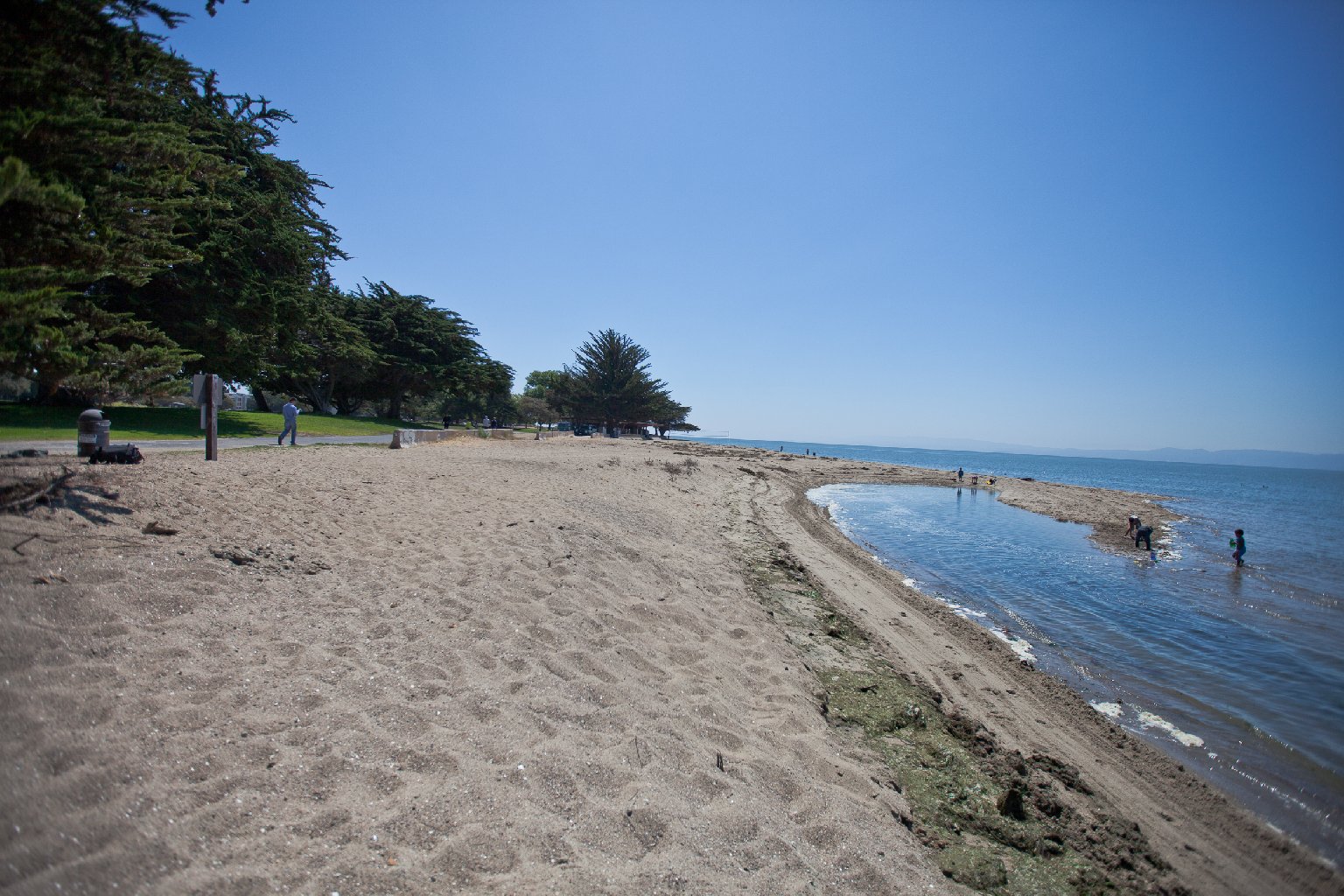
Robert W. Crown Memorial State Beach: Operated in part by the East Bay Regional Park District under an agreement with the state and the city of Alameda, Crown Beach was known as Alameda Beach before it was renamed for State Assemblyman Robert Crown. In later years, though, the beach actually became highly eroded and had to be restored in 1982 by pumping in sand from the bay (a process park managers are getting ready to repeat in the fall of 2013). Today it features dunes and a bicycle trail and is considered one of the few places in the Bay Area where it’s actually more or less comfortable to swim. It is bordered on one side by a bird sanctuary and on the other by the Crab Cove Visitor’s Center. The annual sand castle contest is also a highlight.
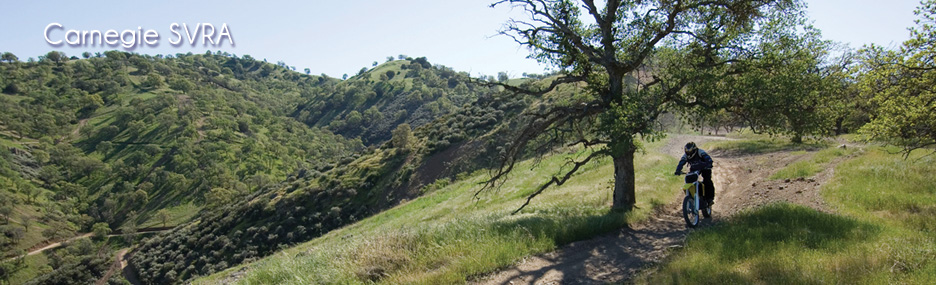
Carnegie State Vehicular Recreation Area: In the hills of eastern Alameda and western San Joaquin counties, Carnegie is the only state vehicular recreation area in the nine-county Bay Area. The 1,300-acre park features a motocross track, an ATV/motorcycle track, a kids’ track and a beginner track. Officials with the state parks’ Off-Highway Motor Vehicle Recreation Division want to expand the park, a plan that has run into resistance from conservationists who say the area deserves protection from off-road vehicles
Carnegie State Vehicular Recreation Area is the only park for off-road vehicles in the Bay Area. Photo: California Department of Parks and Recreation, Off-Highway Motor Vehicle Recreation Division
Lake Del Valle is a hybrid property, run by a number of agencies. Photo: Dmitry Sumin/Flickr
Lake Del Valle State Recreation Area/Del Valle Regional Park: Lake Del Valle, in eastern Alameda County south of Livermore, is a hybrid property. The lake was created as part of the State Water Project (state Department of Water Resources), is counted a state recreation area (Department of Parks and Recreation), and is managed as part of the East Bay Regional Park District. Del Valle is a popular destination for camping, swimming, fishing, hiking and cycling.
Suisun Marsh is one of the largest marshes in the state. Photo: Mary Mactavish/Flickr
Suisun Marsh/Grizzly Island Wildlife Area: Here’s what the state Department of Water Resources says about Suisun Marsh, south of the Solano County city of Fairfield: “… The largest contiguous brackish water marsh remaining on the west coast of North America… Suisun Marsh includes 52,000 acres of managed wetlands, 27,700 acres of upland grasses, 6,300 acres of tidal wetlands, and 30,000 acres of bays and sloughs. It is home to public waterfowl hunting areas and 158 private duck clubs. The marsh encompasses more than 10 percent of California’s remaining natural wetlands and serves as the resting and feeding ground for thousands of waterfowl migrating on the Pacific Flyway.” DWR manages the marsh jointly with the U.S. Bureau of Reclamation, the state Department of Fish and Wildlife, and the Suisun Resource Conservation District. DFW runs several wildlife areas that provide public access to the marsh, the biggest of which is the Grizzly Island Wildlife area. It’s an amazing land- and waterscape and popular with hunters who are permitted to take (in season) everything from rabbits to waterfowl to tule elk.
Redwood Regional Park: Redwood Regional Park, which runs along the rugged crest of the Oakland Hills, is part of the sprawling East Bay Regional Park District, which includes 65 parks on 113,000 acres in Alameda and Contra Costa counties. Redwood is a major destination for hikers, trail runners, mountain bikers and dog walkers. The park includes an attraction for trout lovers: a beautifully crafted fish ladder used (we’ve heard) by spawning rainbow trout.
Redwood Regional Park is part of the sprawling East Bay Park District. Photo: Miguel Vieira/Flickr
Joseph D. Grant County Park: Covering nearly 10,000 acres on the flanks of Mount Hamilton, the park is the largest in the Santa Clara County Parks system. The park is a draw for equestrian sports and for the usual palette of outdoor activities, including hiking and mountain biking.
The Conservatory of Flowers is one of many attractions in Golden Gate Park. Photo: Kwong Yee Cheng/Flickr
Golden Gate Park, San Francisco: A 1,000-acre swath of former sand dunes running from the center of San Francisco to the beach, this is one of the most famous parks in the world and arguably the city’s greatest asset. Home to two of the West Coast’s greatest museums, the California Academy of Sciences and the de Young (fine arts), it’s also got the wonderful Conservatory of Flowers, playing fields, a bison paddock, the Japanese Tea Garden, playing fields, picnic grounds, lakes, and ample room for walking, running, cycling and roaming of all kinds.
Foothills Park, Palo Alto: Palo Alto has an extensive network of open spaces, including the 1,400-acre Foothills Park. The park features miles of hiking trails, great vistas of the Bay Area, and a host of wildlife-spotting opportunities.
The San Leandro Reservoir has plenty of trails and plant life for visitors. Photo: SFBayWalk/Flickr
East Bay Municipal Utilities District/Lafayette and San Pablo reservoirs: EBMUD, which provides water to most residents of Alameda and Contra Costa counties, owns 27,000 acres of watershed lands in the East Bay. The district manages two popular recreational destinations there, the Lafayette and San Pablo reservoirs, along with 80 miles of trails for hiking and horseback-riding in adjacent open space.
Marin Municipal Water District: The district owns about 21,000 acres of watershed lands. Mount Tamalpais Watershed is part of a huge complex of protected land that includes Mount Tamalpais State Park and the Golden Gate National Recreation area and offers great hiking and fishing.
The Starr King Open Space is owned by the neighborhood in Potrero Hill. Photo: Deborah Svoboda/KQED
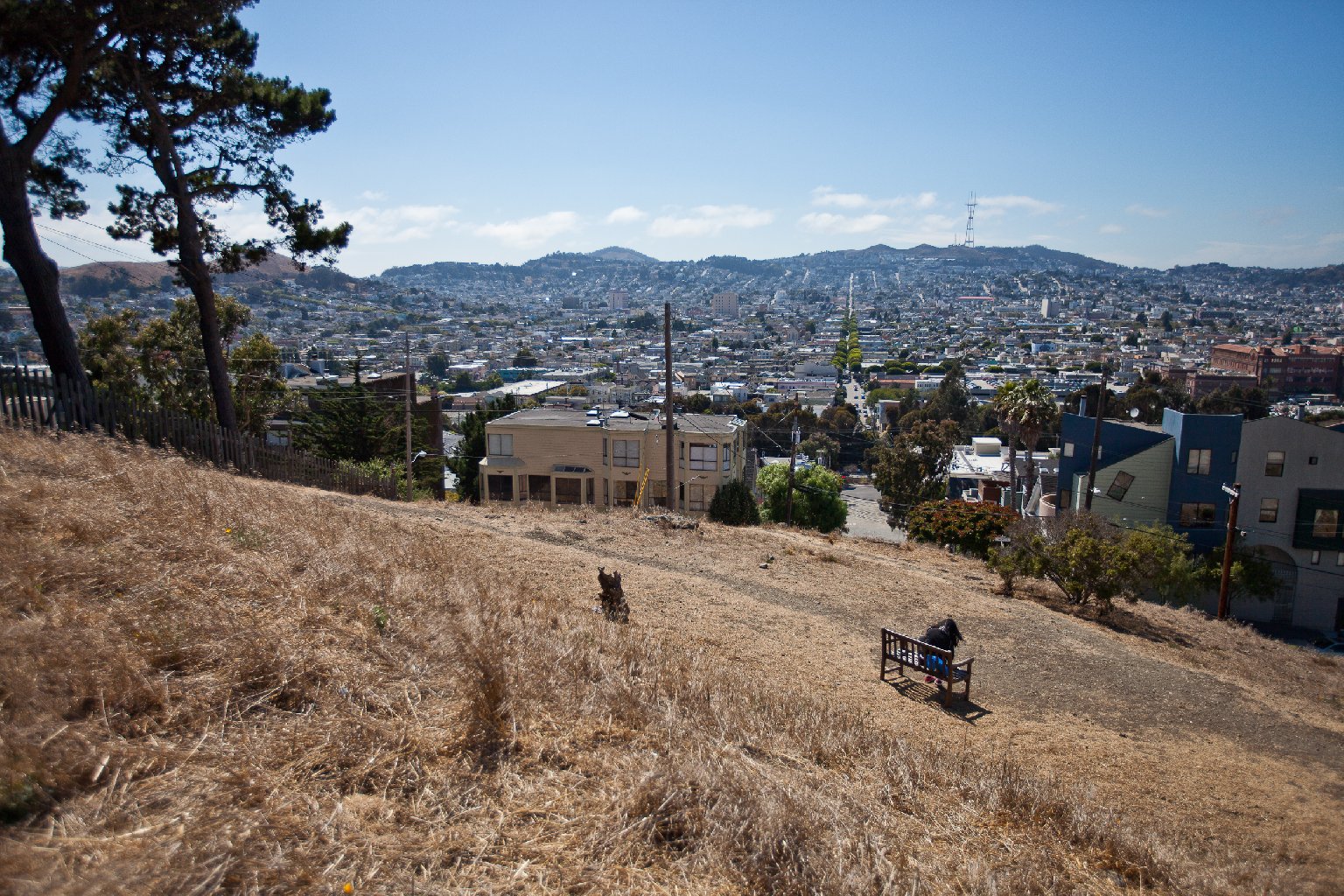
Starr King Open Space, San Francisco: Perched on the south side of Potrero Hill, this 3.5-acre property runs from 23rd and Carolina streets to 24th and De Haro streets. It was saved from development and deeded to a neighborhood group in 1984. Through the work of volunteers has been reclaimed as a serpentine natural grassland. The group that oversees the property is careful to note it’s not a park: “An open space is an environmentally protected area which people may enjoy but which may not be developed with the usual park amenities.”
Rush Ranch Open Space, Solano County: Run by the Solano Land Trust, the Rush Ranch Open Space is a 2,000-acre operating cattle ranch on the edge of the Suisun Marsh. The marsh provides a unique spot for wildlife viewing and bird-watching, but the majority of Rush Ranch’s offerings are educational. The Rush Ranch Educational Council is a 501(c)3 that does things like provide free programs to elementary students. A visitors’ center and historical blacksmith shop provide exhibits and docent-led tours.
Valentine’s Day is upon us. Images of hearts and cupids are everywhere. What’s on your agenda for this special day? If you’re still open to ideas, we’ve got some for you.
INSPIRING GIFTS
What’s on the menu for Valentine’s Day? This year, it’s all about salt, sugar, bacon and beer. And chocolate, of course, in every way from molten to heart-shaped. Here’s a pick from our list of delectable local treats.
DELECTABLE RECIPES
A box of chocolates and flowers might earn you some points, but you’ll definitely score by making something homemade. And you don’t even have to create something overly complicated. It’s the thought that counts. So here is a heartfelt and handmade recipe for Gooey Baked S’mores. Plop a heart-shaped marshmallow on top of some chocolate and a graham cracker, light it on fire and you are set! It is that easy. And that tasty!
ACTIVITIES FOR SINGLES
So you don’t have a boo. No biggie. Sure, it’s fun to hold hands and have someone buy you an eclair for no reason and all that jazz. Loving someone else is super. But there’s another form of love that predates loving someone else: the love you have for yourself a.k.a. The Greatest Love of All! Here are a few ideas of ways to spend your Valentine’s Day. Read it here on KQED Pop.
RULES FOR ONLINE ROMANCE
Conversation hearts and chocolate samplers fill the grocery aisles, your inbox is filled with coupon deals for roses and romantic dates, and your grandmother has yet again asked if you have a “special friend.” Dan Slater, author of Love in the Time of Algorithmsvisited KQED’s Forum recently. Here’s some advice on how to make sense of the online dating scene.
A good hotel bar is a happy place, an elegant but relaxed haven where gussied up guests—locals and tourists alike—mix in right alongside post-work corporate casual and fresh-off-the-ferry explorers still in their sneaks and Alcatraz sweatshirts. The very atmosphere casts a more glamorous sheen over everyone. By the varied nature of their clientele, a constant stream of strangers, hotel bars carry just a hint of chance and mystery, and a sense that anything could happen.
Here’s a roundup of our favorites.
SAN FRANCISCO
There’s no dearth of hotel bars in downtown San Francisco: the classics (e.g. Top of the Mark and the Starlight Room) to the modern lounges conveniently clustered on Geary Boulevard around Taylor Street (Hotel Monaco, Hotel Adagio, and so on). But apart from the tired, contrived, and sometimes creepy ones, these classics rise above the rest.
The Redwood Room at the Clift Hotel is a delight of “lodge deco”—as if Nick and Nora Charles shined up the Ahwahnee Hotel. Beautifully designed and decked out in wood panels and Art Deco details, this place exudes class and a chic sense of humor. The real action is at the back of the lobby—the Redwood Room—where the paintings slide and shift and a DJ keeps the night crowd lively with subdued house music. The bar itself, with its towering mirrored display, is breathtaking. For a quieter experience (i.e. where visitors can have an intimate conversation), check out The Living Room directly across from registration. Same booze, but with lush sofas and deep sinking club chairs.
This lush bar might best be described as Mad Men set in the woods, with tables and counters fashioned from gorgeous slabs of trees surrounded by low-slung Danish modern furniture. For a more cosmopolitan setting, enjoy the handcrafted cocktails in The Lounge with the skyline for company.
After a whirlwind shopping tour in Union Square, the Clock Bar at the St. Francis offers a lovely and easily accessible respite from the crowds—as well as a great stiff drink. It’s small, but comfortable and worth a stop for the tired and chilled.
(In a case of an exception proving the rule, honorable mention does go to the Tonga Room, which, for those with a sense of humor and a yearning for balmier climes, offers that unique tiki bar experience—really, who can resist drinks served in coconut shells with umbrellas?)
Located in the posh Claremont Hotel, this bar is spare and modern without being cold. Paragon offers stunning views of the sunset and the San Francisco skyline, especially pretty when it’s lit up at twilight. Take advantage of East Bay weather and enjoy cocktails on the deck. Live jazz Fridays and Saturdays.
Five is actually a restaurant in the Hotel Shattuck with a sweet bar and lounge that’s very easily accessible by BART (downtown Berkeley station). Make sure to catch the “after hour happy hour” offered everyday from 7-9pm.
Since the 1930s, the Hotel De Anza has presided over downtown San Jose’s sparkling social scene. The beauty of the hotel is amplified by its storied past (one of San Jose’s few Zig Zag Moderne buildings). Inside, visitors can relax in the Hedley Club Lounge amidst art deco elegance. Settle back in a plush armchair or enjoy a table on the patio and, with Al Green softly crooning, you can actually enjoy a conversation. Live jazz Thursday-Saturday evenings.
Located off Cesar Chavez park, the Fairmont boasts not one but three hotel bar options: the Pagoda, the Bamboo Lounge, and The Grill. Skip the first two and go straight to The Grill, which has an elegant Rat Pack feel with deep leather booths and a build-your-own martini menu. It also has a patio and great people watching.
The Pelican Inn transports you to another time and place: an English inn and pub tucked onto the rocky ledge of the Marin Headlands. Dark and cozy, it’s the perfect foil for coastal fog. Hike from Tennessee Valley and enjoy a pint by the fire as a reward. Enjoy a meal at the restaurant or take advantage of the pub’s bar menu and warm up with some English comfort food. On nice days, take your lunch on the patio, then stroll down to Muir Beach. (Nice to note that the Pelican takes advantage of its proximity to organic coastal farms and ranches, serving local meats and seasonal vegetables from the Zen Center’s Green Gulch Farm next door.)
Tucked under the Golden Gate Bridge, Farely Bar at Cavallo Point offers stunning views of San Francisco, the Bay and the Golden Gate Bridge—day or night. The bar has a distinct Northern California charm with a beautiful antique tin ceiling, leather club chairs and fireplaces. Enjoy drinks inside or out (they even provide blankets on the outdoor patio to keep stargazers warm in the evening). Music Monday nights.
San Francisco 49ers fans celebrate a touchdown in September in New York. (Elsa/Getty Images)
It’s a tough time of year for the non-football fan in San Francisco.
Everywhere you go, it seems like people are talking about the 49ers and the Super Bowl. Your friends might be having a conversation about Colin Kaepernick and the “#QuestforSix,” and all you can do is smile and nod along. You’re thinking, Kaper-who? Quest for what? Which Coach Harbaugh? – but you don’t want to seem out of the loop. You’re worried your fan friends might laugh.
For Bay Area residents who want to get in on the Super Bowl fun, but don’t bleed 49ers red-and-gold, here’s some basic information that can help you get through the weekend, and might even help you enjoy the game.
Q: Are the 49ers usually good?
A: The 49ers are one of the most successful franchises in NFL history, having won five Super Bowl championships since 1981 (the team is hyping this year’s Super Bowl run as the “#QuestforSix.”) It’s the only team to have played in more than one Super Bowl without losing. The team’s roster in the past three decades has included some of the game’s greatest players, including wide receiver Jerry Rice (who holds the league’s career record for touchdowns scored), quarterbacks Joe Montana and Steve Young, running back Roger Craig, and defensive back Ronnie Lott (Rice, Montana, Young and Lott are all in the Pro Football Hall of Fame). The 49ers won four Super Bowls in the 1980s, including three under Coach Bill Walsh. The team last won the Super Bowl in 1995 and went into a long decline in the late 1990s, failing to make the playoffs for a decade after the 2001-02 season. The team returned to playoffs last year, its first season under Coach Jim Harbaugh, going 13-3 and reaching the NFC Championship game for the first time since 1997. The 49ers ended this regular season with an 11-4-1 record.
Q: Are there any players on the team from the Bay Area?
Larry Grant in 2011 (Ezra Shaw/Getty Images)
A: Linebacker Larry Grant (No. 54) and receiver and kick returner Kyle Williams (No. 10) are the only 49ers who are Bay Area natives. Grant, who plays mostly on special teams, was born in Santa Rosa and attended Foothills High School in Sacramento as well as City College of San Francisco. Williams, who will miss the Super Bowl because of a knee injury, was born in San Jose but grew up in Arizona, where he was a high school sports star. A few more players were born or attended high school in other parts of California. Safety Dashon Goldson (No. 38) was born in Carson and attended Narbonne High School in Harbor City; linebacker Clark Haggans (No. 51) was born in Torrance and went to Peninsula High School there; tight end Delanie Walker (No. 46) was born in Pomona and went to Pomona High School; guard Mike Iupati (No. 77) went to Western High School in Anaheim; and backup quarterback Alex Smith (No. 11) went to Helix High School in La Mesa. But arguably the most notable 49er with California roots is starting quarterback Colin Kaepernick, No. 7. Kaepernick was born in Wisconsin but moved with his adoptive parents to Turlock, south of Modesto, when he was 4. As a fourth-grader at Turlock’s Dutcher Elementary School, Kaepernick wrote a letter saying he hoped he would grow up to play for the 49ers or the Green Bay Packers.
Q: Tell me about the Harbaugh family.
A: 49ers Coach Jim Harbaugh and Ravens Coach John Harbaugh have one sister, Joani. She’s married to Tom Crean, the head basketball coach at Indiana University. Jim, John and Joani’s father, Jack Harbaugh, is a former college football coach. Their mother’s name is Jackie.
So, to summarize, Jack and Jackie Harbaugh have three children: Jim, John and Joani.
Q: Do the 49ers have a mascot or something I can dress up as?
A: Meet 49ers mascot Sourdough Sam.
Sourdough Sam (Amy Meredith/Flickr)
If you really want to go that route, you can always try and find a vintage Yosemite Sam costume. But generally, fans of pro sports teams don’t dress up as mascots. Maybe just show your spirit by buying a team T-shirt; they’re relatively cheap and plentiful. A jersey with a player’s name on the back can cost $100 or more. If you really want to go all out, consider dyeing your hair and getting decked out in face paint and team swag.
49ers fans during the NFC Divisional Playoff Game against the Green Bay Packers in San Francisco. (Harry How/Getty Images)
Q: What’s the deal with the point system?
A: It’s complicated. A team can get points a few different ways, including:
Scoring a touchdown, which is worth 6 points.
Kicking the extra point, which is worth 1 point. After a touchdown, the offensive team is given one additional play to score extra points. If they use that play to kick the ball through the uprights, they get one point, called the extra point.
Kicking a field goal, which is worth 3 points. A field goal occurs when the placekicker for the offensive team boots the ball through the uprights. (A note for the football fans reading this: we realize this is a very basic explanation of scoring. If we get into two-point conversions and safeties, and the differences between field goals, kickoffs and punts, we’ll just create confusion that will distract from the purpose of this post.)
The history of kicking and scoring in football can be traced to its roots in rugby and soccer. Many of the rules for American football were derived from rugby rules.
Q: How long does the game actually last?
A: A football game is divided into four 15-minute quarters. However, the running clock often stops for incomplete passes, injuries, timeouts and television commercials, as well as after a team scores and when players travel out of bounds at the end of a play. There also are breaks between quarters and at halftime. As a result, the average game lasts about three hours from kickoff to the final whistle.
It’s always tough to decide what to do on the final night of the year. Below, we’ve made it easier for you to make a choice.
1. Half Moon Bay Brewing Co. Early Bird New Year’s Eve Party
One of the benefits of living on the West Coast is that you can watch the ball drop on the East Coast before reasonable bedtime. Bring the whole family to the Early Bird Party at Half Moon Bay Brewing Co. and eat, listen to music and New Years it up, all before 9pm.
2. The Fresh & Onlys at The Chapel in San Francisco
If you want to see some great music and enjoy a little of the craziness that is New Year’s Eve in the Mission, this show might be just the ticket. The Chapel is the new venue on Valencia Street that everyone has been talking about since September and this show is full of the perfect awesome rock and roll to help you ring in 2013.
3. Erykah Badu at the Fox Theater in Oakland
Maybe you want your New Year’s Eve show a little more dramatic? There is no way Erykah Badu at the Fox won’t be amazing. Besides the fact that the Fox is one of the most beautiful venues in the Bay, Erykah Badu has literally never disappointed anyone?
4. New Year’s Eve at Laughing Lotus in San Francisco
For some people, New Year’s Eve is a panic-inducing event that will never live up to expectations and generally ends in some sort of humiliation. Want to avoid over-drinking to cover up your anxiety and then watching someone else kiss your ex-boyfriend at midnight? How about yoga, chanting, music and dancing at Laughing Lotus? Get some exercise, get some perspective, get some community and wake up in the morning with a good attitude.
5. Noon Year’s Eve at the Bay Discovery Museum in Sausalito
If you want to make sure your kids get a good dose of New Year’s Eve countdown-ing but don’t want that to get in the way of your more adult nighttime plans, take them to Noon Year’s Eve and let them countdown to noon instead! There’s even a special noontime ball drop.
6. Hot Buttered Rum and Family
What would Bay Area New Year’s Eve be without some bluegrass? Everyone’s favorite, Hot Buttered Rum will keep you dancing all the way into 2013.
7. Winter Wonderland in Downtown San Jose
Here’s a way to make New Year’s Eve live up to expectations: carnival rides and ice skating! Bring the whole family to downtown San Jose for an active and exciting and affordable kid-friendly New Years Eve.
Do you aspire to celebrate the holidays without contributing to consumerism culture, without polluting the Earth, without buying more stuff? Of course you do, you Prius-driving fan of public media. Not sure how? Here’s a step-by-step guide and some motivating facts pulled from Forum’s recent show on the topic.
SET EXPECTATIONS EARLY.
Christmas morning is not the time to tell people that you do not want nor will you give a traditional gift. Katy Wolk-Stanley, who writes the blog The Non Consumer Advocate, suggests to tell people early on what to expect.
“The time to have those conversations about how you want to do gift exchanges is now, because a lot of people have already purchased their gifts.”
The idea here is to be pre-emptive but not preachy. Communicate what you hope for without judging or putting down the other person’s lifestyle — or a gift they may have already bought you.
“I let people know ahead of time that I would love to have, perhaps a contribution to an organization that I appreciate, or a gift certificate for a restaurant,” said Beth Terry, author of My Plastic-free Life. “And if they give me a thing that I don’t want, I’m very gracious about it.”
THINK VINTAGE.
Consider this permission to regift — thoughtfully. This isn’t simply about passing along unwanted knick-knacks or boxed chocolates. This is about giving an object that you possess and enjoy to someone else who might also appreciate it.
“This could be a family object, not necessarily a Faberge egg of heirloom quality, but an aunt’s special brooch or a picture you’ve enjoyed at somebody else’s house,” said Wolk-Stanley. “Or even a book that you’ve read and you think, ‘I bet so-and-so would really like this book also.'”
Adds Terry: “I think there is definitely a stigma sometimes about second-hand things, but we can reframe that. We can use words like ‘vintage,’ or ‘antique.’ One of my friends bought another friend a beautiful vintage Kitchen Aid blender from eBay. It was old, it was second hand, but it was in great shape.”
CHANNEL YOUR CREATIVITY.
Wolk-Stanley says it helps to view changing your gift-giving traditions as “a creative challenge rather than a limitation.” Finding a non-object (or a slightly-used object) to express your affection for someone is tough. But also fun. It allows you to consider what’s meaningful in your relationship with the recipient and what brings him or her joy.
[module align=”right” width=”half” type=”aside”]
Why We Should Be Less Wasteful
There are 62 Legos for every single man, woman, and child on the planet.
The average American uses as many resources as 32 Kenyans.
One million additional tons of trash is produced each week between Thanksgiving and Christmas.
There’s been a 1,000 percent growth in the use of self storage by Americans in the last 30 years.
– Adam Werbach, co-founder of the sharing service Yerdle
[/module]
“When thinking about gifts for people, think about what they would really love and appreciate and not just what’s being thrown at you by the media and by the advertisers,” Terry said.
And remember: a one-size fits all approach to giving is wasteful, no matter how well-intentioned. “A stainless steel water bottle sitting in a closet is not a green gift if the person isn’t going to use it,” said Terry.
GET OVER THE IDEA THAT GIFTS ARE FOREVER.
Most things in life are not forever. And that’s okay. Gifts should be no different.
“When I give a gift to someone, I’m not thinking, ‘I’m giving you this and you have to keep it forever,'” said Wolk-Stanley.
You have to disconnect from the object that you give — it’s not the end of the world for a present to be regifted or donated. Wolk-Stanley says if she gives a present and it doesn’t find a home in the person’s life, “[I’m] totally happy for them to move it along.”
Along those same lines, a gift doesn’t need to be a physical object that someone can hold or place on a shelf.
“You can have conversations with people, saying, ‘You know, I’m at a point in my life where I have the things that I need,'” said Wolk-Stanley. “‘I really appreciate the thought, but how about instead of doing a gift exchange between the two of us, let’s instead spend that money and go out to lunch.'”
And most experiences don’t require packaging, shipping, or a trip to the mall.
ACCEPT THAT GIFT GRUBBERS EXIST.
Let’s face it — someone who begins emailing you gift ideas in October is probably not going to be happy with a used book. You have two choices. You can choose a gift-alternative for all the other people on your list and simply buy the gift grubber what he or she wants. Or you can grow some thick skin, tell your family and friends about your new approach to the season, and proceed as planned. If someone is offended?
“That’s on that person,” said Wolk-Stanley. “That has nothing to do with you. Let it go.”
The holidays are the perfect time to merrily combine two of your favorite things: art and shopping. We know you love supporting artists and independent retailers, so we contacted local shop curators for creative holiday gift ideas: one from their own establishment and one from another neighborhood shop. Here are their picks.
Lauren Smith and Derek Fagerstrom from the Curiosity Shoppe made selections for the holiday traveler who needs a little reminder of home. Their SF Zipper pouches are “perfect for all the little things in your life—great for pocket electronics, art supplies, toiletries, etc.”
Jamie Alexander from Park Life has another idea for outdoorsy types, a handmade wooden flashlight by Gad Scot Tal that was created to benefit the Headlands Center for the Arts. It’s charming and “built of reclaimed wood from local dismantled dwellings.”
From his own shop, Jamie suggests a canvas tote by Farm Tactics, which is made from recycled climbing nylon and is available in several colorways. For your fashion-conscious (or hoarding) friends, a bag is always the right answer when it comes to gift giving.
We contacted the good folks at The Thing Quarterly because a subscription to the “object-based publication” is high on our list for art lovers. Four unique art editions created by blue chip artists are delivered throughout the year, and nothing sounds more delightful than free, surprise art. The Thing’s Holiday Special subscription includes a bonus: their best selling edition, a Dave Eggers shower curtain, “or any amazing back issue of your choice.” It will arrive at your art lover’s door in time for the holidays, dressed up in Macfadden & Thorpe-designed wrapping paper.
Jonn Herschend and Sarah Simon from The Thing also recommend stoneware mugs by Albion, Calif. artist Cliff Glover, available at Gravel & Gold, which sounds like a good gift for your boss. It will hold her coffee each morning, reminding her to give you a raise next year.
Andrew Martin Scott, proprietor of local zine shop, Needles & Pens, recommends a recent publication called PUBLIC NOTICE by Nathaniel Russell. He says, “It’s hilarious, and everyone who picks it up laughs out loud.” It’s filled with fictional flyers that “run the gamut from Found Dog and Idea Party…all the way to an ad for Grampa’s Waterfall Skate Jam.”
He also recommends Curator’s 2013 songwriter calendar “because everyone loves Stevie Nicks, right?” You’ll also find portraits of Nina Simone, Bob Dylan, David Bowie, and Johnnie Cash.
Julie Cloutier from General Store has ideas for the chef and the jewelry junky in your life. For the kitchen, Luke Bartels’ handcrafted, “elegantly shaped wood cutting boards,” would make a gorgeous addition to any countertop. Plus, double as a classy surface on which to serve cheese, or perhaps some bootleg foie gras.
Available in different sizes in silver or gold, Julie also suggests the Pt. Reyes Hoops from Gravel & Gold, because everyone knows that the fastest way to a woman’s heart is through her pierced earlobes.
Jamie Kidson and Adrienne Armstrong of Oakland’s Atomic Garden have chef suggestions that pair nicely with The General Store’s cutting boards—a nice bottle of Katz and Company’s Organic Artisan Olive Oil from Market Hall in Rockridge.
Atomic Garden’s Teak Pie Server comes sweetly wrapped with a 100% linen dish cloth and is one of many lovely kitchen and home items available at this Rockridge shop.
For the San Francisco expat (who mostly likely moved to New York or LA), Giselle Gyalzen of Rare Device suggests a print of Jennifer Maravillas’ San Francisco Map, a colorful addition to any ex-local’s (or local’s) art collection.
Giselle also suggests the Anchor Denim Duffle Bag from San Franpsycho, a shop that showcases local artists’ work through hand-screened items from clothes to dog wear. The cool anchor makes this bag perfect for hard-to-please teenagers.
Now that you’ve checked the chefs, bosses, nature and art lovers, travelers, jewelry junkies, expats, and moody teenagers off your list, it’s time to treat yourself. You need a new bag to cart around all those gifts, don’t you? Happy holiday shopping to all, and to all a good bag.