
Tag Archives: WCI

California’s Climate Partners Get Cold Feet

On Wednesday’s edition of The California Report, correspondent Tom Banse takes the pulse of a vital organ in California’s climate strategy; the regional carbon trading market. The upshot: Reports of its well-being may be greatly exaggerated.

Are they with us?  It’s hard to tell looking at some of California’s supposed partners in the Western Climate Initiative.

WCI includes six states besides California and four Canadian provinces.  Last year the group agreed on a regional “cap-and-trade” plan to reduce greenhouse gas emissions (and not coincidentally to show the federal government how it’s done).  Governors and environmental agencies in the participating states continue to voice support for moving ahead with a regional initiative.  The rub is that the executive branch cannot just snap its fingers and will the plan into being.  A major policy change like this requires state legislatures to adopt the cap-and-trade rules.  And some of those lawmakers definitely have other ideas.

Utah offers the most dramatic example.  Before adjourning for the year, the state House of Representatives voted 52-19 in favor of a non-binding resolution directed at Utah Governor Jon Huntsman:

    “…WHEREAS, experts, including the Congressional Budget Office, warn against cap and trade policies, especially regional programs like the seven-member WCI;WHEREAS, experts also point out that the costs of such programming will be borne by consumers, placing a disproportionately high burden on poorer households; andWHEREAS, no state or nation has enhanced economic opportunities for its citizens or increased real GDP through cap and trade or other carbon reduction policies:NOW, THEREFORE, BE IT RESOLVED that the House of Representatives urges the Governor to withdraw Utah from the Western Climate Initiative.”

Huntsman, a Republican, is apparently ignoring the legislative shot across his bow.

Skepticism is also alive and well in the Arizona Legislature, where this preemptive strike skips the whereases and gets right to the job of handcuffing the executive branch.

    “The [Arizona Department of Environmental Quality] shall not participate in the Western climate initiative that is organized and operated by an affiliation of state governors and one or more provinces of Canada.”

The succinct bill has passed out of state House committee and awaits a floor vote.

Meanwhile in New Mexico, the legislature is done for the year.  Legislation to authorize a greenhouse gas emissions cap was not even broached.  Montana’s legislature is still in session, but all lawmakers in Helena have the stomach to tackle is preparatory measures.  They would set up the regulatory framework for underground carbon storage (aka, sequestration) and require large companies to track and report their carbon emissions.
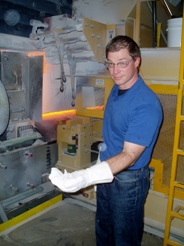
At his glassmaking plant in southwestern Washington, Steve Smith worries that a regional cap on carbon emissions will render his business unable to compete with suppliers outside the region. Photo by Tom Banse.
At his glass making plant in southwestern Washington, Steve Smith worries that a regional cap on carbon emissions will render his business unable to compete with suppliers outside the region. Photo by Tom Banse.

The governors of Oregon and Washington State served up the full climate enchilada to their legislatures this January only to see it picked apart.

That leaves California as the sole state in the Western Climate Initiative that has so far adopted cap-and-trade as the law of the land.  California’s partners have consistently told us that a national program is the preferable way to regulate greenhouse gases.  Now the “preferable” way is starting to look like the only way.

Western Cap-and-Trade Plan Taking Heat

Proponents of the Western Climate Initiative’s (WCI) climate action plan encountered some vocal critics on Tuesday as nineteen U.S. Senators and House members from 10 states challenged western governors to rethink the plan’s approach to cutting carbon emissions.

In a letter to the governors, members of the Congressional Western Caucus, including three from California, expressed particular concern about capping carbon during the most severe economic slump in the post-war period.

WCI is a cooperative plan by 11 western U.S. states and Canadian provinces to create a regional cap-and-trade system for greenhouse gases.  Craig Miller reported on the plan in September for KQED’s The California Report.

The critics’ letter takes issue specifically with what it says are the WCI’s plans to rely on “renewable technologies and demand destruction” and to allow “for virtually no new baseload power plants deployed in the West through 2020 that are powered by natural gas, clean-coal-with-carbon-capture, renewable hydropower or nuclear energy”.  They say the region will lose billions of dollars in investments in green technology due to a plan that prevents new fossil-fuel power plants, even those with CO2 capture and sequestration technology.

At issue seems to be the WCI’s plan for the emissions caps, which are slated to be a “flat line” from either 2012 or 2015, depending on the source.  According to the WCI’s recommendations, the line would be set using “the best estimate of expected emissions for sources covered in the cap and trade program” in 2012.  Under this system, there would be very little room for increased emissions from any new power source covered by the program (i.e. electricity generation, combustion at industrial and commercial facilities,  and oil and gas processing).

The letter refers to a recent economic analysis commissioned by the Western Business Roundtable that found that the WCI would be expensive, cause job losses, and would not affect global climate.

California congressmen Dan Lungren, Elton Gallegly and George Radanovich were among the signers.

National Cap-and-Trade Program Unveiled

California’s largest electric utility joined with a coalition of about 30 other companies and environmental groups today, in taking the wraps off a proposed national climate strategy. After two years of talks, the U.S. Climate Action Partnership, which includes PG&E, is ready to put its muscle behind it’s Blueprint for Legislative Action, just in time for Inauguration Day.

The program uses a trading program for carbon credits, much like the Western Climate Initiative, a collaboration of several western states and Canadian provinces. The goal is to roll back greenhouse gas emissions to:

> 97%‐102% of 2005 levels by 2012
> 80%‐86% of 2005 levels by 2020
> 58% of 2005 levels by 2030
> 20% of 2005 levels by 2050

While stated a little differently here, the targets reflect what has become the broadly accepted goal of cutting GHGs 80% by 2050.

A thorny question surrounding carbon trading programs is always whether pollution credits will be auctioned off or given away free to major emitters. According to the group’s “blueprint:”

“USCAP recommends that a significant portion of allowances should be initially distributed free to
capped entities and economic sectors particularly disadvantaged by the secondary price effects of a
cap and that free distribution of allowances be phased out over time.”

This would appear to conflict with the stated goals of the Western Climate Initiative, whose representatives have committed (at least verbally) to making companies pay for most credits up front. And yet the USCAP plan carries the endorsement of major environmental organizations, such as The Nature Conservancy and the NRDC, both of which are members.

As one corporate executive put it at the plan’s unveiling, “We simply think you have to give away a significant portion…and then phase them out over time.”

The USCAP plan also offers emitters the chance to buy approved carbon offsets and gives special allowances to companies that have already achieved verifiable reductions in GHG emissions–or plan to do so.

AB-32: Now What?

Whew. OK, two years after California’s Global Warming Solutions Act was passed into law, the “solutions” package now has the force of regulation…sort of.

The unanimous vote of the California Air Resources Board yesterday to accept its “scoping plan” for implementation, wasn’t so much the final gun as the second-half kickoff. Don’t get me wrong: the vote was momentous as a kind of intermediate milestone. But there’s a lot to do if the law is really to kick in as scheduled, three years from now.

For instance, there’s that whole cap-and-trade thing. When it comes to putting a market in place for trading carbon credits, the carbon cops in Sacramento have agreed to collaborate with a half-dozen other states and follow the general conventions of the Western Climate Initiative, which are still to be worked out.

Then there’s that pesky EPA waiver to let California put its own regulations for tailpipe emissions in place. The state law enabling that has been on the books for about five years now, stalled by federal EPA officials under the Bush administration. Okay, that’s a gimme. We already know that waiver will finally be granted, sometime shortly after Inauguration Day. But even that signals the start of a complex internal process to get the new regs in place.

In fact, virtually nothing about AB-32 is automatic. As they say, the Devil is in the details. And most details have yet to be laid out, argued about, and worked out, before we can really start marking progress toward the broad goals of cutting greenhouse gas emissions (which are still rising, worldwide).

I sat down with James Goldstene, Executive Officer of the Air Board, and asked him what happens next. You can hear his answer by clicking on the player, below.

[audio:http://kqed03.streamguys.us/anon.kqed/climatewatch/goldstene.mp3|titles=James Golstene on AB-32]

Punting the Issue

oil-refinery-300.jpgWhen California creates a cap and trade system to deal with greenhouse gas emissions, as it is planning to do, there’s going to be the question of what to do with the revenue. Actually, first there’s the question of if there will be any revenue, as Mary Nichols, Chair of the California Air Resources Board (CARB), told a roomful of Silicon Valley venture capitalists and green tech leaders this week at the offices of fuel cell innovator Bloom Energy.

California’s cap and trade planning is tied to the Western Climate Initiative, but the consortium is leaving the decisions about how to dispense credits up to each state.

Nichols said that those who would be buyers in the potential cap and trade system are “very resistant” to the idea of an auction. Not exactly surpising.

But many clean energy innovators see the revenue from a cap and trade auction as the perfect opportunity to help new green technologies survive the tenuous period between venture capital funding and commericial viability. Funds from a cap and trade auction could help mitigate the risk private companies take on to develop the innovations that will be needed for a greener future.

Nichols admitted that how much of the credits to auction and where the money should go is the most controversial issue around AB 32. She cited the “cap and dividend” option, a scenario in which all the revenue would go “right back to the public, like in Alaska,” as a politically popular option. She also mentioned using the funds to reduce corporate taxes.

Bloom Energy CEO KR Srindhar likened the “cap and dividend” option to “giving people a fish” (I can only assume as a reference to the old adage about how teaching someone how to fish is better than giving him a fish).

“In the early stages, if we [California] want to be a leader in this field, we need to be seeding it to create jobs. When we do, then, month after month, they’ll be getting that dividend,” Srindhar told Nichols, asserting that money invested in green tech would pay off in the form of job creation and a better economy.

Nichols reponded by saying that she was “thinking about punting the issue for awhile.”

As we have blogged before, CARB is tasked with implementing AB 32, which requires that the state reduce its greenhouse gas emissions to 1990 levels by 2020.

According to rumors, Nichols may be influencing more than just California’s climate policy soon. Unnamed sources in recent reports have cited her as a potential Obama pick for EPA head in the new administration.

Three Bucks a Ton

You load 16 tons and whaddayou get? The late Tennessee Ernie Ford’s answer to that was “Another day older and deeper in debt.” But in the emerging carbon market, we now have a real answer: about $48.

At least that’s how much you’d use up in carbon credits if you participated in the nation’s first “cap-and-trade” auction for carbon emissions, which set the price for a ton of carbon in that particular market at $3.07. That auction last week was for RGGI, the Regional Greenhouse Gas Initiative, casually known as “Reggie.” It’s the carbon trading market set up by a group of ten northeastern states and it may give us a preview for when trading begins by the Western Climate Initiative, a consortium of eleven western states and Canadian provinces, including California. As I reported last week, the WCI just made public its general gameplan for carbon trading to begin in 2012. The first RGGI auction raised $40 million, which the states can now spend on developing low-carbon sources of energy (let’s hope “Reggie” fares better in the long run than “Fannie” and “Freddie.”)

Actually, 16 tons isn’t even enough to get you noticed in these carbon markets. Burning a gallon of gas in your car typically releases less than 20 pounds of CO2. Only facilities that pump out 25,000 tons or more per year will have to comply with WCI, which has yet to decide what portion of its credits to give away or auction off.

On Friday, we expect staffers at the California Air Resources Board to release the last version of their “scoping plan,” before it goes to the board for approval. It’s the master plan for implementing the state’s comprehensive law to combat the effects of climate change. Part of it hinges on California’s participation in the WCI, so the successful first auction of credits by RGGI bodes well.