Tag Archives: Policy

Head-to-Head: Chevron and The Sierra Club

Two giants of California’s energy debate squared off at a Commonwealth Club forum in San Francisco last night.

Chevron CEO Dave O’Reilly and Sierra Club Executive Director Carl Pope fielded questions from moderator Alan Murray of The Wall Street Journal and a sometimes impassioned audience, about renewable energy opportunities, reducing greenhouse gas emissions, and predictions for the future of the United States’ energy economy. Several questions also concerned Chevron’s high profile court battle in Ecuador and the oil company’s presence in Richmond, the Bay Area city where a major Chevron refinery dominates the skyline–and some say, local governance
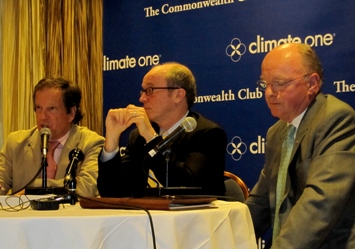
Carl Pope, ED of Sierra Club Alan Murray, Executive Editor of WSJ Online Dave O'Reilly, CEO of Chevron. Photo: Gretchen Weber
From left to right: Sierra Club chief Carl Pope; WSJ Online Executive Editor Alan Murray; Dave O'Reilly, CEO of Chevron. Photo: Gretchen Weber

In what was less of a debate than a discussion, Pope and O’Reilly agreed that the United States needs to make major changes towards greater energy efficiency and that the country must begin to rely more on renewable energy sources.

Their views diverged significantly, however, on the timeline for such changes. While Pope supports a 90% reduction of greenhouse gas emissions from today’s levels by 2050 and says he believes this goal possible, O’Reilly projected that by 2050, the United States will have reduced its GHG emissions by no more than 20-25% from today’s levels.

O’Reilly said that even if the U.S. replaced the entire transportation system with a zero-emissions system, the country would reduce GHG emissions by just 34%–and that doing likewise with the nation’s power generation would reduce GHGs by another 40%.

“So we have to ask ourselves, can we replace our entire energy system–transportation and power–in just a few short decades?” said O’Reilly. “I think the transition is going to take some time.”

According to O’Reilly, his company is already the largest provider of geothermal energy in the world and yet only 2% of Chevron’s income currently comes from renewable energy.

“The challenge of scale demands that we acknowledge that conventional energy sources will remain indispensable for decades,” said O’Reilly. “We must be realistic. For the foreseeable future we need to develop it all: conventional as well as non-conventional energy, as well as renewables and alternatives.”

When asked what his prediction was for how much of Chevron’s income would come from renewable energy sources by 2050, O’Reilly said he thought the number would be about 10-15%.

Pope responded, “The world will have room in 2050 for a very small company, 90% of whose energy comes from fossils [fuels]. The world will not have room, or tolerance, in 2050 for a big energy company [that does], so if Chevron wants to be successful, I think Chevron’s going to need to change those numbers.

Pope also called on Chevron to “come to the table” with local communities in which Chevron operates, such as Richmond, CA, and he proposed that all oil companies donate 10% of their profits to a global fund to clean up areas of the world damaged by the petroleum industry.

Not surprisingly, Pope and O’Reilly agreed that the highest priority for reducing GHG emissions is to replace coal with natural gas or another less carbon-intensive energy source, and while on stage, the men shook hands on an agreement to lobby the issue together in Washington.

KQED will broadcast the entire Commonwealth Club event at 8 p.m. on Friday, June 19, with a rebroadcast at 2 a.m. the following morning.

BK Franchise Serves Up Some “Baloney”

I know: This didn’t happen in California, so why mention it? Well, sometimes stories come in that just seem to crystallize the persistent (some polling would suggest growing) public division over climate change and this is a good example.

When signs on Burger King outlets started opining that “Global warming is baloney,” a Memphis reporter decided to check it out. His exchanges with the local burgermeister and the parent company make for pretty amusing reading.

Interesting that while polls taken within the last year have indicated flagging faith in the prevailing view of climate scientists that the world is warming, a spring poll by the Pew Research Center showed 59% of Americans supporting some kind of cap on carbon emissions. Though still sharply divided along party lines, that could indicate that some kind of reluctant consensus is forming around the issue.

No Crystal Ball for Fusion Power

Lawrence Livermore Nat'l Lab
Photo: Lawrence Livermore Nat'l Lab

Now here’s a guy with some historical perspective: For something north of a half-century, David Perlman has been covering science for the San Francisco Chronicle. On KQED’s Forum program this morning, he noted that “40 years ago, they said ‘in 20 years, we’ll have unlimited energy from fusion’.”

The record will show that we didn’t quite get there–but that hasn’t stopped them from trying. The long quest for bottled fusion will pass another milestone this week, when the US Dept. of Energy formally cuts the ribbon on the National Ignition Facility (NIF) at Lawrence Livermore National Lab.

Comparing the hardware with other titanic undertakings, like the CERN particle accelerator in Switzerland, Perlman called the 192-laser assembly “one of the most amazing machines–if it succeeds–and one probably won’t know for the next two, three years.”

That’s the hopeful time frame for creating fusion in a fuel pellet the size of a BB (artistically rendered in the image, above) Will they? Perlman says: “I would not dream of putting a bet on it.”

Nor would sparking some mini-fusion at NIF quickly translate to a national solution for clean, safe energy. Scaling that ignition up to practical size for reactors would likely require decades more.

A NIF technician appears to be gazing into a "crystal ball," which is actually used to amplify laser beams--but not much good for predicting the future. Photo: Lawrence Livermore National Lab
A NIF technician appears to be gazing into a "crystal ball." Precision-ground crystals are used to amplify laser beams--but not much good for seeing into the future. Photo: Lawrence Livermore National Lab

Earlier this week, in an interview with NASA scientist James Hansen, I asked him about the potential for nuclear power to make a comeback with new technology. Rather than waiting for fusion, Hansen favors the technology known as “fourth-generation nuclear,” which he says could “burn nearly all of the fuel, where at present, the nuclear technology that we’re using burns only one percent of the energy in the uranium.” From one percent to “nearly all” would represent a drastic reduction in the current radioactive waste problem.

There may be some wishful thinking in that. An early report published in the magazine 21st Century Science & Technology describes these “Generation IV” reactors as “about 50% more efficient than conventional nuclear reactors.”

Other nations have moved ahead with Gen-IV reactors. The French expect to have one under construction by 2020.

Meanwhile, as the US pursues a parallel Gen-IV research program, it will press on toward the Holy Grail of fusion with its Livermore megalaser, described by Perlman as “already a mini-Manhattan Project.” Costs so far have run to nearly triple the original budget of more than a billion dollars. DOE expects to spend $140 million per year to run the NIF. So, it would be–you know–nice if something comes of it.

New Tailpipe Regs are an “Alternate Reality”

Amy Standen specializes in science and environmental reporting for Quest. She’s among the guests today on KQED’s Forum program. Listen to the archived program here.

Hazy day in L.A. Photo: Craig Miller

Yesterday afternoon, as I started working on my news spot about the new federal standard for tailpipe emissions, I dug up my notes from over a year ago, the last time I covered this story in any depth.

The contrast in tone between then and now amazed me. Back then, I was describing accusations of outright lying, government actions that California enviros called “completely illegal,” and California officials “sharpening their knives” as they marched into battle with EPA former Administrator Stephen Johnson. It was September, 2007, and Democratic lawmakers, led by Henry Waxman (D-CA), were accusing the White House of strong-arming the EPA into denying California its “waiver,” or permission to regulate auto tailpipe emissions. The mood between California environmentalists, many of the state’s elected officials, and the Bush administration couldn’t have been more hostile.

Today, it’s as if we’ve landed in an alternate reality.  Not only has California been given its more fuel-efficient cars, but those same laws are taking effect nationwide. The new rules actually exceed anything that California–traditionally the most ambitious state in the union, when it comes to greenhouse gas regulation–could have asked for.

Instead of knives being sharpened, California enviros are singing the praises of “an historic blueprint to carry out rigorous greenhouse gas emission standards,” to quote one email I received today. Another group told the New York Times: “This is the single biggest step the American government has ever taken to cut greenhouse gas emissions.” Compared to the fall of ’07–actually make that since ’05, when California first asked for the waiver and the EPA first started stalling–it’s like night and day.

Still, listening in to the White House background press briefing on Monday afternoon, you could hear the seeds of criticism taking root in a few reporters’ questions.

Sure, American automakers will be making more fuel-efficient cars, one reporter asked, but what is the White House doing to encourage consumers to buy them? (in addition to restricting tailpipe emissions, the new rules also substantially increase fuel efficiency standards for manufacturers’ fleets–SUVs and trucks will still be available; they’ll be more fuel efficient than before, but less efficient than smaller cars.) The question takes on new relevance as the federal government finds itself a major stockholder in auto companies.

President Obama says the new regs will have the equivalent impact of taking 177 million cars off the road.

California’s Water Meter Rebellion Withers

City water conservation specialist Marilyn Creel shows Fresno resident Mary Ann Evans how to adjust her sprinklers to point them away from the sidewalk.

Monday on The California Report, Central Valley Bureau Chief Sasha Khokha tracks one city’s longstanding rebellion against water meters–and says the day of reckoning is nearly at hand. Listen to Sasha’s story here.

I admit it. I wanted to do this story because I saw so many of my neighbors watering their driveways. What I learned is that unmetered cities are a long and slow-dying tradition in the Central Valley.

Martin McIntyre, who used to head Fresno’s water agency, explained how vehement anti-metering forces swayed voters and banned meters in the city charter:

“They were really false arguments. The simple phraseology was ‘meters are taxing machines,’ and they’re going to use meters to fund city hall activities. And, in fact, as is the case for all municipal water supply systems, the funds collected from ratepayers by law can only be used for the operation and improvement of the water supply system. Nonetheless, that resonated with some of the public and it was very easy for a handful of people to get prominent headlines above the fold simply by saying city hall is taxing us to death.”

State lawmakers overrode Fresno’s rule, because they understood that cities with meters use less water.

Ellen Hanak, a water researcher with the Public Policy Institute of California, has found that metered cities use about 15 percent less water than unmetered cities. And cities with a tiered rate system save an additional ten percent on top of that. In addition to usage, her report compares different cities’ water rates. Of course, San Franciscans get away with using less water because–guess what? Many of them don’t have front yards.

Hanak crunched statewide residential water rate numbers and determined that more than half of San Joaquin Valley residents don’t have water meters. (For further details, read the survey disclaimer.)

But meters are coming, one way or another.

There are basically three laws that will eventually require the entire state to install water meters. One says that all homes built after 1992 must have meters. Another dictates that cities that get federal water (like Fresno) have to install meters by 2013. And yet another law says that all California cities (including holdouts like Sacramento) have to be metered by 2025.

Fresno is gearing up to install its first meters this year. They’ve even created a handy Q&A for skittish customers.

And if you thought Central California was the only laggard, this might make you feel better: many Chicago residents don’t have meters, either.

But they probably don’t have the sprinkler ladies–who can fix any leaky, squeaky, spritzy sprinkler, and make sure it’s pointing away from the sidewalk.

KQED’s Sasha Khokha braves sprinkler spray to record Fresno’s city water conservation team at work.

“The Australian Reality”

Australia's Simpson Desert. Photo: Mike Gillam

Referring to Australia’s seven-year drought, that’s how the state’s top water manager describes the new paradigm for water planning at the Dept. of Water Resources.

Speaking to a packed house at the annual forum of the Sacramento River Watershed Program yesterday, DWR Director Lester Snow said his staff is assuming that 2010 will be another dry year. Snow warned about “loss of resilience” in the state’s water system, calling it “completely unsustainable” in it’s present form, given predictions for population growth, coupled with anticipated effects of climate change.

All speakers at the forum seemed to agree that a paradigm shift is in order. Thomas Philps, a strategist at SoCal’s Metropolitan Water District, pointed out that in Victoria’s capital city of Melbourne (Australia), per capita water consumption runs about 40 gallons per day, while in California’s capital, it’s 280 gallons. As Sasha Khoka will report Monday morning on The California Report, Sacramento is just one of several cities in the Central Valley that still doesn’t meter its water use. Philps added that the Sacramento region is “on a trajectory” to use the same volume of water as Los Angeles, though he did not say by when.

UC Davis geologist Jeff Mount cautioned against relying on additional surface storage to secure California’s water future. Not only does storing water become “very expensive” year over year, but dams and reservoirs “don’t create any new water,” he said. (If some think Mount is taking a “jaundiced view” of the situation, it might be because he braved a bout of hepatitis to deliver his morning talk)

In a panel discussion on resource planning, moderator Greg Zlotnick of the Santa Clara Valley Water District asked panelists to respond with “true” or “false” to a quote from the Pacific Institute’s Peter Gleick in a story aired on NPR last week. The quote, as given by Zlotnick, was: “Government has built infrastructure and made promises that can’t be kept.” Here are the panelists’ responses:

Tina Swanson, The Bay Institute: “True.”

Philps: “True, but…” (Generally true but MWD doesn’t really expect to get its full contractual allocation of water anymore, anyway)

Don Glaser, US Bureau of Reclamation: “False, but…” (Water allotments from his agency’s Central Valley Project are intended to be “supplemental contracts,” to augment use of groundwater and other sources, but Glaser sees the statement becoming “more and more true in the future.”)

Snow: “Hell, no.”

California Not Catching the Wave…Yet

Tom Banse’s radio report on West Coast wave energy aired Thursday morning on The California Report. It’s also posted to the Climate Watch Radio section on this site.

A Crib Sheet for West Coast Ocean Energy

Every now and then when the government gets something right, it’s only fair to give credit.  So today we give props to the Federal Energy Regulatory Commission for making public records easily accessible.  Combined with our handy-dandy crib sheet, you can be the reporter and dig up all sorts of newsworthy nuggets.  We’ll get to some examples, but first the overview:

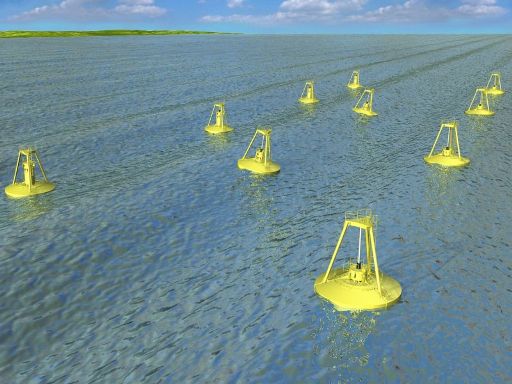
Wave energy buoys proposed for Reedsport, OR (artist's conception). Photo by Tom Banse.
Wave energy buoys proposed for Reedsport, OR (artist's conception). Image provided by: Ocean Power Technologies

Starting in 2006, there was a “gold rush” on the ocean to stake claims for wave energy sites.  Now the spray is settling and an industry shakeout is occurring.  Energy developers have given up on about a third of the wave power projects they proposed along the West Coast.  Some tidal power proposals are ebbing away as well.  When things go sideways, we rarely get a press release about it.  Often the news pops up first in a filing to FERC.

FERC is the agency that oversees wave and tidal power projects in state waters (up to 3 miles offshore).  The agency’s webmasters set up an “eLibrary” to archive project applications and correspondence.

You can see on the crib sheet that FERC dismissed three ocean energy projects in California waters last month.  The simple explanation is that the three projects ended up on the wrong side of a bureaucratic turf battle.  The Department of Interior’s Minerals Management Service (MMS) won jurisdiction over all energy development on the outer continental shelf, defined in this case as more than three miles offshore.  Grays Harbor Ocean Energy Company president Burt Hamner explained in an e-mail:

FERC has cancelled its entire preliminary permit process for projects located on Federal ocean waters, and thus dismissed our seven pending applications for preliminary permits (as well as those of a few others).  The new MMS framework says that applicants for wave projects must first get a MMS lease for space, then apply to FERC for a commercial hydropower license.  But, MMS is prohibited from issuing leases in national marine sanctuaries.  Two of our projects, San Francisco and Hawaii, are in sanctuaries.  Therefore these are terminated because there is no way to get a lease or permits there.

At the City of San Francisco, utility specialist Randall Smith said the FERC dismissal of the city’s preliminary permit for the Oceanside project “doesn’t put us back to square one, but does force a step back.”  Smith elaborated, “The difference with MMS is getting a lease.  That’s a little more protracted.”

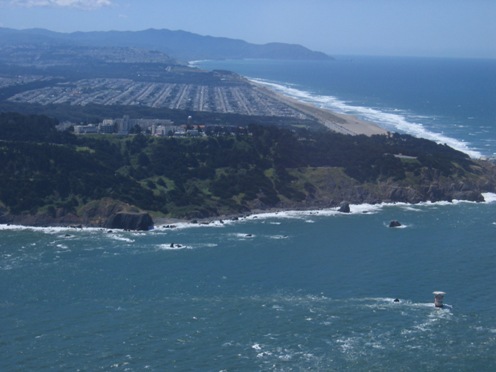
One wave power project was proposed for waters off San Francisco's Ocean Beach (upper right).
A wave power project proposed for waters off San Francisco's Ocean Beach (upper right) is in limbo.

The voluminous dockets for PG&E’s WaveConnect projects off Humboldt and Mendocino Counties, and the Green Wave Mendocino Wave Park suggest those are the ones moving ahead the fastest.  PG&E recently secured $6 million to pay for environmental studies, design work, and permitting.  The utility started its community outreach by scheduling two town meetings–in Eureka on May 19 and Ft. Bragg on May 21–both scheduled for 6 pm.

And now, the secret code: An easy way to keep tabs on a marine energy project is to make note of the applicant’s docket number (the one that starts with P-xxxxx) and then periodically plug that number into a “Docket search.”  (Click on “Submit” rather than the more prominent “Search Consolidated Dockets” button.)Here are all of the West Coast wave energy projects proposed to FERC, listed from north to south, as of this week:

P-12751 Makah Bay (Finavera)  license surrendered  4/09

P-13058 Grays Harbor Ocean Energy (Grays Harbor Ocean Energy Company)  11/2007

P-13047 Oregon Coastal Wave Energy (Tillamook Intergovernmental Dev. Entity) 10/2007

P-12750 Newport OPT Wave Park (Ocean Power Technologies)  permit surrendered 3/09

P-12793 Florence Oregon Ocean Wave Project (Oceanlinx)  4/2007, withdrawn 4/08

P-12713 Reedsport OPT Wave Park (Ocean Power Technologies)  3/2006

P-12743 Douglas County Wave Energy (Douglas County, OR)  9/2006  (oscillating column device on Umpqua River jetty)

P-12749 Coos Bay OPT Wave Park (Ocean Power Technologies)  3/2006

P-12752 Coos County Offshore (Bandon, Oregon) (Finavera) permit cancelled w/o objection 6/08

P-12779 Humboldt County WaveConnect (PG&E)  2/07

P-12753 Humboldt County Wave Energy (Finavera) permit surrendered 2/09

P-13075 Centerville OPT Wave Park (Ocean Power Technologies)  11/2007

P-12781 Mendocino County WaveConnect (PG&E)  2/07

P-13053 Green Wave Mendocino Wave Park (Green Wave Energy Solutions, LLC)  10/07

P-13377 and P-13378 Fort Ross Project- N & S (Sonoma County Water Agency)  2/09 pending

P-13376 Del Mar Landing Project (Sonoma County Water Agency)  2/09 pending

P-13308 San Francisco Ocean Energy Project (Grays Harbor Ocean Energy Company, LLC)  10/08 Dismissed 4/09

P-13379 San Francisco Oceanside Wave Energy Project (City and County of SF)  filed 02/09 Dismissed 4/09

P-13052 Green Wave San Luis Obispo Wave Park (Green Wave Energy Solutions, LLC) filed 10/07 pending

P-13309 Ventura Ocean Energy Project (Grays Harbor Ocean Energy Company)  10/08 Dismissed 4/09

Total proposed wave energy projects since 2006: 21

Total projects scrubbed by developer: 5

Total projects rejected by FERC: 3

For extra credit – Noteworthy tidal energy projects:

P-12585 San Francisco Bay Tidal Energy Project (Oceana Energy)  10/08

P-12672 Columbia River Tidal Energy Project (Oceana Energy) Permit surrendered 3/08


Pivotal Week for Pika Protection

American pika. Photo by Chris Ray.

Note that an update to this story was posted on May 6.

The hamster-sized, high-elevation haymaker known as the American Pika has had its “day” in court–and then some. Now it may be making inroads toward listing as a threatened species, while questions persist over whether that would be premature.

Friday was the deadline for officials at the U.S. Fish & Wildlife Service to decide whether to further consider the pika for listing under the federal Endangered Species Act.

The San Francisco-based Center for Biological Diversity (CBD) has been pursuing listing for the pika under both the state and federal Endangered Species Acts. On April 16, a Superior Court judge in San Francisco ruled that the California Fish and Game Commission applied too stringent a standard, when it voted last year to reject the CBD’s petition to list the pika under the California law. The CBD says it expects the court to formally order the state to go back and take a second look at whether the critter deserves protection.

Meanwhile federal wildlife officials had until May 1 to decide whether to formally review the pika’s plight and consider listing it under federal law. A response is expected to be published in the Federal Register this week.

Complicating the case is an apparent difference between the fate of pika populations in the Great Basin, where field research clearly shows pika colonies in trouble, and colonies in the Sierra Nevada range, which may be faring better.

Pika thrive only at high elevations, in the rocky conditions known as talus. Their band of tolerance for temperature is very narrow, so some biologists see them as an indicator species for global warming. Temperatures that humans may consider merely balmy, can be fatal for pika.


Chris Ray, an ecologist at the University of Colorado, has studied pika in the mountain ranges of the Great Basin. She’s identified and ranked several stress factors that pose threats to the animals, including habitat shrinkage and exposure to both heat and cold.

Ray, who presented her latest research at the USGS-sponsored Pacific Climate Workshop last month, is cautious about endorsing an ESA listing just yet, saying: “I do not think there are data indicating that the species as a whole is in danger of extinction, however the loss of isolated populations from the Great Basin has me concerned.”

“I think it’s very reasonable to consider potentially listing some sub-populations of pika.” Ray says that in order to do that, a case would have to be made that there are genetically distinct sub-species of pika. In its petition, CBD claims that five sub-species have been identified in California. But scientists at UC Berkeley and the U.S. Forest Service who have done field research in the Sierra, have said it’s less clear that those colonies are in trouble.

CBD staff biologist Shaye Wolf says a 1995 study found “evidence for four genetic units across the pika range, roughly grouped as Sierra Nevada, Cascades, Southern Rockies, and Northern Rockies. However, better genetic analyses using more sensitive genetic markers (like microsatellites) are necessary to understand pika population structure.”

Wolf says that for its ESA petition, the CBD drew on a 1981 study that used population distribution to break out 36 “subspecies” of pika.

“Smart Grid” Getting Some Juice

img_3197_blogThe mainstream media’s beginning to catch up to the “smart grid” story; the grand plan to remake the nation’s electrical distribution system.

On Friday, NPR began a ten-part series; “Power Hungry: Reinventing the U.S. Electric Grid.” The reports will air on both of the network’s flagship programs, Morning Edition and All Things Considered.

KQED’s Lauren Sommer set up the series earlier this month, with her backgrounder on emerging smart-grid technologies for Quest. Her report also includes a narrated slideshow, that includes a look inside PG&E’s version of “Mission Control.”

In March, Rob Schmitz previewed some of the challenges in his two-part series for Climate Watch, “Green Gridlock.”

And if you’re still “power hungry” after all that, Scott Pelley’s piece on the coal power industry is well worth a twelve-minute investment at the 60 Minutes website.

Congressman: Delta Fish a “Worthless Little Worm”

Peter Johnsen, U.S. Fish & Wildlife Service
Photo: Peter Johnsen, U.S. Fish & Wildlife Service

In hearings by the House Energy & Commerce Subcommitee today, Rep. George Radanovich (R-Fresno) called the Delta smelt “a worthless little worm that needs to go the way of the dinosaur.” He made the remark as part of a five-minute attack on “environmental alarmism,” in response to testimony from former vice-president Al Gore, founder of the Alliance for Climate Protection.

The tiny fish, recently listed by the state Fish & Game Commission as “endangered,” came up in remarks by Radanovich about the current drought conditions in the Central Valley. He blamed the lack of water on lawsuits that have restricted water supplies to farms, “for a Delta smelt–a worthless little worm that needs to go the way of the dinosaur. They’ve shut pumps down and restricted water deliveries to California over that thing, when what’s eating it is a striped bass, a non-native species in the Delta.”

Radanovich rejected the possibility that climate change might be a player in the current drought. Instead he took aim at what he described as “collaboration between environmentalists and sport fishermen,” blaming that for slashed water allocations to farms, as many as 60,000 job losses and “a $6 billion-dollar hit to our economy.”

“That is not global warming,” he said. ” “It’s the result of bad policy caused by environmental alarmism.”

Joining Gore among the 21 witnesses before the subcommittee on Day 4 of the climate bill hearings was UC Davis professor Dan Sperling (.pdf link), who had just come from a marathon hearing before the California Air Resources Board. Last evening the Air Board approved the first-ever Low-Carbon Fuel Standard, as part of it’s plan to reduce greenhouse gases.