After a fire at a California state park, volunteers used satellite imagery to study the recovery
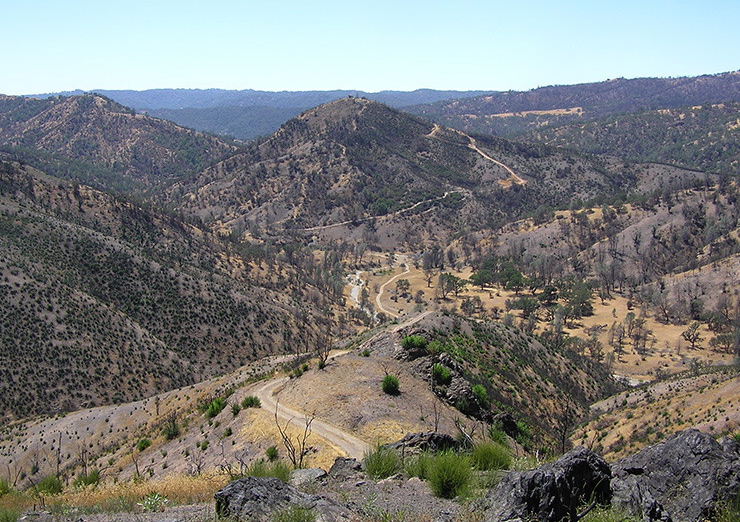
Henry Coe Park in Santa Clara County is big: 87,000 acres of former ranch land, dotted with oak trees, meadows that burst with wildflowers each spring, and vast stretches of chaparral. Given that Coe is nestled near Silicon Valley, it makes sense that the retirees who volunteer here bring a certain technical bent to their appreciation of the place.
Case in point: the Lick Fire of September 2007 (Craig Miller reported on it for The California Report). Named the Lick Fire after it was first spotted from the nearby Lick Observatory, the wildfire burned 47,760 acres in the Mt. Hamilton Range by the time it was contained, eight days later.
Since then, citizen scientists who volunteer for the park have been paying close attention to see how the burned land bounces back. In particular: Bob Patrie, a former project manager in Silicon Valley, and Winslow Briggs, Director Emeritus at Carnegie Institution of Washington’s Department of Plant Biology. Together, they’ve pored over satellite imagery to document the impact of the fire on various plant communities in Coe Park.
They used data from the Landsat 5 satellite (before it failed last November). There have been seven Landsats, each designed to provide overlapping coverage of nearly the entire surface of the earth on a regular basis.
Patrie and Briggs zeroed in on a technique for determining the severity of wildfires known as Normalized Burn Ratio, or NBR.
Patrie explains that the chlorophyll in growing plants soaks up red and blue light to maintain photosynthesis, but reflects infrared light to keep from overheating. “This pattern of reflectance is unique to growing green plants. Thus the difference in reflectivity between near-infrared and visible red light from any particular patch of land (NIR-RED) is strongly correlated to the level of photosynthesis from that same patch.”
Patrie and Briggs decided to study four plant communities:
- Mixed chaparral
- Gray pine oak woodland
- Mixed oak woodland
- Ponderosa woodland
“These communities are not mono cultures, nor was the burn intensity uniform over each area,” Patrie says. Just so, they found something interesting: plant life bouncing back after a fire, “tops off” at the same point as before the fire. “You can see that there’s an intrinsic limitation to the amount of any given plant in any given territory,” says Patrie. “It’s true in each kind of ecosystem.”
What they haven’t been able to answer is why bulb flowers “just went crazy” after the fire. Briggs says “Native Americans knew that. They’d do a burn, then harvest the bulbs, some of which are edible.” But the question remains, “What signals to the bulb to flower? The smell of smoke?”
That’s a question they’re still exploring–and can explore further, now that it’s clear the park will stay open, a story told on The California Report on Monday.
Explore KQED’s entire series, “California’s State Parks: On the Rocks,” at our special coverage page.
He who is not contented with what he has, would not be contented with what he would like to have.