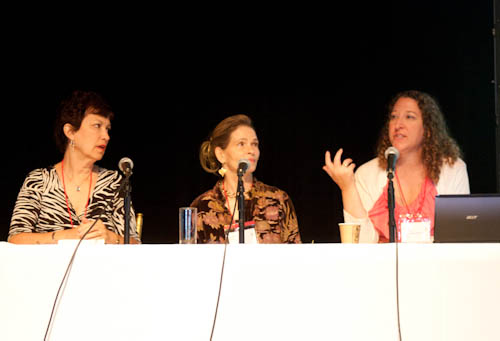
Recipe Writing with Dianne Jacob, Amy Sherman & Kristine Kidd

Recipe Writing Panel
Dianne Jacob, Kristine Kidd, Amy Sherman

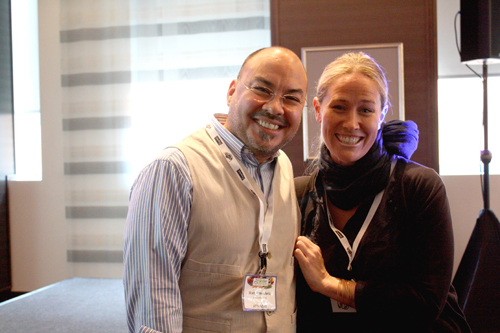
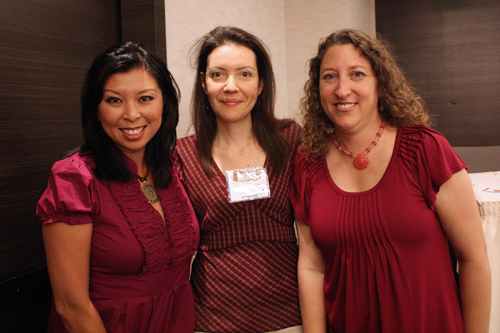
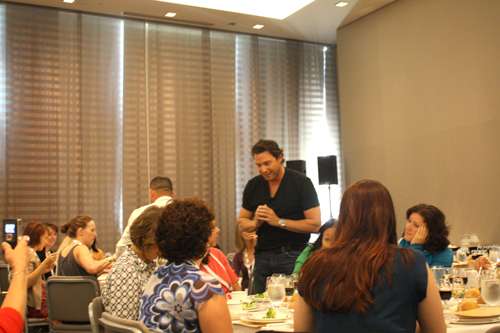
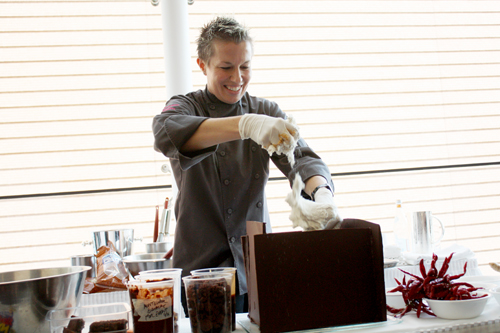
The first panel at the International Food Blogger Conference (IFBC) this past weekend in Seattle dealt with writing a great recipe, paying for content, and taking your work as a food blogger to the next level. Dianne Jacob, author of Will Write for Food, sat alongside writer and recipe developer, Amy Sherman (BAB blogger) and cookbook author and former food editor of Bon Appetit Kristine Kidd. Each speaker brought their own unique experiences in writing and recipe development, kicking off the session by discussing the importance of being generous and giving proper credit when adapting a recipe. Amy Sherman also urged bloggers and writers not to give recipes away for free. It can be flattering for beginning bloggers to be approached by online sites of print publications requesting to use a recipe. But Sherman noted that this only complicates things for folks trying to make a living by writing and developing recipes. While there were great tips on how to approach editors with recipes and how to take recipe development to the next level, the heart of the panel discussion was based around writing a great recipe. Below you’ll find some of the highlights:

Elements of a Recipe
Jacob, Sherman and Kidd discussed the four main elements that make up a recipe–each should be carefully considered to engage your reader, and achieve continuity and clarity:

1) Title: Keep your title straightforward, tempting, descriptive and fun. After all, it’s the first thing your reader will see.

2) Headnotes: The headnote of a recipe is the information right after the title and before the ingredient list. It’s important here to tempt your readers, give them either sensual or helpful information (or both!), perhaps some cultural or historical tidbits regarding the recipe or a personal story. Kidd discussed the importance of the headnote as an invitation for your readers–make them curious about your food. The headnote is the “why” of the recipe: out of all of the gazpacho recipes in the world, why are readers going to want to make yours?

3) Ingredients: The speakers agreed that it’s most common to list ingredients in the order in which they’re used. They also encouraged writers to remember that readers also use the ingredient list as a shopping list, so make it easy to shop from. An example Kidd provided was calling for “1 medium onion” instead of “2 cups onion”–people don’t shop for 2 cups of onion.

4) Directions: Think about how you’d like to present your directions. Often, if there’s an editor involved, you won’t have a choice. But if it’s on your personal food blog or website, make a decision: do you want numbered steps, bullets, or short paragraphs? Readability and clarity are key.
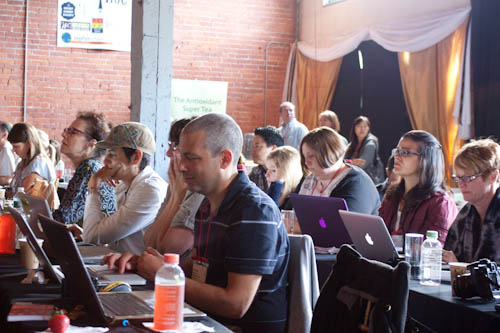
Conference Attendees
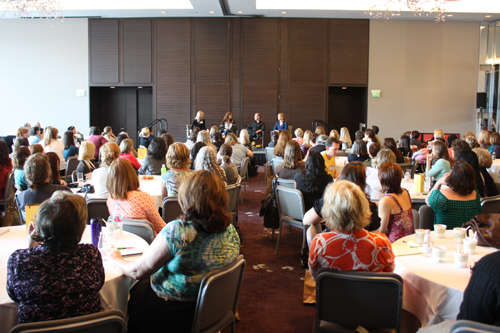
Conference attendees busily taking notes

Recipe Writing Tips
Jacob, Sherman, and Kidd moved on to discuss their own personal tips and advice for crafting an inviting recipe that works:

1) They began by encouraging people to think about their style of recipe writing: are you brief and direct or warm and friendly? Like any kind of good writing, you need to find your voice and make a concerted effort to remain consistent in the way you write your recipes. Chatty is o.k. (although it tends to be longer which Kidd pointed out often discourages readers)–just be chatty consistently.

2) Give more than one indicator: In recipe writing, indicators are descriptions or hints describing when a task is completed. Because all ovens are different, weather conditions vary, and folks have differing levels of cooking experiences, having more than one indicator is critical. An example: “Saute onions for ten minutes or until golden brown” (“ten minutes” and “until golden brown” are your indicators here).

3) Use the word “about” before giving a prescriptive number of minutes. Again, since everyone has different ovens and is working with numerous variables, adding “about” gives the recipe writer a bit of an out–putting some responsibility in the hands of the reader.

4) Give more than one measurement: Giving readers both weight and volume measurements is important, especially with baking Sherman noted. Kidd suggested that with savory cooking like soup, very precise weight measurements are probably not as critical.

5) Think About Your Audience: It’s imperative to think about your reader: who are they? How much information do they already know? Of course, these are always mere guesses but you need to decide if it’s important to give instructions on sauteing onions. Will this be obvious to them? Where do you draw the line on how much information and instruction to provide?

Recipe Writing Resources
Jacob, Sherman, and Kidd suggested looking at food websites and magazines you like for good models. Sherman encouraged reading international magazines as well to look for new and interesting food trends that haven’t quite surfaced here in the States. They also provided a list of the following fabulous recipe writing resources:
Recipe Writers Handbook

The Food Substitution Bible

Food Lovers Companion

Recipes Into Type

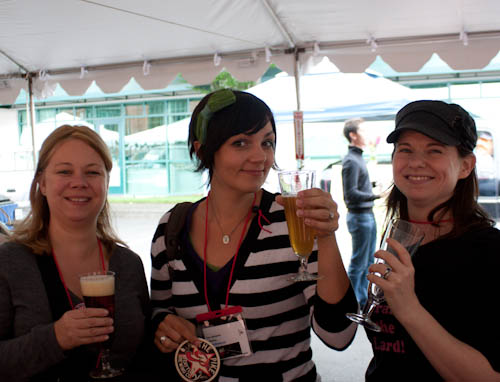
Conference Attendees Debriefing
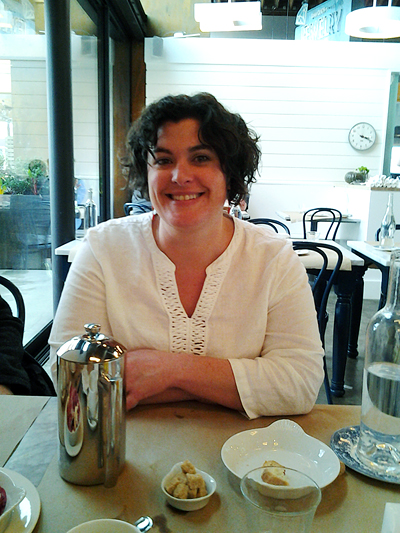
Conference Attendees Debriefing: Denise Woodward (Chez Us), Tracy Benjamin (Shutterbean), and Kristina McLean (TNLocavore)
Hungry Girl

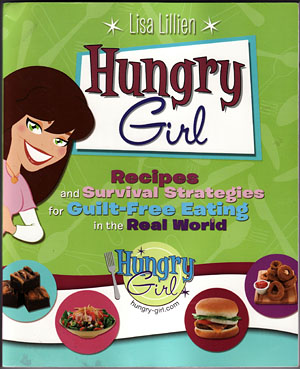
Hungry Girl bookcoverSeveral weeks ago, Amy Sherman gave me a cookbook entitled Hungry Girl: Recipes and Survival Strategies for Guilt-Free Eating in the Real World, because she knew it would drive me crazy.
How well she knows me.

I browsed through the pink-tinged pages looking at the recipes, fighting my way through the over-enthusiastic use of exclamation marks and cute-and-confusing titles like “pizzalicious chop chop” (page 44) and “amazing ate-layer dip” (page 158). Intending to be “sassy” and “fun”, the writing comes across as though it were the product of a calorie-obsessed teen-aged girl rather than an adult woman.

The author, Lisa Lillien, is “a self-appointed ‘foodoligist’ (sic)” and founder of the website HungryGirl.com – a popular website with more than 100,000 subscribers. According to her website, she rightly states that she is neither a dietitian nor a food professional, but “an average female, struggling with the same food issues most females struggle with every day.” Losing and gaining the same 10-15 pounds several times over, and trying “every diet under the sun,” she has a self-admitted food obsession– counting calories and finding low-fat, low-carbohydrate substitutes for a wide variety of foods.

The book, which is a natural extension of her popular website, is sadly rife with rather unnatural foods. For example, her “2-good twice-baked potato” (page 124, from”Manly Meals” Chapter 6) calls for fat-free American cheese and fat-free liquid non-dairy creamer. Is substituting the fats found in natural dairy products with things like corn syrup solids and Polysorbate 60 (both found in non-dairy creamer) such an excellent idea, however many calories might be saved? Polysorbate 60, as I have learned from a rather amusing article posted at Wired magazine, is:

…made by polymerizing ethylene oxide (a precursor to antifreeze) with a sugar alcohol derivative. The result can be a detergent, an emulsifier, or, in the case of polysorbate 60, a major ingredient in some sexual lubricants.

Perhaps the dish should be re-christened “2-good twice-lubed potato.” (And hint to the recipe testers– you might want to sprinkle the potato with paprika and parsley after removing it from the oven.)

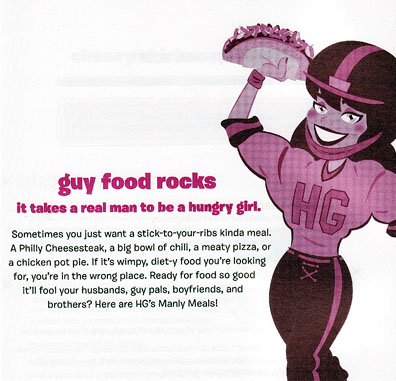
Hungry Girl Manly Meals

In Chapter 12, or, “Happy Hour”, Lillien states up front that it’s no secret that alcohol has “lots of calories”, and guides her readers towards lower-calorie choices if one must drink, but her drink recipes fumble. The “kickin’ cranberry cosmo“ (page 249), for example:

Ingredients:
5 ounces Diet Ocean Spray Cranberry Spray Juice drink
1 1⁄2 ounces of vodka
1 teaspoon lime juice
5 to 8 ice cubes

Optional: splash of diet lemon-lime soda, lime wedge (for garnish)

By omitting the Cointreau or triple sec for the sake of approximately 20 calories, Lillien has turned the Cosmopolitan into a Cape Cod. I should think any author as attached to the color pink as Miss Lillien is would know the difference.

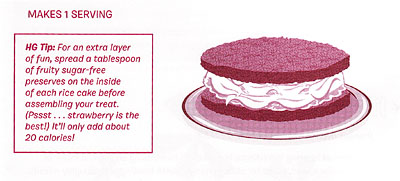
And dessert? How about the “ginormous creamy frozen caramel crunchcake” (page 227)? Cover the top half of one caramel-flavored rice cake with Cool Whip Free. Gently place another rice cake on top, making a sandwich. Freeze for at least 1 hour, then enjoy. There’s that Polysorbate 60 again. And high-fructose corn syrup? Yup. A diet high in fructose makes lab rats fatter than those placed on other diets. Read that Wired article again – it’s all about Cool Whip. Oh, it’s also been pointed out that the Sorbitan Monostearate, which is also found in this fat-free topping is sometimes used as hemorrhoid cream.

Rice Cream Sandie

Super fab!

This book isn’t all bad. In fact, it contains some excellent, sensible advice for those of us out there battling with our own weight issues. For example, Lillien suggests ways of staying active at work, how to avoid mindless snacking, and is vigilant about listing the per-serving calories, fat, sodium, fiber, carbs, sugars, and proteins in all of her recipes.

And not all of the recipes are creepy, just most of the names. For example, the “v10 soup” is completely devoid of atomic-age substitutes and comes with a warning that it is “jam-packed with an INSANE amount of veggies!!!”

Perhaps I’ve got it all wrong. Maybe living as I do in the heart of the Bay Area has spoiled me to the point of not recognizing what the “real world” might be, in terms of day-to-day eating. I’m not an on-the-go girl trying to fit into cute, size 2 pants. Nope, I’m a nearly-40 year-old man. But, as a gay man, the tyranny of body consciousness and fitness is not unknown to me.

In a country which is growing fatter by the year, it’s a shame that the author, who has such a large following, should choose to lead her readers down the path of empty calories and diet tricks. In an effort to help people avoid the “real world” dangers of fast food and junk food, Miss Lillien merely offers pale substitutes of the originals. In obsessing over calorie and fat content, she offers little in the way of whole foods–relying heavily upon heavily processed, store-bought items instead– many of which are thought to contribute to weight-gain in the first place, like high-fructose corn syrup.

Is Hungry Girl’s cookbook “guilt-free” as advertised? Hardly. This book, however well-intentioned, offers little in the way of substance. If anything, it’s guilty of promoting the same unhealthy food obsessions that drove Miss Lillien to create her popular website in the first place.

Now, if you will please excuse me, I’ve got a big bowl of Fiber One® drowning in some delicious non-dairy creamer to consume.

Ben Affleck, Theo Chocolate & Collections Cafe in Seattle

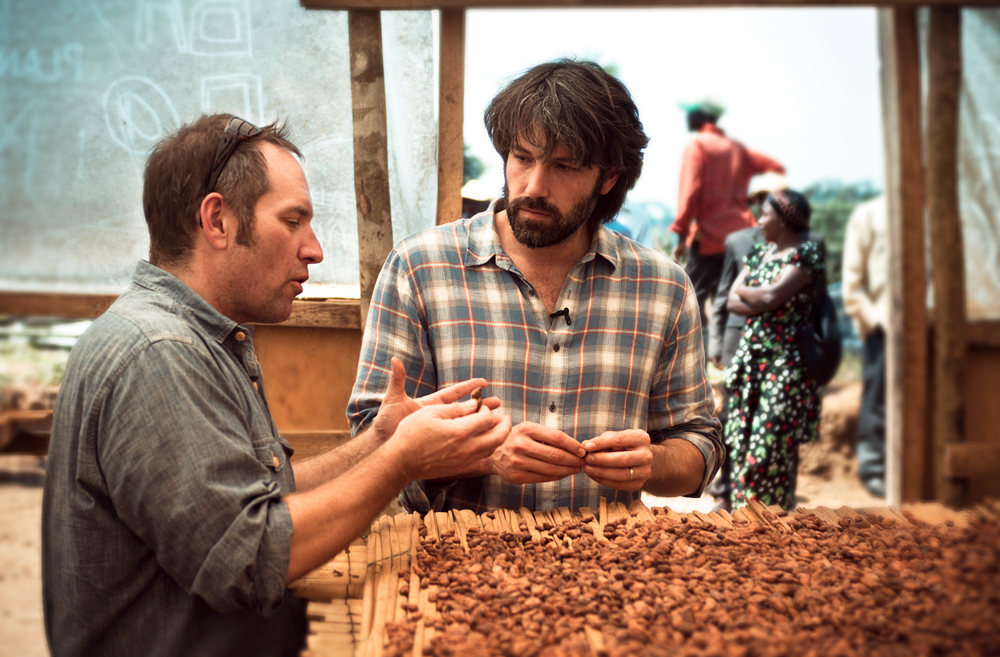
Theo Chocolate CEO Joe Whinney and actor and Academy Award-winning movie director Ben Affleck inspect cocoa beans in eastern Congo. Photo: Piet Suess

A certain Seattle fair trade chocolate-maker has cozy ties to Ben Affleck. Affleck is known as much for his political activism as he is for his acting, directing, producing and “interesting” reveals on the state of his marriage to Jennifer Garner. More on Affleck and Theo Chocolate in a bit.

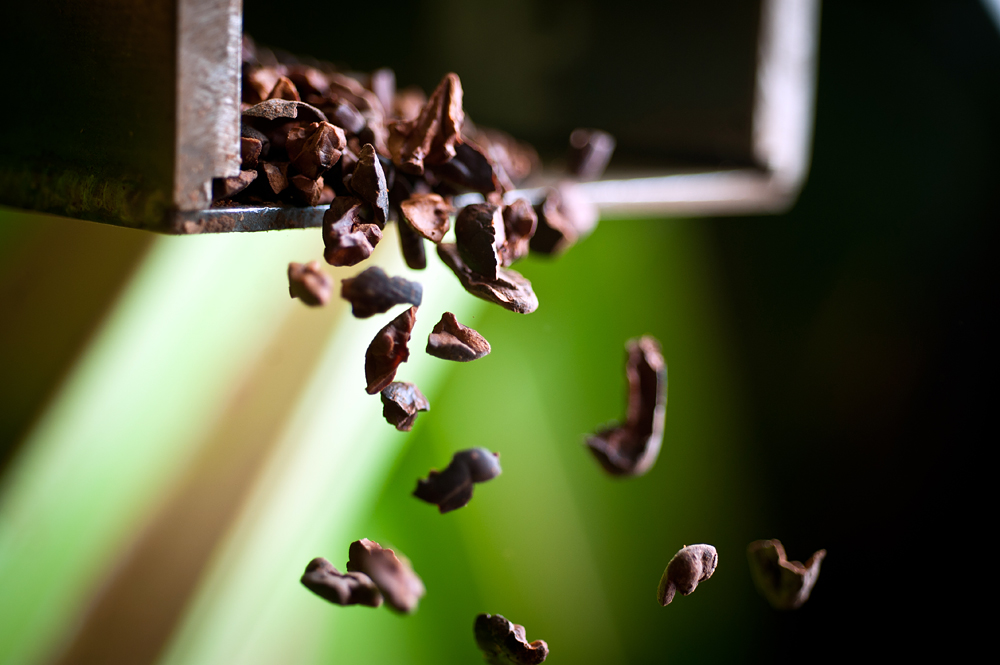
Cacao nibs from Theo Chocolate. Photo: courtesy of Theo Chocolate

During the Bay Area’s first dot-com, dot-gone boom in the late Nineties, I used to visit Seattle a few times a year for event work, often squeezing in a day or more with my family tribe up there. When my last box of pens, light-up balls and other dot-com collateral was safely shipped back to Silicon Valley, I’d hightail it to the Seattle ‘burb of Mukilteo, which looks over the Puget Sound, to rest and hang with my young cousins. The routine at my aunt and uncle’s home revolved around delicious home cookouts that reflected the local bounty—things like planked salmon (a fish that, ironically, my Uncle “Kiwi” avoids, after decades of professional sea fishing) and crab with some fresh, seasonal vegetables. Red Hook beer, made locally since 1981, was the house beverage of choice.

There were restaurant adventures, too, mainly to family-friendly Thai or Mexican joints. Aunt Kelly, who had worked in the hospitality biz, told me all about chef Tom Douglas as we noshed at his Dahlia Lounge–even today, Douglas remains a prominent Seattle chef and restaurateur, cookbook author, spice rub line and all. Once this branch of my family moved to New Zealand, where my uncle is from, the frequency of my Seattle trips tapered off…almost completely. I was therefore very excited to return to Seattle recently to explore and eat. While I did find myself pining for folks who now live on the other side of the world, the city was still its welcoming and occasionally drizzly self. Here are food-centric spots that caught my attention:

Theo Chocolate

Ben Affleck is working with Theo Chocolate to create some rather good chocolate bars, via the Eastern Congo Initiative (ECI), which aims to help farmers in Africa’s Eastern Congo. Affleck founded ECI and took a hands-on approach and inspected cocoa beans with Theo Chocolate CEO Joe Whinney. The Theo tour in the fun and funky Fremont neighborhood is a must-do and tour guests get discounted pricing on many sweet treats in the retail space. Sample, see, smell, and learn about chocolate in a historic 28,000-square-foot brick factory that in recent years housed the Red Hook Brewery and up until 1941 was home to the city’s electric trolley fleet. I liked the set up of the color-coded, hour-long tour, which made for an easy-to-follow visit of a site that is gearing up to make nearly six millions pounds of chocolate annually.

Collections Café at Chihuly Garden and Glass

Both the Collections Café and sister restaurant Sky City show their affinity to Slow Food Seattle through the quality of food preparation and ingredients as well as through the wine and craft beer lists. Sky City offers a memorable meal and spectacular views atop the Space Needle, yet it is spendy and more of a special occasion spot.

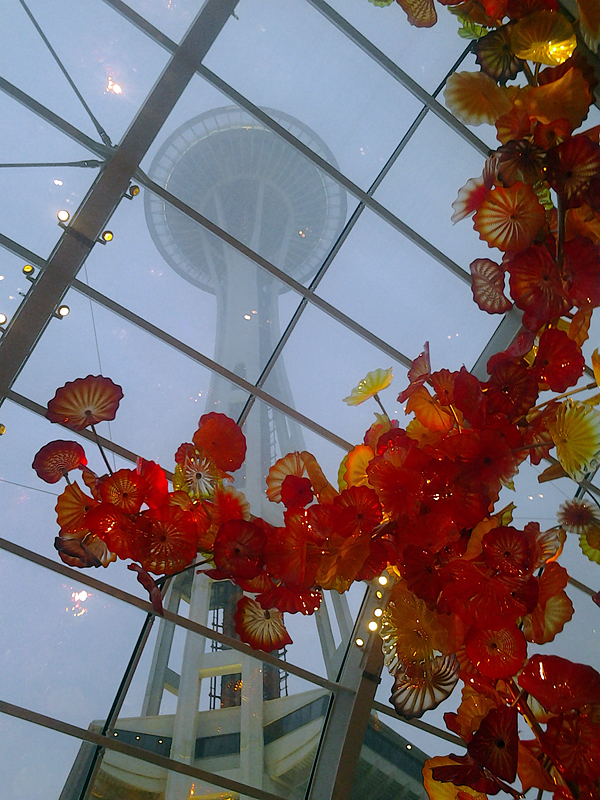
View of Space Needle from Chihuly Garden and Glass Photo: Mary Ladd
View of Space Needle from Chihuly Garden and Glass
Photo: Mary Ladd

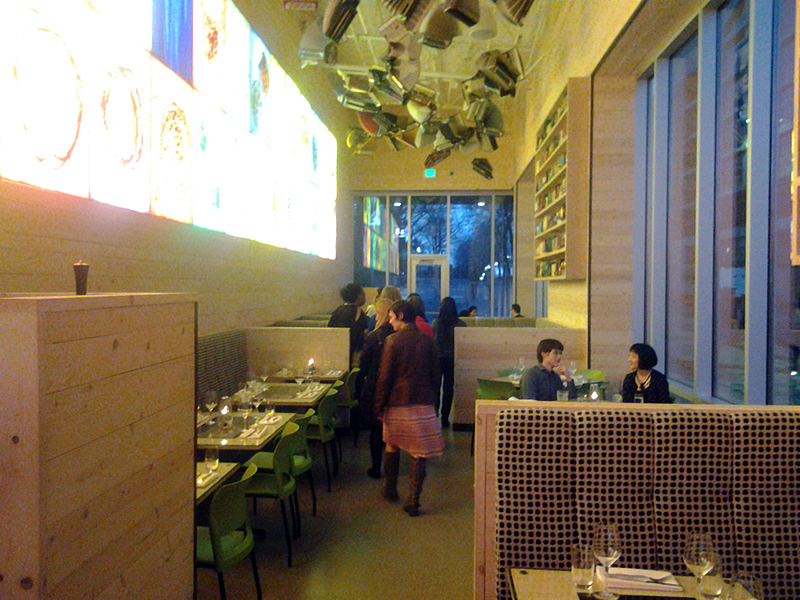
Downstairs near the Chihuly Garden and Glass space, the daily menu efforts of chefs Ivan Szilak and Jeff Maxfield at Collections Café are gentler on the pocketbook. Dishes served in a space that is directly nestled under the Space Needle include crispy Beecher’s cheese curds (made nearby) with bourbon tomato jam, salmon shrimp cakes, and the dish that got Szilak his job — chicken paprikás. Renowned glass artist Dale Chihuly, whose world famous glass work and Americana collections can be viewed at the museum, is known to stop in regularly for the burger with red onion jam, bacon, Beecher’s Marco Polo and peppadew aioli. I grew up collecting stickers, dolls, and books—so the arrangement of collections (accordions, corkscrews, radios, etc.) under glass and hanging in the restaurant kept my attention. This is museum food, but the cooking and menu show a flair and variety that is worlds away from limp institutional fare. For summertime, chef Szilak plans on serving a Bourbon Ice Cream Coke Float for a decidedly adult dessert.

Inside Collections Cafe. Photo: Mary Ladd

The Whale Wins

This is the newest restaurant from Renee Erickson, who has been cooking for over fifteen years and first broke into the culinary scene via her Boat Street Cafe and Kitchen. Renee has received accolades for her growing mini-empire of tasty restaurants that include Narwhal, an oyster mobile food truck. The James Beard Awards have come a-callin’ and Bon Appétit gave Erickson’s The Walrus and the Carpenter oyster restaurant a spot on its “20 Most Important Restaurants” list. One of the adorable factoids about Renee is that her mother, Shirlee, is involved with Renee’s Boat Street Pickles’ production.

Renee Erickson at The Whale Wins. Photo: Mary Ladd
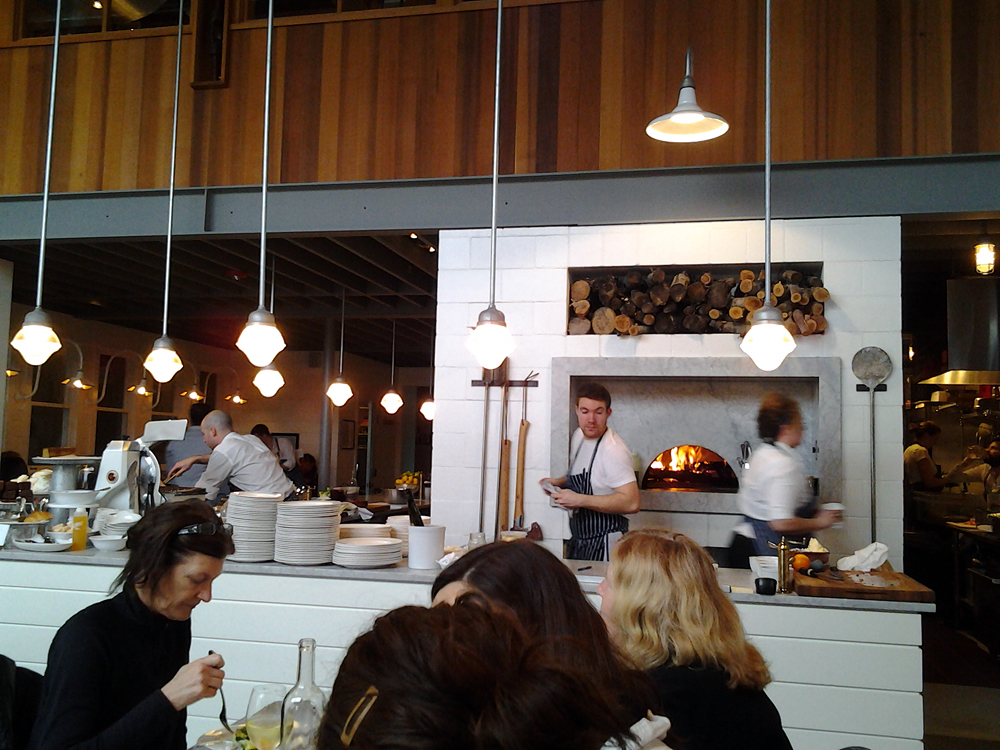
The open kitchen at The Whale Wins. Photo: Mary Ladd

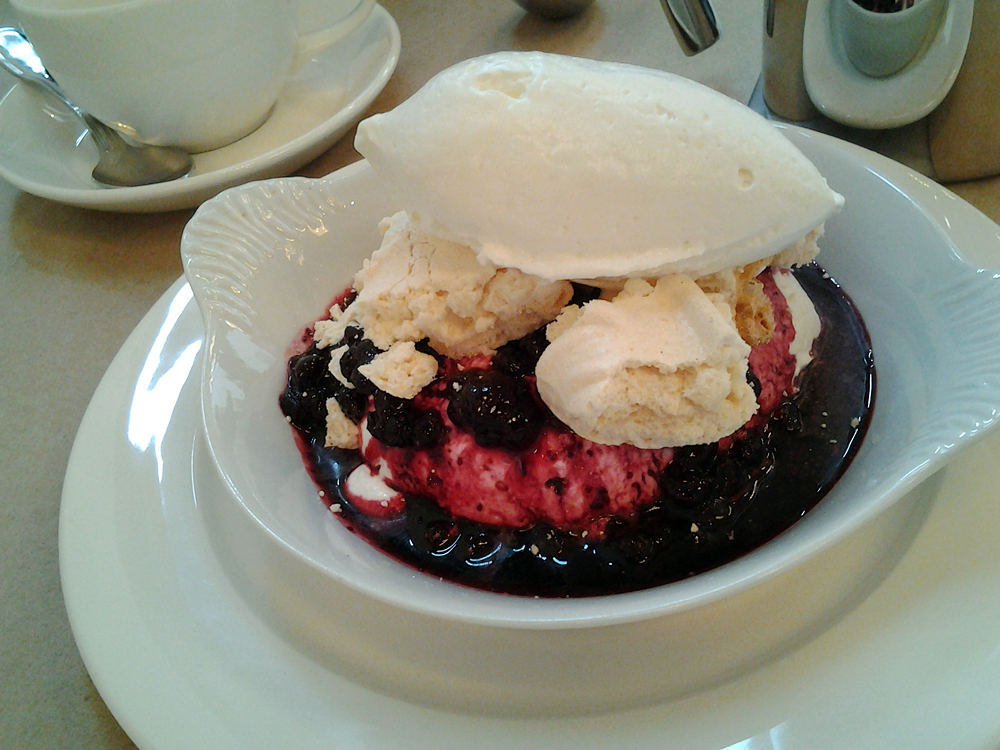
Over lunch at The Whale Wins that included views of the treasured wood-fired oven, Renee told me this about Seattle’s culinary state: “I feel very lucky to be here. In the past six to seven years, the area has exploded. We have ‘the best of’ wine, cheese makers, cheese, everything.” (Renee’s wild huckleberry Eton mess dessert could easily be a contender for that “best of” list.)

Wild Huckleberry Eton Mess Dessert from The Whale Wins. Photo: Mary Ladd

Matt’s in the Market

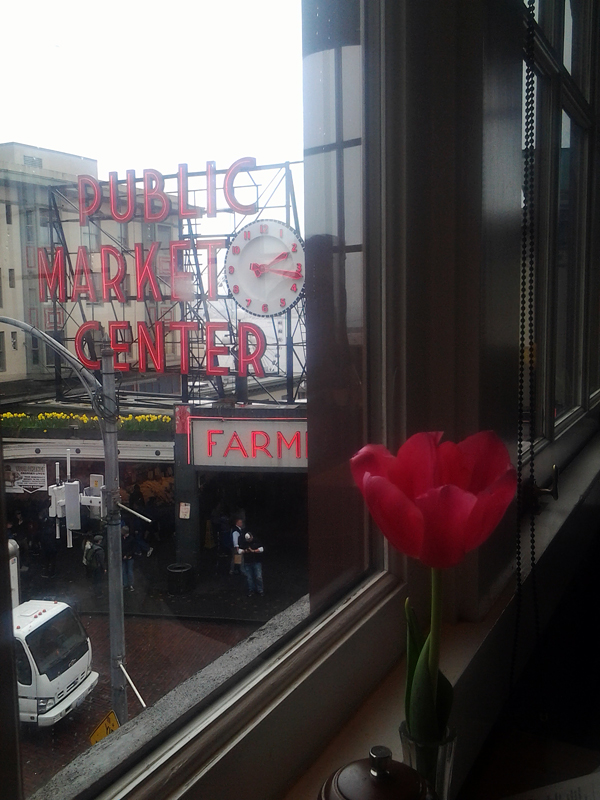
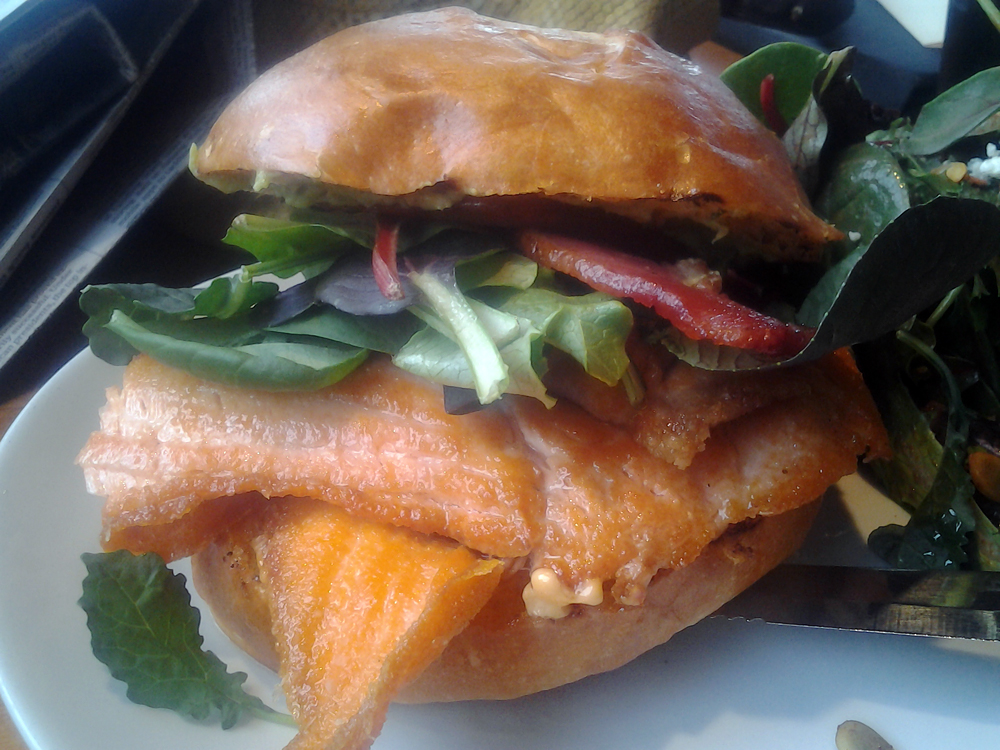
The “fishwiches” from Matt’s in the Market (includes killer views of the Pike Place Market) came highly recommended. Matt’s has expanded the restaurant seating area and serves six sandwiches daily, three with meat. While the falafel with pork cheeks sounded interesting, I was there for the fish. My steelhead fishwich with bacon, guacamole, miniature greens, and spicy aioli on brioche bread was a tad messy but worth the effort. Customers at the bar were enjoying a Mexican Fernet breakfast martini. The room with a view includes jovial staff in an open kitchen, big windows and fresh floral accents.

View from Matt’s in the Market. Photo: Mary Ladd
Matt’s in the Market Fishwich. Photo: Mary Ladd

Lola

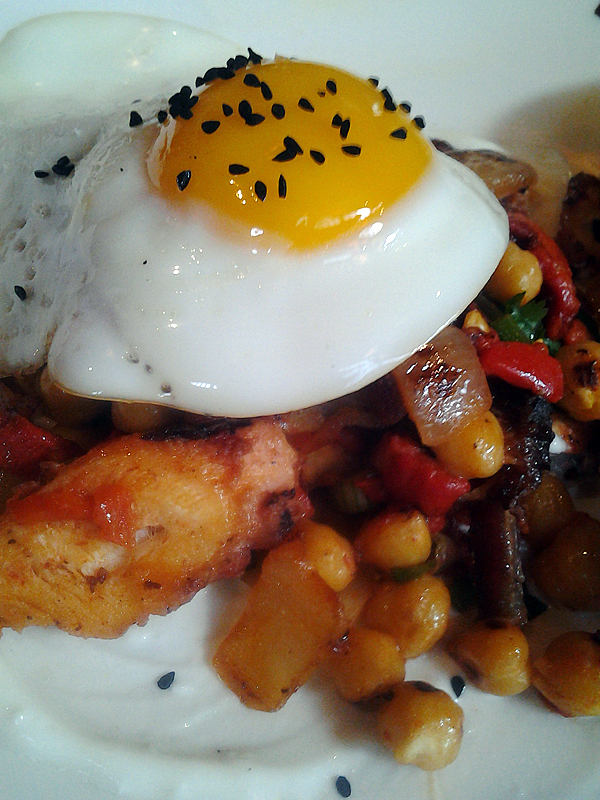
Food writer Amy Sherman pointed me to the Tom’s Big Breakfast at Lola, saying, “It might change your life.” Lola is a Tom Douglas restaurant gem in Belltown, the kind of place for a “power breakfast,” going by how many folks were there in business suits. For the uninitiated, Tom’s Big Breakfast has Mediterranean octopus with Florina peppers, onions, bacon, cilantro, and garlic yogurt. Octopus for breakfast? Sure, especially when it is tender and flavorful octopus cooked to perfection. The Big Breakfast also has eggs served sunny side up with toast. Another morning menu must is the donuts to order, which arrived in a paper bag that was shaken at the table—all the better to coat the donuts with sweet sugar that is only enhanced by seasonal jelly and vanilla mascarpone accoutrements. And yes, this Tom’s Big Breakfast is best shared.

Tom's Big Breakfast at Lola. Photo: Mary Ladd
Tom’s Big Breakfast at Lola. Photo: Mary Ladd
Donuts at Lola. Photo: Mary Ladd

Related Information:

Theo Chocolate
Address: Map
3400 Phinney Avenue N.
Seattle WA 98103
(206) 632-5100
Factory tours offered daily. Reservations strongly recommended. Book three to four weeks ahead.
Facebook: Theo Chocolate
Twitter: @theochocolate

Collections Café at Chihuly Garden and Glass
Address: Map
305 Harrison St.
Seattle WA 98109
(206) 753-4935
Website
Facebook: Chihuly Garden and Glass
Twitter: @chihulygg

The Whale Wins
Address: Map
3506 Stone Way North
Seattle, WA 98103
(206) 632-9425
Facebook: The Whale Wins
Twitter: @Thewhalewins

Matt’s in the Market
Address:
Pike Place Market
94 Pike St #32, Seattle, WA 98101
(206) 467-7909
Facebook: Matt’s in the Market
Twitter: @mattsinthemkt

Lola
Address: Map
2000 4th Ave. Seattle, WA 98121
(206) 441-1430
Facebook: Tom Douglas Restaurants
Twitter: @TomDouglasCo

Disclosure: Mary’s trip was organized by the Chihuly Garden and Glass at Seattle Center.

Local Food+Drink Secrets of Chutney Chef Alison McQuade

Alison McQuade at the Clift Hotel

McQuade’s Celtic Chutneys are made by the San Francisco-based “Chutney Chef” Alison McQuade. This writer has seen McQuade’s chutneys used for private and catered events, as accoutrements with cheese and meat platters…and more. McQuade hails from Glasgow, Scotland, and has lived in the U.S. for the past thirty years. BAB contributor Amy Sherman reported in 2005 how McQuade got her start:

“One year I made chutney to give away as Christmas presents. It was my grandmother’s recipe and I went online to make labels and get jars. I gave some to my hairdresser and she asked me to bring some more over for one of her customers–I thought that was a wee bit cheeky! This was a gift after all. But it turned out she had a tasting going on and her customer was one of the owners of Cowgirl Creamery. My first paying customer, she said she wanted 60 of each flavor.”

Consumers can find the chutneys locally at Cowgirl, Irish Castle Gift Shop, Falletti Foods, Cheese Plus, and Whole Foods SOMA. This growing chutney business is the winner of a 2006 Independent Food Festival & Awards. McQuade shared with BAB some recent product developments: “I’m currently introducing a new line of jellies — pomegranate habanero, serrano pepper, pear chocolate jalapeno, zinfandel chocolate and pinot noir.”

McQuade: “I have lived in ‘Tenderloin Heights’ for years and love this area with its proximity to shops, restaurants and the park at Grace Cathedral … only two blocks away!” She’s hoping “at some point in the very near future to start a little soup kitchen with the help of some local neighbors. There are so many aging and sick people around us here in San Francisco. I’d like to pitch in and help a little more. I work with Dinner With Grace, [which is] a Grace Cathedral run service where volunteers cook food on Tuesday night twice a month. On the Wednesday, we deliver the food and eat with the residents of nearby SRO hotels.”

Here are McQuade’s favorite food and drink spots:

THE FAVORITES:
I love the Shakshuka from Cafe Zitouna (North African) on Polk Street. It’s generally breakfast food, but they serve it all day with lamb sausage and it’s just amazing!

Lahore Karahi — I’m constantly in search for the best mattar paneer. I’ve found my favorite version yet is here. Unfortunately, they’ve been closed the past couple of weeks but are about to reopen so I can get my fix.

Farm:Table does such lovely bites for breakfast. I love their daily boiled eggs served on baguette gussied up with bacon and greens, mushroom, radish and even chutney! They tweet their menu every day and it’s always mouthwatering! [SFoodie noted McQuade’s curry-gold habanero chutney served with said eggs last year ]

Sugar Café (soups made from scratch every week day by Ignacio the soup king): I crave his cauliflower cheese soup.

The Huntington Hotel for happy hour is one of my favorites. They oftentimes provide appetizers and there’s always something the chef has just whipped up on the spur of the moment.

GUILTY PLEASURE
Zante’s Indian pizza: I will often have that delivered on a rainy night (they deliver all over the city). That’s all I need … served with a refreshing amber beer!

WINE TIME
I have two favorite wine bars — Hidden Vine (which is about to move to the financial area) but I’m one hundred percent certain something interesting is going to take its place.

Also, the Rosebowl Florist and Wine Bar, a little hidden gem in opera plaza. Deidra keeps this rather small place stocked with an interesting and well-priced selection of wine. She’ll often put out little plates of food to keep the regulars happy. A nice lively selection of people frequent this place almost every evening.

FOOD SHOPPING
I do like to shop in my neighborhood as well as the Ferry Building, where I get all my fresh fruit and vegetables. I like to support the mom and pop stores and the one near where I live, Mayflower Market is the friendliest and best stocked of all the little markets. They have an incredible range of packaged food, organic, juices, [and a] and sandwich counter. Often times, the Mom will be making some delicious meatball dish with spices from scratch and she always insists everyone has a taste.

I also love to shop in Japantown–especially at Nijiya, where they have an excellent selection of fresh fish and sashimi. I always leave with some crackers or little cookies individually wrapped. They make for interesting and well-received presents!

Need a present for yourself? For readers who don’t live near any of the stores that sell McQuade’s, the products are newly available on Amazon.com.

Website: McQuade’s Celtic Chutneys
Twitter: @mcquadechutneys
Facebook: McQuade’s Celtic Chutney

Scouting John Waters’ San Francisco Food Stops

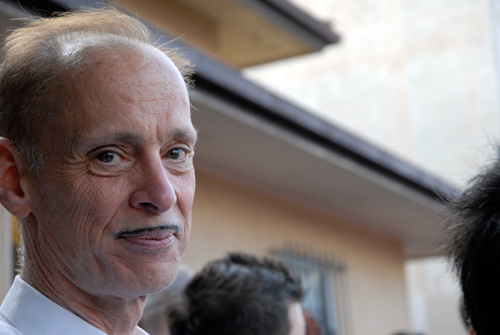
John Waters at the 2009 Folsom Street Fair in San Francisco. Photo copyright Wendy Goodfriend
John Waters at the 2009 Folsom Street Fair in San Francisco. Photo by Wendy Goodfriend

One of the reasons why celebrities like cult-film maker John Waters love San Francisco is that the Bay Area tends to not fawn and make a big deal of their presence. The film director, writer, conceptual artist and Pope of Trash Waters may have fallen for our hometown enough to call it home (if only on a part-time basis). Two years ago, he decided to buy a place in Nob Hill, according to a San Francisco Chronicle report by Catherine Bigelow in January this year. Bigelow described Waters first visit to the Jeannette Etheredge owned North Beach watering hole, Tosca. Waters went to Tosca after he attended the 75th anniversary of SFMOMA with artworld-celeb friends who are also his neighbors here. Sightings of Waters have also been documented on the Mission Mission blog–among other places–last year. There are reports on Mission Mission of Waters hanging out at an art show opening party, as well as the Polk Street post office (from Cooking with Amy’s Amy Sherman), Borderlands Bookstore, and doing his grocery shopping and riding buses and MUNI are sited.

We don’t have any sort of real paparazzi here like the movie hub Southern California (SoCal) does, and instead resort to various ways of noting and communicating encounters and occasional contact with famous types. The bounty of natural beauty, cultural heritage, middling to decent public transportation (which Waters reportedly enjoys using), and of course food culture ranging from street food to California cuisine and white table cloth establishments make the deal of Bay Area living that much sweeter. Northern California is generally a more relaxed environment versus the hustle-bustle-do-you-know-who-I-am? aggression and cheesiness that smacks you in the face constantly in L.A. My first job out of UC Berkeley in the mid-1990s was working for Nancy Hayes Casting, which was then located in Russian Hill. Through that line of work, I was able to work on movie and commercial projects and meet a rash of actors, directors, and related celebrities and creative types in from other parts of the country and world. They often wanted to learn about our city’s bookstores (Green Apple and City Lights remained among the go-to spots that they are today), nightclubs (DNA Lounge ring a bell?), restaurants (everything from Perry’s to Swan Oyster Depot and Rose Pistola to even the now-thankfully-shuttered Planet Hollywood), hikes, and historical places just like any other visitor, famous or not.

Waters’ presence and activities here has been noted frequently in traditional print media, as well as on blogs and other social media including Yelp. He is one famous visitor who decided to take up residence in San Francisco. Although Waters is mainly based out of Baltimore, he also has a home in New York City and a summer home in Provincetown. Waters has been making, writing, and directing films for forty years, and his long body of almost always controversial film work includes Pink Flamingos, Female Trouble, Pecker and two film versions of Hairspray that later became a Broadway sensation. If the names Dawn Davenport, Prudy Pingleton, and Tony The Tickler ring a bell, then you are familiar with Waters often times gross out material that famously includes the scene in Pink Flamingos where Waters’ muse and childhood friend Divine (a drag persona by Harris Glenn Milstead) eats dog feces on camera. The dog-doo poo-poo scene was for real sans cuts, edits or effects, and was ground breaking in the pre-YouTube and Internet era. Censors and prim and proper types may consider Waters, who has long been confirmed as a gay man, to be pushing the boundaries of good taste and decency. Others, who are fans, await his next film or art project with baited breath. His trademark pencil thin mustache is as much a part of his public identity as are his ties to Divine and the Dreamlanders group of Baltimore area actors, Mink Stole, Ricki Lake, Johnny Depp, one time porn queen Traci Lords and the now freed purported criminal and heiress Patricia Hearst. All have played roles in Waters’ work, and show how he creates and uses characters that may already have inherent shock value with the public.

In 2008, Waters was in San Francisco to put on a one-man vaudeville show at the Castro Theater, to benefit the Frameline film festival, which is definitely LGBT friendly. The Castro was a favorite of Waters because Pink Flamingos has played there. Waters vaudeville act was one that he originated with his pal and muse Divine decades ago. He said that he thinks of himself as a “Filth Elder” more so than the “Pope of Trash” nickname he received from William Burroughs. Waters’ elder reference is perhaps his way of acknowledging that he is in his sixties. I emailed The Filth Elder last week to find out the food-centric spots he likes to frequent when he lives in San Francisco. Aside from his picks below, you can also plan on catching Waters at his City Arts & Lectures appearance happening on May 25th for his Role Models book tour…San Francisco is the first stop on the tour.

Waters cites Zuni at the top of his list, adding “my old friend from Provincetown Billy West started it.”

Zuni Café
1658 Market Street (between Franklin and Gough)
(415) 553-2522
Hours: Tuesday, Wednesday, Thursday 11:30 am to 11 pm
Friday and Saturday 11:30 am to midnight
Sunday 11:00 am to 11:00 pm | Closed Monday
(415) 553-2522

The Big Four, where Waters swoons that it is “SOO Sunset Boulevard.” Big Four spokesperson Kellie Samson confirmed that “he usually comes in with a few other people (family and/or friends) and…is quite approachable and has a good rapport and is friendly with our staff. Since he lives in the neighborhood, he’s often seen walking in Nob Hill and on the cable car, etc.”

The Big Four Restaurant at the Huntington Hotel
1075 California Street (at Taylor Street)
(415) 771-1140
Hours: Breakfast Monday – Friday: 7am to 10am
Saturday – Sunday: 7am to 11am
Lunch service at The Big 4 will be available on Thursdays and Fridays between the hours of 11:30am and 3pm, only.
Dinner Nightly: 5:30pm to 10pm
Bar Nightly: 4pm until midnight Thursday – Friday:

All day Piano entertainment Daily, 5pm to 11:30pm
• Michael Parsons (Monday – Saturday)
• Steve Klawiter (Sunday)

Foreign Cinema. Through representative Keelin Czellecz, chef-owner Gayle Pirie & Floor Manager Tracy Smyth commented that Waters “often orders fish” and receives “an amuse [bouche]” from the Foreign Cinema kitchen. Waters told me “I drink Stoli martinis,” and his friends enjoyed gin martinis — 209 Gin with olives. Waters is friendly to curious customers, and “is one of the few celebrities that have come in that people feel like they can go up to the table and talk to him. He is really sweet when he is approached.”

Foreign Cinema
2534 Mission Street (between 21st Street and 22nd Street)
(415) 648-7600
Hours: Dinner
Monday – Thursday 6pm to 10pm
Friday – Saturday 5:30pm to 11pm
Sunday 5:30pm to 10pm
Brunch
Saturday 11am to 3pm
Sunday 11am to 3:30pm

Range
Range Restaurant
842 Valencia Street (between 19th Street and 20th Street)
(415) 282-8283
Hours: Monday – Thursday 6pm to close
Friday – Sunday 5:30pm to close

La Ciccia. Sardinian Italian food in Noe Valley. According to La Ciccia spokesperson Eleanor Bertino, Waters “came in on a really busy night.” Wife-owner Lorella Degan told Bertino that “he was with two other men, and he ordered pasta and was very nice and warm… in no way demanding.”

La Ciccia
291 30th Street (at Church Street)
(415) 550-8114
Hours: Tuesday – Sunday 5:30pm to 10pm (Closed Mondays and Major Holidays)

Nob Hill Café
1152 Taylor Street (between Clay Street and Pleasant Street)
(415) 776-6500
Hours: Monday – Friday Lunch 11am to 3pm, Saturday & Sunday Brunch 11am to 3pm, Dinner Nightly from 5pm to 10pm

The lunch counter in Armani shop. Gina Chinchilla, who is General Manager of the Armani café would only comment, “Unfortunately, we are not allowed to give out any information about our clients that visit the Cafe. We may only confirm that he does indeed frequent our Cafe.”

Armani Café
1 Grant Avenue (between Market Street and O’Farrell Street)
(415) 677-9010
Hours: Monday – Saturday, 11am to 4pm; Sunday from 12 noon to 4pm

See’s Candy: according to Sharyl Mitchell of See’s, “Mr. Waters used to visit our Union Square Shop that is now closed” at 350 Powell Street. He would buy all kinds of candy, and the manager at the store recalls seeing him “all the time.”

BlogHer Food ’09

BlogHer Food '09 Keynote: Ree Drummond, David Lebovitz and Elise Bauer
BlogHer Food ’09 Keynote with Ree Drummond, David Lebovitz and Elise Bauer

Founded in 2005, BlogHer’s mission is to create opportunities for women who blog to pursue exposure, education, community and economic empowerment. Today, it reaches more than 15 million women each month via a Web hub with a listing of over 22,000 blogs by women (ranging from topics on politics, news, and technology, to food, health and family), a publishing network of more than 2500 blog affiliates, and annual conferences like the inaugural BlogHer Food ’09 which took place Saturday, September 26th.

I felt giddy as a school girl as I ran my finger down the list of speakers lined up:

David Lebovitz, David Lebovitz: Living the Sweet Life in Paris
Diane Cu and Todd Porter, White on Rice Couple
Elise Bauer, Simply Recipes
Heidi Swanson, 101 Cookbooks
Helen Dujardin, Tartelette
Jaden Hair, Steamy Kitchen
Matt Armendariz, Matt Bites
Pim Techamuanvivit, Chez Pim/Menu for Hope
Ree Drummond, The Pioneer Woman Cooks
…among others.

These are the blogs I turned to for inspiration and guidance when I first decided to create my own. These are the people I looked to and thought, yes, that is what I want to do! To carve out a little space of my own, building my own story with each scrap of experience, word, or crumb I shared with the world.

As I sat amongst 300 fellow food writers/bloggers, rapt with attention as our blog crushes talked about the trials and tribulations, joys and inspirations of food blogging, I felt a wonderful sense of community. Regardless of where we were from, what we liked to write about, how long we’ve been at it, we had at least one thing in common…food. And the inexplicable need to talk about it.

And talk we did.

The day was divided into three tracks: Visual, Vocation, and Values, with speakers represented from diverse backgrounds and perspectives.

blogher-food-09-Matt Armendariz and Heidi Swanson
“Developing Your Visual Voice” — Matt Armendariz and Heidi Swanson

The Visual Track focused on food photography — developing your visual voice, basic principles and techniques, and how to take your photography to a new level.

blogher-food-09-Jaden Hair, Helen Dujardin and Amy Sherman
“Your blog is great…now what?” — Jaden Hair, Helen Dujardin and Amy Sherman

The Vocation Track delved into best practices on building a better blog, blogging as a profession, developing business relationships online and offline, and protecting yourself and your work. Bay Area Bites’ very own, Amy Sherman from Cooking with Amy moderated a panel in this track all about letting your blog lead the way to new opportunities.

BAB also represented on the Values Track, with Jen Maiser, the woman behind the Eat Local Challenge, leading a discussion on “The Politics of Food…and Food Blogs” — the very deliberate movement to change minds within and about the food industry. This track also explored “How Food Blogs Can Save the World,” with discussions on how bloggers can support issues they care about, and how to take that action offline as a volunteer or activist.

And, of course, there was food.

blogher-food-09-Rocco DiSpirito
Rocco and the lunching ladies

While overcooked pasta for lunch left much to be desired for, it appeared that Rocco DiSpirito did some damage control with his amped up charm, flying from table to table (dizzying as it may have been).

TuttiFoodie and Scharffen Berger hit the sweet spot with its Chocolate Adventure Contest demo with Elizabeth Falkner, Executive Chef of Citizen Cake and Orson.

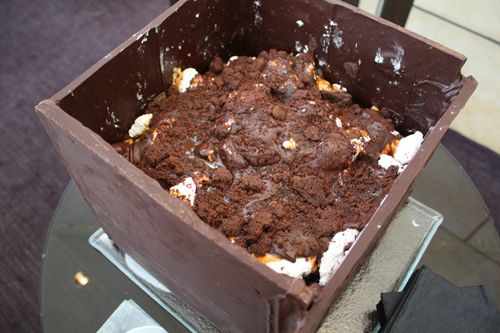
The concept of the Chocolate Adventure Contest is to create an inventive recipe using Scharffen Berger chocolate and least one of their 17 listed “adventure ingredients.” Chef Faulkner demonstrated her confectionary prowess by using 11 of them in her Chocolate Adventure Box, layering all sorts of goodies like homemade pandan-flavored marshmallow, peanut butter, cumin, and corn nuts, among other things.

blogher-food-2009-Elizabeth Falkner
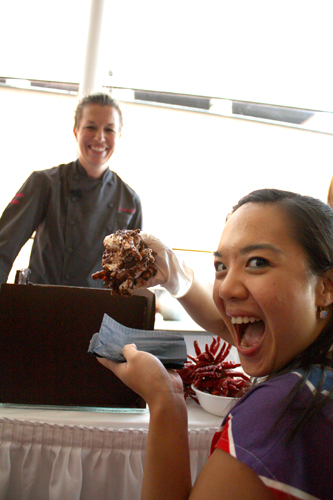
Chef Elizabeth Falkner gets sticky

blogher-food-2009-Chocolate Adventure Box
Chocolate Adventure Box

Now for the fun part…

blogher-food-2009-chocolate adventure box
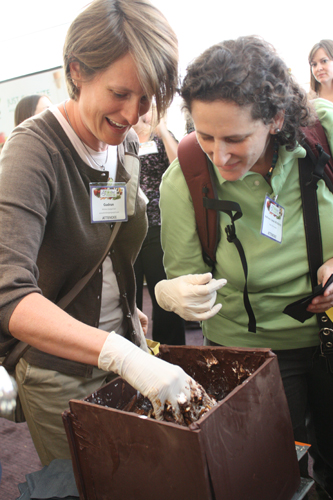
Dive in! (Gudrun from Kitchen Gadget Girl goes fishing)

blogher-food-2009-scharffen berger chocolate adventure contest
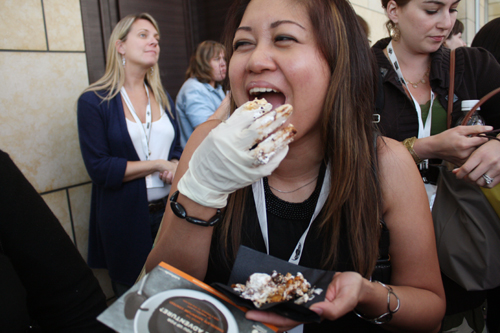
Yeaup, really get in there (Photo credit: Amy Wilson, Streaming Gourmet)

After we were sufficiently sugar-high, the Closing Keynote treated us to an open discussion with Elise Bauer, Ree Drummond and David Lebovitz — three accomplished bloggers who have been at this a while. With very different styles and approaches to blogging, it was interesting to hear how they responded to similar challenges of sustaining momentum and avoiding burnout. It was also reassuring to hear that 1 post typically takes them anywhere from 4-6 hours to complete…and that it doesn’t always come easy to them.

blogher-food-2009-Todd Porter, Diane Cu and David Lebovitz
Party time: Todd Porter, Diane Cu and David Lebovitz

BlogHer Food ’09 was very much about community, support, and growth. More coverage on the conference can be found in the live-blogging forums, but for a quick recap, here are my 5 take-aways from the sessions:

• Create opportunities — Put yourself out there. Talk to people. Network. Step away from the computer.

• Come from a place of authenticity — Sincerity goes a long way.

• If a business is what you want, treat it like a business — Have a plan, make goals, create a vision that will keep you inspired.

• Share more than just the sugar and the flour — People want a person and a life behind the blog. Don’t be afraid to share your story.

• Writer’s block and burn out — Happens to the best. Remind yourself of what you want. Do what makes you happy.

At the end of the day though, the highlight was getting to meet so many kindred souls. The weird and beautiful thing about blogging is how well you get to know someone from a distance. It was a real pleasure meeting many bloggers I’ve been following for months, and in the end, I guess that’s what it’s really about. Human connection (over something good to eat).

blogher-food-2009-chocolate adventure box
Joy, Gourmeted

Bay Area Food Bloggers on Twitter

twitter logoDo you know about Twitter? It’s the reason that many Bay Area food blogs have been lying dormant lately, and why mothballs are piling up on our RSS readers. Twitter is a “micro-blogging” site where users can post statements of 140 characters or less. And many of us do it, many times a day. It’s quick and following your favorite bloggers is easy to do. Even if you’re not interested in “tweeting” yourself, you can set up a Twitter account and follow your favorite bloggers. Just select the links below and press “follow” under the username. Then, each time you go to Twitter, you’ll be able to see what everyone is up to.

Why follow Twitter? Is it just one more time-waster in a day? Maybe, but I am starting to feel differently. Folks who follow Bay Area food blogger Pim found out yesterday that Daniel Patterson had scored two Michelin stars for Coi before any large news organization had reported it. Using Twitter, you can talk directly to the corporate offices at Whole Foods. And many of us talk about the food news of the day on Twitter long before we write blog posts or comment on community boards.

Twitter is also changing the way that organizations do business. To learn more about that, check out this story about Twitter on Marketplace.

I’ve listed some of the Bay Area Twitter feeds that I follow below. You’ll recognize the first few as authors on Bay Area Bites. This list, however, just scratches the surface. For a more comprehensive list of food bloggers on Twitter, see the Serious Eats list.

Stephanie, Grub Report
“Having hot cocoa and Kraft Mac ‘n’ Cheese for breakfast. Clearly, I am now 12.”

Amy Sherman, Cooking with Amy
“off to buy polenta. I always think I have it on hand but then it turns out to be couscous or cornmeal…”

Bay Area Bites
“Temescal farmers’ market rocks! cauliflower, artichokes, shitake mushrooms, lamb sausage…and, of course, indian food…my sunday addiction”

Shuna, Eggbeater
“One day establishments specializing in sweet things will eradicate the mis-spelling DESERT. One Day… One can hope beyond hope, yeah?”

Michael Procopio, Food for the Thoughtless
“currently working both a Wells Fargo dinner and a Morgan Stanley…”
“Fargo folks are laughing, Stanley folks are not.”

Genie, The Inadvertent Gardener
“Four hours until I have to leave the house again to get to my dinner engagement. Need to make a realistic list that does not include sloth.”

Pim, Chez Pim
“I can eat cream cheese frosting by the cupful, really I can, and I am…um, eating it, by the cupful…”

Kristin, Offbeat Eating
“Yum, had my first pupusa–bean and cheese–at the Alemany farmer’s market. I could get used to eating those.”

Biggie, Lunch in a Box
“Used a pile of beautiful tomatoes tonight in a no-cook pasta sauce with smoked mozzarella and basil. Bug approved, wants the rest in bento.”

Jennifer Jeffrey
“Tamari-sesame rice cakes: eh. Not exactly what I was looking for in a mid-morning snack”

Sam, Becks & Posh
“My work colleagues raised their eyebrows at my radish-eating habits today. I took a pile of them to a meeting for a snack. They think me odd”

Denise, Chez Us
“I have to say vanilla bean spongettes w/burnt caramel sauce was OUTSTANDING! I will post all later … tomorrow.”

Sean Timberlake, Hedonia
“is making leftovers ragù: lamb/beef shank from Friday’s ad hoc ossobuco, lamb chop/rabbit from Eloise last night, braising liquid & tomatoes …”

Derrick Schneider, An Obsession with Food
“Making Heidi Swanson’s ‘Do-it-yourself Power Bars’ because we were near Rainbow Grocery, the only store that carries all the ingredients.”

Elise, Simply Recipes
“just posted my rabbit cacciatore … Waiting for the ‘You can’t kill thumper!’ people to descend.”

Organizations I follow on Twitter
Serious Eats
Whole Foods
Center for Food Safety
American Farmland Trust
BART(so I can get to my dinner dates on time!)

And you can find me Twittering here.

KQED's Forum: Slow Food Nation

forum logo
listenListen to Slow Food Nation on KQED’s Forum.

Slow Food Nation
This Labor Day weekend San Francisco will host Slow Food Nation — a four day gathering to promote sustainable and healthy food. We talk with organizers and experts in the slow food movement, exploring the connection between our plates and the planet.

Host: Michael Krasny

Read Amy Sherman’s Event post about Slow Food Nation.

Depression (Era) Food

Yes, I know. The word of the hour is recession but, frankly, I don’t know the difference. Nor do I much care, since I’ve never had much money to lose anyway.

On Tuesday, my cousin Stephanie sent me an odd little collection of cookbooks from the 1930’s– all three of them product-related (Heinz 57, Royal Baking Powder, and Crisco). They made me giddy. And then, out of nowhere, my friend Lyle hands me a book called Cheerio! — a cocktail book from 1930. Published in New York in total contempt for the Volstead Act. If ever there was a time one needed a drink, it was the 1930’s. Unless it was the 1940’s, of course.

On Wednesday, Amy Sherman commented that online traffic to low-cost ingredient recipes has nearly doubled in the past three months.And yesterday? While soaking in a bathtub full of gin before work, I noticed, as I flipped through the pages of Saveur magazine, that this month’s issue is featuring items like Mock Apple Pie, Rabbit Stew, and pasta, pasta, pasta.

In case, you didn’t know, that’s poor people food.

Is the American mindset taking a turn towards the cheap? I think this will be rather fascinating to watch. History repeating itself often is. If one doesn’t mind reruns, of course.

In the meanwhile, I think I’ll just pour myself a Cholera Cocktail, put a little Al Bowlly on the Gramophone, and wait for all this anxiety explode into a delicious panic.

Have a lovely weekend.

From Lemons, Lemonade

At some point in his motivational speaking career, Dale Carnegie uttered the famous, if misguided words:

“When fate hands you a lemon, make lemonade.”

The fault is not so much in the sentiment– making lemonade out of lemons is, naturally, a rather positive, productive activity. What bothers me is the underlying belief that there is something inherently unpleasant about this citrus fruit. Carnegie was not alone in his thinking. Used car salesmen have given the lemon a bad name over the years, associating them as they do with automobiles that are slick and shiny on the outside, but of dubious dependability under the hood, which is all rather pot vs. kettle when one stops long enough to think about it.

All I know is this– Carnegie’s family certainly didn’t hail from a sunny, Mediterranean clime, or he would never have said it. He might instead have related his comment to the Germans or the idea of an eight-hour work day. When fate hands you a German… you can fill in the rest.

Of course, Carnegie was telling his audience that, when fate hands you something unpleasant, make the best of it. When fate hands me that kind of lemon, I would more than likely stare at it for a moment and say something like, “I don’t think that lemon is mine,” and walk away.

When fate or, more often than not, the supermarket checker hands me an actual lemon, I am more likely to own it. When fate hands me Meyer lemons, I get happy.

I am not about to delve into the history and genetics of the Meyer lemon today. Others have done it well enough that I do not have to. I suggest you let our own Amy Sherman tell you about them. Read her blog post on Meyer lemons.

If you want a few ideas as to what you can do with Meyer lemons, read another Amy’s (Scattergood) fun list “100 things to do with a Meyer lemon” from the Los Angeles Times online to get some great ideas. Some are oddly practical, like playing fetch with them in order to freshen canine breath. If you can come up with other uses, please let me know. No one has mentioned the Meyer lemon as an elbow-softener. Perhaps there are few people who still care for supple joints as I do.

And if you really, really want to know everything you could possibly want to know about the lemon, its history, and its uses, by all means go out and buy yourself a copy of Much Depends on Dinner by Margaret Visser. It’s quite a fascinating read.

Look, I just like lemons. Perhaps it’s my Sicilian heritage and the fact that my ancestors actually earned their bread and marmellata exporting the little yellow fruits. Which leads me to wonder that, had Dale Carnegie been born, say, Dale Carneghi, he might have said, “When fate hands you a lemon, make limoncello.” But he wasn’t and he didn’t, so I am stuck with making lemonade for the purposes of today’s post.

It strikes me as a cruel twist of fate that a fruit which makes such a great summer thirst-quencher should reach its peak in the dead of winter, but that isn’t going to stop me from making it. One still needs to stave off scurvy, even in the chilly months. What better way to pretend that winter isn’t happening than to wear gingham, put some zinc oxide on your nose and pour yourself a tall glass of lemonade? It is denial perfected. After all, I believe it was Mr. Carnegie who also said, “Happiness doesn’t depend on any external conditions, it is governed by our mental attitude.” I am not going to argue with him about that. With that as my new credo, I shall chose to pretend it isn’t raining outside, my complexion isn’t pasty, and I haven’t gained 10 pounds. Instead, you’ll find me inhabiting my inner world, where it’s perpetually sunny, and I am always tan and thin. Thanks for the motivation, Dale.

Meyer Lemonade

Meyer lemons are ideal for making lemonade. Lacking confidence in their own identity (half lemon, half mandarin), they share space well with others. Three flavors that blend well (in lemonade) with the fruit are mint, cucumber, and coriander. Yes, coriander. Don’t ask me how I know. I have chosen mint today because it is pretty.

Ingredients:

1 cup freshly squeezed Meyer lemon juice– about 5 to 6 lemons, depending upon size and juiciness. You can actually squeeze them the night before– the juice won’t separate like orange juice does.

1 cup simple syrup. Mint is added to mine here. I’m not telling you how to make simple syrup.

3 to 4 cups cold, clean water.

Mint sprigs and (very) thinly sliced Meyer lemons for garnish.

Ice cubes, if you’re into them. I find they keep the garnish from floating to the top.

Preparation:

1. Take all the ingredients and dump them into a big enough pitcher. Stir and serve.

Or, if you want to be very French about it and serve it comme un vrai citron pressé…

1. Place lemon juice and syrup in the antique apothecary beakers you found for next to nothing at the marché aux puces in Dijon last autumn. Place on a tray with chilled, bottled Volvic, one pastis glass and spoon per person, and a pack of Gauloises Blondes. Let your guests prepare their own concoctions, according to personal taste.

Note: If you opt for cucumber lemonade, slice up a cucumber thinly, add to the water and refrigerate for 24 hours. For coriander? I haven’t quite figured that one out. I’ll let you know when I do.

Serves 4 to 6.

Menu for Hope: Food Bloggers give Back

One of the annual highlights in the food blog community is Menu for Hope – a fundraising event that raises money for the World Food Programme, a United Nations Food Aid Agency. Annually, the event is hosted by Pim Techamuanvivit from Chez Pim. Last year, Menu for Hope raised an astonishing $60,000.

The funds this year will be going to a school lunch program in Lesotho, Africa. According to Pim, the Lesotho program is focusing on “buying food locally to support local farmers and the local economy”. (Do I have to tell you how excited I am about this program?)

Food bloggers around the world offer prizes — everything from cookbooks to fully cooked meals — that are bid on by donors who donate $10 per virtual raffle ticket. A full list of prizes can be found on the Chez Pim site. As of this morning, over $7,000 has already been donated to this year’s event.

Each year, the Bay Area boasts some prizes that can only be claimed if you live in the area or if you travel here to get your prize. Here are some of my favorites so far (along with the prize code in parenthesis):

(UW08) Custom Mixology Service
Anita and Cameron from Married with Dinner often feature amazing drinks and spirits on their blog. Win their prize and they will work with you and come to your home to create delightful cocktails for you and 12 guests.

(UW32) English Afternoon Tea
This year, Sam from Becks and Posh is offering a tiered prize. If the total amount donated to her prize is over $2,500 and you live in or can travel to the Bay Area, she and June Taylor will host an English Afternoon Tea for you and your friends.

(UW10) Dinner for 2 with wine pairing and a private tour of Manresa’s biodynamic garden with chef David Kinch.
Pim is offering this prize with her partner, David Kinch and it involves dinner at one of the most lauded restaurants in the country.

(UW04) Boccalone Boar Sacchetto of artisan salumi
Boccalone is a new entrant on the local salami scene, and the Bunrabs are offering this gift courtesy of Boccalone. Prize must be picked up at the Oakland or San Francisco Salumi Society gathering.

(UW17) Dinner for 8 prepared by Brett Emerson
Brett Emerson, owner of the soon to be opened Contigo, is offering dinner made for 8 people in his new Noe Valley home.

(UW18) Bento Box and Tour of SF Japantown with Lunch in a Box.
Biggie, the blogger at Lunch in a Box, is a person who I’d like to explore Japantown with. She’s fluent in Japanese and could probably explain many of unidentifiable Japanese foods to me.

You can find other gifts donated by West Coast bloggers (including our own Amy Sherman) at Rasa Malaysia.

Nuts and Bolts of participating:

– Donating started yesterday and continues through December 21.
– To donate, go to First Giving. To specify a specific prize, follow the instructions on the Chez Pim website (scroll down to the instructions and screenshots).
– Check back on January 9 to see if you’ve won!

Celebrity’s Pasta Lover’s Cookbook

Yesterday in a jetlag haze, I turned on the television. On a certain morning program a certain host was discussing insomnia and in the same breath joked that watching “c-span” might serve as a possible cure. It struck me as pretty funny that even daytime TV has staked out its place in the pecking order. Ok, I can hear them saying, we might not be primetime but we’re better than c-span!

In addition to tips on skin care, a recap of the Miss America contest and Oscar fashions (now you know why you don’t watch daytime TV) was a segment with Mario Batali and Kristin Davis promoting a free pasta cookbook that is also a fundraiser for America’s Second Harvest. Hold the phone! I take back all the mean things I said about daytime TV!

I love Mario Batali, I love pasta and I passionately believe in the work of America’s Second Harvest. Believe it or not, I’m pretty big on Barilla pasta too. In Italy it was the “house brand” with my family and so it is for me most days.

I checked out the cookbook and found it filled with celebrity recipes that have been “tweaked” by Mario Batali and Giada De Laurentis. The recipes look terrific, and why wouldn’t they be? But better yet, by downloading a copy of it, for free, Barilla will donate a $1 to America’s Second Harvest and you can even specify your own local food bank if you so desire. Nice. A definite win, win, win. Go get your copy. And stay away from morning TV, unless of course it’s Sesame Street.

post written by Amy Sherman

Little Saigon, Orange County, California

By pure coincidence, two of your Bay Area Bites authors will be taking a trip to Vietnam in the next few months. Amy Sherman and I separately planned trips are both packing our bags and getting our palates ready to taste the wonderful food of Vietnam.

In preparation for my upcoming trip, I took a drive through Little Saigon in Southern California this week. Little Saigon crosses parts of Westminster, Santa Ana, and Garden Grove in Orange County, and is considered the oldest, largest, and most prominent Vietnamese community in the United States.

The restaurants and food offerings in this community are remarkable. Everywhere you look, there is an overwhelming number of pho shops, banh mi stores, and restaurants offering food from every part of Vietnam.

Knowing that I only had a limited amount of time to spend in Little Saigon, I consulted several reference sites that cover the area, and made a concrete plan. The area is spread over several square miles, and I was glad I had a set plan in order to hit the best spots.

My first stop was New Trieu Chau Restaurant. It had been described on Chowhound as having the “best noodle soup you can get”. The menu is large but descriptions are brief and not very forthcoming. I chose soup with thin egg noodles, and it came with cut pork, pork balls, chicken, liver and shrimp. The broth was satisfying and the noodles were perfect. Thin and firm, I slurped up every bit of noodle that I could. Chowhound posters also mention that the donuts here are good for dunking in soup, but as this was my first stop of several, I skipped the donuts.

Across the street from New Trieu Chau is a chain store called Lee’s Sandwiches. Lee’s serves banh mi sandwiches, cream cakes, baguettes, and other various items in their clean and well-lit store. I’m not a banh mi expert (yet) so don’t really feel I can judge it, but the pickled slaw on my BBQ Pork sandwich was craveable, and the baguette was delicious. Next time I come to Little Saigon, I would like to try the favorite of Elmomonster and other Little Saigon experts: Banh Mi and Che Cali. Elmonster claims that Lee’s Sandwiches serves a good sandwich, much like In N’ Out serves a good, mass-produced burger, but that Bahn Mi and Che Cali is the real deal.

The restaurant that I was really sorry to miss this trip is called Brodard. It’s well known for Nem Nuong Cuon: Spring rolls wrapped in rice paper with a fried egg roll inside. The roll has pork in it, and is supposedly quite delicious. Alas, Brodard was closed and I am going to have to try it another time. It’s in the same shopping center as New Trieu Chau, but it’s located behind the 99-cent store, in the very back of the shopping center.

The Thanh Son Tofu Factory is an interesting shop that contains all types of tofu products that you can imagine. Here, I bought a tasty tofu pudding which was a large container of piping hot tofu with a container of sugar syrup on top which, when added to the tofu, makes a tasty dessert. This crowded store was full of people buying fried tofu products, soy milk, and fresh tofu to take home.

In addition to the locations above, the ABC Supermarket is worth a trip. The store is chock-full of all sorts of Vietnamese goodies and is a fun place to check out. Additionally, the Asian Garden Mall has many small food stalls that had tempting looking food. The Asian Garden Mall would be a good place to try a wide variety of Vietnamese foods within a small area.

REFERENCE SITES FOR LITTLE SAIGON

Wikipedia: Little Saigon
Monster Munching, a blog about eating in Orange County that covers many restaurants in Little Saigon.
The OC Weekly.
Chowhound

RESTAURANTS AND STORES MENTIONED IN THIS POST

ABC Supermarket
8970 Bolsa Ave (at Magnolia), Westminster

Asian Garden Mall
9200 Bolsa Ave (between Magnolia and Brookhurst), Westminster

Banh Mi and Che Cali
8948 Bolsa (at Magnolia), Westminster

Brodard
9892 Westminster Ave (at Brookhurst), Garden Grove
Closed Tuesdays
(714) 540-1744

Lee’s Sandwiches
13991 Brookhurst Street (at Westminster), Garden Grove
(714) 636-2288

New Trieu Chau Restaurant
9902 Westminster Ave (at Brookhurst), Garden Grove
Open 7 Days
(714) 537-2433

Thanh Son Tofu Factory
9688 Wesminster (between Magnolia and Brookhurst), Garden Grove
(714) 534-2100

Books for the Seasonal Cook

When I first started cooking with the seasons, I had to make some transitions in the way that I cooked. Before this time, I would find a recipe that I wanted to make, and then would go to the supermarket to find each ingredient. Nevermind that it was the dead of winter and I was looking for zucchini, the market provided exactly what I needed.

Once I started going to the farmers’ market on a regular basis, I found I wasn’t always finding what I needed. “Do you have cilantro?” I’d ask. “Not in season,” the farmer would tell me. Nevermind that I had to have cilantro for the dish I was creating. I was faced with a problem: I could either ditch the idea of eating seasonally and run to Albertson’s for cilantro from a far away place or I could adapt the way that I cooked to match what was available at the farmers’ market.

These days, cooking is a much different proposition. I often have less control over what vegetables are in my household, and I rarely walk out of the house with a recipe that is hard and fast. Most vegetables come to me through the CSA we belong to, and with that, we have no control over what comes to us. Any other items I supplement come from the farmers’ market but I often go with nothing in mind and return with whatever looked best that day.

At home, I have collected a bookshelf of reference books to guide me whenever I have a foreign fruit or vegetable. Before this year, for instance, I had never cooked with a rutabaga. It showed up in my CSA box with a few suggestions, but I wanted to know more.

My first reference for what to do with vegetables is usually Vegetables from Amaranth to Zucchini by Elizabeth Schneider. Schneider shows a photo of the vegetable, and then a lengthy description. From her book we find out the rutabagas came to the United States in the 19th century, and that you can have success cooking rutabagas in any way aside from the way that most people cook them: boiled for a very long time. Schneider then outlines basic uses for the rutabaga in a general manner: you can julienne it and serve it raw, marinate it in salads, or steam it until al dente among many other suggestions. From the “selection” section we learn that we want our rutabagas to be relatively heavy as that implies juiciness.

The last section of each entry is the one that I often read first. In an area called “Pros Purpose,” Schneider asks lots of industry professionals what they do with rutabagas in their kitchen. This section does not have specific recipes, but usually has short blurbs from many chefs generally describing dishes in their kitchens featuring the vegetable.

When I first mentioned buying The Victory Garden Cookbook last summer, fellow BAB writer Amy Sherman commented “You will LOVE the Victory Garden Cookbook, mine is falling to shreds…”. Marian Morash first published the Victory Garden Cookbook in 1982, and I remember it well from growing up. To this day, my mom uses Morash’s scalloped potatoes recipe from this book. The Victory Garden Cookbook combines growing information about specific vegetables with preparation methods and general information for those of us who don’t grow our own food.

In Morash’s section about rutabagas, we learn some additional tidbits about rutabagas. They can be stored for a couple months if unwashed and stored in a container of dry sand, sawdust or peat. Another option for storage is to freeze mashed or pureed rutabagas. In her many recipes, there is a delicious-sounding Shinbone Soup with Turnip and Rutabaga made with beef shinbones, and even a sweet rutabaga pie, as she says that root vegetables make “wholesome yet delicate pies.”

When Heidi talked about The Organic Cook’s Bible on her site about a month ago, my first response was suspicion. I am generally wary of books that are targeted at “organic” cooks, as I feel that someone using organic ingredients can use any recipe available, and that it is a marketing ploy to make people buying organic foods think that they need to find books aimed at them. One look at this book, however, and I knew that I had to have it.
Jeff Cox’s 500-page tome is organized into sections describing “Vegetables”, “Fruits”, “Nuts, Seeds, Beans & Grains”, “Herbs and Spices”, and “Meats, Dairy & Eggs”. The layout for each entry is well-organized and easily understandable. After spending just three weeks with this book, I am already finding it to be an invaluable reference. The entries are succinct, but give the reader a lot of information about each fruit and vegetable.

From the rutabaga entry, we discover that some rutabagas are grown for their seeds and commercially become canola oil. Cox explains the season that rutabagas are available (fall and winter) and has a lengthy description about uses. His approach seems to be very much that of a consumer who has used most of these fruits and vegetables in his home kitchen, though he is well qualified by having been and editor of Organic Gardening for many years, as well as hosting Your Organic Garden for public television.

If you are a seasonal cook like me, any of these books would be an invaluable addition to your library.