
How Dissecting a Pencil Can Ignite Curiosity and Wonderment

4328886363_99bb6cae82_o
David Cosand/Flickr

Can the act of making or designing something help kids feel like they have agency over the objects and systems in their lives? That’s the main question a group of researchers at Project Zero, a research group out of the Harvard Graduate School of Education, are tackling alongside classroom-based teachers in Oakland, California. In an evolving process, researchers are testing out activities they’ve designed to help students to look more closely, explain more deeply and take on opportunities to change things they see around them.

The program is called Agency By Design and it relies on nimble, malleable activities Project Zero researchers call “thinking routines” that slow down the pace of the classroom to make space for deep observation and wonderment. That happens by talking and discussing objects or systems in the everyday world to help kids develop words to describe their thinking. It’s more a framework than a specific step-by-step process. The Oakland educators experimenting with thinking routines teach a range of ages across public, private and charter schools. They each adapted the exercises to fit their purposes.

“The main focus we’re looking at is an idea about how students might gain an alertness to their designed world, the designed objects and systems in their world,” said Jessica Ross, a senior practitioner specialist at Project Zero. “If you have multiple opportunities to engage with the designed world and notice the complexities of the design, will those repeated activities allow you to see that you might change that design?” Ross queried.

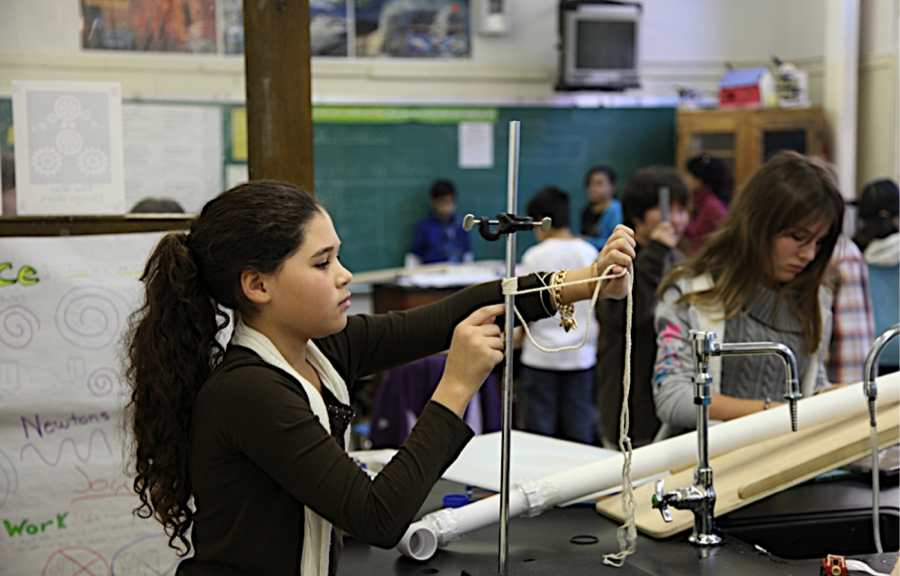
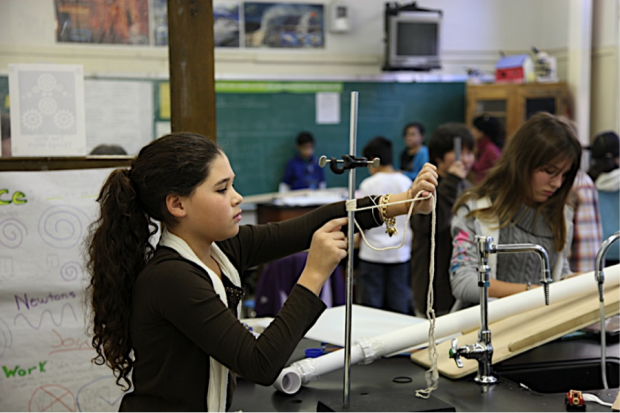
One big emphasis in the project so far has been on looking deeply at even the simplest of objects. In a thinking routine called “parts, purpose, complexity” students are asked to carefully observe the individual parts that make up an object. When each part has been thoroughly explored they start discussing and wondering about the purpose of each part. Then they think about how even a simple object can be complicated when broken down into its component parts.

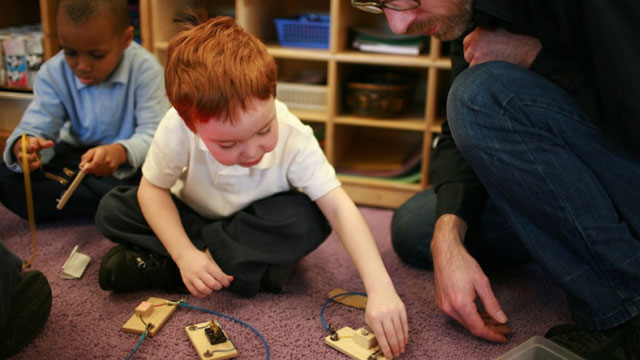
A public school kindergarten teacher at Emerson Elementary found that this thinking routine needed to be broken down further for her young students. She first thought she’d try the “parts, purpose, and complexity” routine to toy cars. “What we found was that students didn’t have the language for them to go really deep,” said Carla Aiello, “so we started looking at a pencil because it’s an everyday object they use all the time and that they have language for.”

Because students were looking at something completely ordinary, they were able to describe very specifically what they were noticing, dissect its simple parts and talk about how those parts work together. Students even designed their own pencils and looked at mechanical pencils as a design innovation. “That could lead into thinking about not just objects, but systems, and are they working for you, and if not why, and what would you do differently,” Aiello said.

Now, Aiello says she sees students approaching all their work in a different way. A thinking routine called “see, think, wonder” has opened up her students’ ability to question. In the routine students look closely at something, take note of their thinking and then ask questions about what they can’t see.

After introducing this thinking routine, Aiello moved onto a science unit on snails where she didn’t intend to introduce any Agency By Design material. But her students approached the snails with a depth of observation she’d never seen them use before. They started talking about the parts of snail, what they do, how they work together. She and the kids charted what they noticed visually (making thinking visible), which helped each child see how his or her classmates were thinking and helped spark new ideas that pushed their thinking a little deeper. They ended up talking about what they could design to make life easier for the snail, including the ideal habitat and conditions for it to live.

[contextly_sidebar id=”26zSmLGBXNKxa1PfONamX6yUJFdjBlPj”]

“I’m moving them in a direction to question things around them and be really curious about the world around them,” Aiello said. She sees the routines building critical thinking skills and reigniting wonder in her students, something she hardly saw before, even in kindergarteners. The open-ended quality to wondering, and lack of a right or wrong answer, has also inspired her students to start wondering about more the stories they read in class. That was a new experience for many of them, who don’t often read at home and aren’t accustomed to questioning stories they’re told.

“It’s already changing how I approach science, and even art; I definitely think more about how to get students to question and problem solve,” Aiello said. She thinks it has been helpful as she tries to teach the Common Core too. “They’re going to have to defend their thinking and so practicing this kind of thinking is going to set them up for the real critical thinking they’ll do later.”

The routines have also given kids who struggle with academics like handwriting, math or English Language Arts to show their creativity and success in school. “[Some] really excelled at looking closely and defending why they were creating something a certain way, and had really thought through why they were doing something,” Aiello said.

APPLYING THE METHOD TO HIGH SCHOOL

When Brooke Toczylowski, a high school art teacher at Oakland International High School first heard about Agency By Design, she wasn’t sure its focus on Maker Education fit the art classroom. She thought of it as something technical, for engineers and programmers. “My thinking has shifted,” she said because the project emphasizes the crossover between designing and making.

In many ways Toczylowski was already practicing skills like close looking and iteration in her classroom because art has always required prototyping, changing course and incorporating critique. But she sees Agency By Design as a great way to bridge the gap between the arts integration work she does and the subject area teaching of many of her colleagues.

“Teachers are designers; they design lessons every single day,” Toczylowski said. “They are trying to meet the needs of their students all the time. It’s a natural fit for teachers, their brains work that way.” So giving her colleagues actual tools like “parts, purpose and complexity” or “see, think, wonder” has been a helpful to all the teachers at her school who are beginning to build those models into their subject areas.

Oakland International teachers have found the thinking routines especially helpful because all of their students are English Language Learners who have been in the country for a short time. Scaffolding language is a part of every teacher’s job, even in art, and giving kids thinking routines that they can do again and again, while developing their language skills is a natural fit.

“It’s just a great way of looking at the world in general, it’s a great way to build curiosity,” Toczylowski said. She’s found that the routines work well with her under-privileged students of color, so she uses them, but she’s troubled at how little diversity there is in the Maker-ed and design thinking movements. She’d like to see these kinds of professional development opportunities offered to more Title I teachers, to help inspire the kind of creative teaching that can ignite learning in all kids.

At the end of last year, Toczylowski worked with a small group of students for three weeks every day, all day on a design project. They redesigned and built new tables for the art room. “They’re these gorgeous wooden tables that students designed and built,” she said. Student conducted interviews to determine what needed changing, and ended up building tables of various heights built in storage space for binders and drawers for materials. They even repurposed some old district materials. At the end of the three weeks Toczylowski said they were much more comfortable with the idea of themselves as designers and builders.

In an after school design group Toczylowski and a group of students even took on a library redesign. They moved a wall, carved out a reading space, moved the mailboxes to somewhere more private and reconceptualized how the space could be used. “We sparked this idea at our school that you can alter and change space and that space is an important element of how we experience education,” Toczylowski said.

They ran into bureaucratic problems along the way, which led to a deeper realization about the way schools operate. “The structure of school is not necessarily set up for deep, hands on, mucky learning,” Toczylowski said.

A COMMUNITY OF LEARNERS

While the research and in-class experimentation with design thinking oriented routines has been eye opening to many teachers, even shifting how they think about their practice, one of Agency By Design’s biggest strengths has been to provide teachers with a community to come together and share ideas. Even better, Project Zero researchers valued teacher’s input, tweaking activities based on their feedback.

“These kinds of projects invest in teacher’s personal learning, which has major impact in the classroom,” Toczylowski said. “An engaged, happy, curious teacher is going to inspire his or her students in that same way.” She especially grateful for the local focus of the project, which was funded by the Abundance Foundation, an Oakland group that requested the research take place in schools in a specific neighborhood. “What’s really exciting is that it has built this network, which never happens,” Toczylowski said. “Some of us are within blocks of each other and we’re coming together to do research and try things.”

Project Zero researchers also recognize that to change classroom practice the research must first make sense and resonate with the teacher. “With any of this kind of work you have to think about the teachers who are exploring this and having time to think about this,” Ross said. Thinking routines that spend a good amount of time just looking at an object might not automatically appeal to a harried teacher trying to get through a busy year.

“We expect teachers to be professionals, to know their learners and know the content they are introducing alongside it,” Ross said. That professional courtesy and the deep discussions around pedagogy and practice are why many teachers enjoyed participating in the program even though it took significant extra time and energy. For their part, researchers are tremendously grateful to teachers for helping them hone their research questions. The research hasn’t yet produced any definitive results, but now they know better where and how to look.


Need Help Picking the Right Learning Game? Some Things to Consider

Getty
Getty

Part 18 of MindShift’s Guide to Games and Learning

To make sense of the broad and complex world of games and learning, we’re inclined to create neatly organized lists and categories. The truth is that there are so many different kinds of learning games, it’s difficult to break them down into clear-cut categories. Especially in an atmosphere of ed-tech entrepreneurship that aims to disrupt our habitual way of thinking about education, familiar classification structures can sometimes hold us back more than they move us forward.

It feels contradictory to divide up the learning games landscape after arguing, earlier in this series, that games can help address the educational need to break down the boundaries between traditional academic content areas. Taxonomy is always tricky and useful only to the degree in which it simultaneously acknowledges ambiguity and fuzziness. But to make it easier to digest, let’s explore some classifications.

What criteria matter when considering learning games? First, ask the broad questions: How and when a game can be used? Then, be more specific: What kind of game is best suited to particular learning objectives?

Short-form, Long-form and Crossover Games

When teachers plan activities for the classroom, we’re usually constrained by the school schedule. Time is set aside for class and we need to work within this framework. Teachers, therefore, think in blocks of time; video game developers don’t. Most video games are played over a longer period of time, often broken down into smaller individual sessions.

[contextly_sidebar id=”6co4wDTE1G50fXB2gNUASQm9L52u2Tfh”]

Think about the earliest iterations of “Super Mario Brothers.” Although you may play only for 30-40 minutes at a time, the game remembers your progress and you can come back to start again from just where you left off last time. Gamers remain on a long continuum toward mastery. How does such a journey translate into the classroom?

In their report, Games for a Digital Age: K-12 Market Map and Investment Analysis, the Joan Ganz Cooney Center makes the distinction between short-form and long-form games. They point out that in a day that’s divided into 40-minute class periods, “transition time and time for instruction or discussion connected to curricular material frequently leaves only 20 to 30 minutes for actually using a learning game.” Short-form games can easily fit within that time frame, but long-form games require a multi-period commitment.

Short-form games tend to resemble the kinds of casual smartphone games that even adults tend to fiddle with during idle time. The majority of games recommended in this series have been short form. “Wuzzit Trouble,” for example, the game Keith Devlin created in order to allow students to actively experience number partitions, can occupy a player for hours, or it can be played for 10-15 minutes.

Played in small doses, short-form games can serve as great interactive examples, reinforcing and supplementing a teacher-driven curriculum. Short-form games tend to work best for learning when they’re focused on a specific skill set or concept. Think of them like brief simulations. For argumentation and rhetoric, check out GlassLab’s “Mars Generation One: Argubot Academy.” For environmental science, try Filament Games’ “Reach For The Sun.”

Long-form games tend to be more open-ended and intricate. These games often start simply and expand over time, so they can easily form the backbone of an entire curriculum. Games like Muzzy Lane’s “Government In Action” can replace a textbook.

The Cooney Center reports that recent research “points to the significant engagement factor produced by long-form learning games.” The coherent unification around both short-term and long-term goals leads increased motivation and ongoing commitment to class projects. In addition, long-form games tend to foster skills like “critical thinking, problem solving, collaboration, creativity, and communication.”

Long-form games, such as Amplify Learning’s “Lexica,” are great for teachers who are really comfortable with video games and have dependable access to newer hardware. Or, try a game-based curriculum, like the Mind Research Institute’s “ST Math.

Crossover Creative Game-based Platforms can fit into either one of these categories. They are flexible in the way they can be implemented. “Minecraft” is a great example of a game that can be used as either short form or long form. Teachers can create short one-time simulation-based assignments, or longer multi-period projects. Game design and coding platforms, such as Gamestar MechanicScratch, or ScratchJr, also cross over and can be used in either short-form or long-form applications. Teachers could introduce these platforms early in the year so that kids become familiar with the interfaces; then they can be used throughout the year for a variety of projects that don’t even have to be related to one another.

GAME GENRES

There are also different genres of games. Puzzlers are probably the most familiar kind of game. They involve identifying a pattern or system and arranging objects according to a certain set of rules. “Tetris” is not only the best-selling video game of all time, but also a fairly simple puzzle game. Many games that began in non-digital versions — solitaire, mahjong, Sudoku — are also puzzlers. In fact, almost all games have an underlying puzzle structure. Otherwise, they’d be completely random, with no patterns whatsoever, and not much fun.MindShiftGames

All video games, like puzzlers, are about pattern recognition. And once the player understands the pattern, the challenge comes from either more intricate puzzles (more complicated levels), or from changing the speed or circumstances in which the player needs to solve the puzzle.

When this happens, the game becomes a Drill and Practice game. Great games like “DragonBox Algebra” and “DragonBox Elements” combine drill and practice with increasingly difficult puzzles. Both of these types of games are especially well suited to mathematics. Traditional manipulatives and non-digital games are plentiful in math because those skills are easily translated into simple patterns. Video game technologies allow developers to design interactive versions of classic math problems.

When developers add compounding puzzles to be solved through a series of moves, it becomes a Strategy Game. Strategy games are also often multiplayer. And when it comes to learning games, it’s common for them to be focused on history. Games like “Historia” or “Making History” can offer experiential simulations of historical events. When students control the armies, key moments in geopolitics suddenly feel substantially more dynamic than just a chronological account of battles. Games like these work well when implemented alongside traditional lecture and research strategies. The long-form strategy games offer an engaging motivation for students to understand and internalize the material.

Some strategy games ask players to embody individual characters. These become Role-Playing Games. Think of “Dungeons and Dragons.” Digital role-playing games are very similar to dice-based role-playing games. Digital platforms, however, make the logistics easy and efficient. No need for tons of cards, binders of scenarios, and little pieces; these things can be employed virtually.

Mission US: Cheyenne Odyssey” is a great example of an educational role-playing game. As the game is described, players become Little Fox, a Northern Cheyenne boy whose life is changed by the encroachment of white settlers, railroads, and U.S. military expeditions. Think of it like a historically accurate digital choose-your-own-adventure book that takes place between 1866 and 1876. Students imagine themselves in the role of a Cheyenne youth. It makes something that seems initially foreign immediately relatable. All of the “Mission US” games are free and come with exhaustive teacher guides.

Some games offer a world of experience without clear objectives. These are called Sandbox Games. Minecraft is the most well-known example of a sandbox game. Just like its life-world namesake, Minecraft is an open-ended creative space but with virtual shovels. Certainly the block world has unique properties (physics engine), but players can do whatever they want within those parameters. MinecraftEdu is a version of the game modified for education that allows teachers to create even more specific parameters that correlate to lesson plans. You can read a lot more about how teachers use Minecraft here.

This list is certainly not exhaustive. There are other kinds of game genres and even subcategories within each genre. But the learning game space is still in its infancy. So many possibilities have not yet been explored. Platformers, fighters and first-person shooters, for example, are among the most popular commercial genres, though I’ve yet to see a good educational implementation of these genres’ conventions. One thing is for sure: creative educators will continue surprising us with ingenious game-based tools that can help teachers and students achieve success together.

Let this list be a starting point to help you to choose appropriate games for your classroom.

Can Games Make High-Stakes Tests Obsolete?

timlewisln
timlewisln

Part 5 of MindShift’s Guide to Games and Learning.

Nobody likes high-stakes testing. The problems are well documented. But maybe games can help to change the way we approach assessment.

At least since John Dewey, educational theorists and scholars have been clear about the inherent shortcomings of thinking about education in terms of standardized, quantifiable outcomes. In order for instructional strategies to be successful at a large scale, they need to take individual differences under consideration. Not all students are the same. They don’t learn in the same ways and it’s a fantasy to believe we can accurately assess them all using identical rubrics. Likewise, a great many of our widely accepted developmental theories are only accurate in a vacuum; they fail to take all the subjective cultural, ethnic, and socio-economic factors into account.

Howard Gardner, John H. and Elisabeth A. Hobbs Professor in Cognition and Education at the Harvard Graduate School of Education, is best known for his theory of “multiple intelligences.” “Human beings have very different kinds of intellectual strengths and these strengths are very, very important in how kids learn and how people represent things in their minds, and then how people use them in order to show what it is that they’ve understood,” he says.

Even if you disagree with his theory about different learning styles, it’s hard to disagree with the notion that making learning personal to students is beneficial.

But as teachers know, bringing that personalized level of attention and assessment in a classroom of 20 or 30 students is a challenge: identifying individualized learning objectives on a daily basis, imagining measurements of incremental achievement, monitoring for mastery, and undertaking ongoing formative and substantive assessments. Consider the compounded complexity for the hundreds or thousands of students in a single school. Tens of thousands in a district. Hundreds of thousands in each state. Millions in the United States of America and globally.

Adaptive and game-based learning technologies aim to untangle the complexity that makes widespread personalized instruction and assessment seem unfathomable. Behind the shiny graphics and mechanics, many games and apps feature complex assessment algorithms that collect and analyze student data. Sometimes that data is simply there for the teacher to view (and also for the student in the best implementations). Other times, the software is collecting data about the learner and adapting accordingly.

On the simplest level, adapting might mean changing the order in which the student is presented with challenges. But it can get way more complex, even factoring in metacognitive data and analyzing the confidence with which a student solves a problem or completes a level.

Adaptive games and apps isolate skills and iterate contextualized instructional sequences, creating precise curricula tailored to the needs, strengths, and challenges of the individual learner. In addition, by cross referencing the data of all students using the system, these technologies can also continually monitor overall effectiveness in a comparative way.

In order to understand how this works, you’ll need to step out of the ordinary way of thinking about education. We tend to break the school experience into three parts: instruction, practice, and assessment. The teacher delivers content to the student. The student does homework. We test for retention.

Games allow these three processes to take place all at once–instruction and assessment simultaneously happening through practice reimagined as play. The promise of game-based learning is not only about increased student engagement and intrinsic motivation, but also about changing the way we think about assessment so that it is no longer in a category by itself.

Using games, we eliminate the negative consequences of summative assessments and replace them with engaging formative assessments. Games provide the ability to  evaluate students continuously in order to understand how to improve our teaching throughout the year.

It’s not too hard to imagine. After all, this is what teachers already do in the classroom. We constantly change our teaching style so that it best serves the particular mix of learners in the room. When the pupil doesn’t “get it,” we instantly adapt our approach. Just think about how we all communicate casually in everyday conversation. We are personalizing assessment when we say, “do you know what I mean?” We are iterating instruction when we say, “think about it this way,” or, “in other words.”

MindShiftGames

All good teachers do this regularly, but they can only do this for a few of their students some of the time. It just wouldn’t be feasible to do it for everyone all the time. Humans are fallible and subjective. We just can’t match the speed and comprehensive efficiency of a computer.

However, in the not-too-distant future, and in a few schools even now, a teacher could tap an icon on a tablet every morning and receive precise assessment data about all the students in the class — data that can be organized and optimized in whatever way is preferable, information that can help teachers design more impactful human-to-human lesson plans.

Dave McCool, President and CEO of Muzzy Lane, a game developer that specializes in 3D multiplayer games for the classroom, is passionate about designing games that can help teachers reach students more effectively. “Unlike traditional assessment,” he says, “game-based learning provides moment-to-moment opportunities for learners to apply their knowledge and demonstrate competency while solving problems in a relevant context. Assessment data reflecting player decision-making can be used to present a personalized learning experience as the game adapts to the learner’s strengths and weaknesses.”

McCool is describing a model where assessment is so fully integrated into a contextualized everyday learning experience that familiar questions about accountability are rendered irrelevant. We may not even talk about assessment anymore. Instead, we’ll simply be able to leverage the data that comes out of ongoing gameplay. Games don’t replace tests; they make tests unnecessary.

The Institute of Play’s GlassLab is working on that very objective (Glass is an abbreviation for “games and learning assessments”). Their mission is to make continuous, research driven game-based assessments available for all standards.

Jessica Lindl, GlassLab’s general manager, reiterated that the enormous amount of data that comes out of game play, contextualized appropriately, has the potential to be “just as reliable as high stakes assessments.”

The unique thing about using gameplay data for assessment purposes is that it enables teachers to assess the choices that learners make rather than content they can regurgitate. Process is prioritized over the rote learning. The game monitors the decisions that learners make, evaluating students’ incremental progress. In other words, games assess how kids are learning rather than what they are learning.

Some people worry that the very notion of using games as assessments is problematic. Most of this criticism is more about the problem with summative assessment than it is with using games themselves. James Paul Gee, a longtime proponent and researcher of games who has written many books on the subject, doesn’t want to see us replace the current “toxic mess” of standardized tests with games. Like Muzzy Lane and GlassLab, Gee understands that, “in a game, assessment and learning are completely integrated. It is hard to tell them apart.” The key point is that good game-based learning should use data that comes from continuous gameplay for the purpose of ongoing formative assessment, not just replace tests with games in a way that barely addresses the current student experience.

Not only will game-based assessment translate into a better student experience, but also the data that games and adaptive learning systems provide will enable researchers to understand, with increasing precision, how students learn best. The promise is certainly exciting. But there’s also a scary side.

If you’re creeped out by the targeted advertising that shows up in your Facebook timeline, or beside your Google search results, imagine what the world would look like if advertisers had been tracking your decision making processes since grade-school. Our concerns about the NSA are nothing compared to the big brother surveillance state that we could inadvertently let into our classrooms.

None of the developers interviewed for this series say they’re interested in these nefarious uses of data. But teachers should still be on guard. Avoid free games and apps that make your students sign up with personal info. Chances are, if they’re free, you’re paying them with data. In addition, whenever you download an app for the classroom, read the terms of service carefully. When learning resources are cloud-based, make sure you agree with the privacy policy. Be cynical and skeptical and remember that part of your job is to protect your students. There’s a Department of Education guide on privacy and student data if you need more information.

Be cautious, but don’t be alarmed. Some of the fear around big data is just a fear of the unknown. In many ways, the world is changing more quickly than we can comprehend. We cannot slow it down, but we can take the ride mindfully.

Most importantly, we can use the new game-based technologies to educate a generation of citizens with more playful personalization than has ever been possible. Game-based learning has the potential to address many of the shortcomings and challenges that our current high-stakes testing environment presents.

The MindShift Guide to Games and Learning is made possible through the generous support of the Joan Ganz Cooney Center and is a project of the Games and Learning Publishing Council.

Beyond Grades: Do Games Have a Future As Assessment Tools?

photo(1)
TB

Most tests represent a snapshot of one moment in the trajectory of a student’s academic journey, extrapolating what the student has learned overall. There are plenty of ways educators are trying to supplement those tests with more nuanced, formative assessments. With the advent of game-based learning, educators have been investigating how data collected from video game play could provide insight into the way students think as they explore new concepts.

A report from the game developers, learning specialists and psychometricians involved with GlassLab’s project SimCityEDU finds that there’s great potential for games and assessment, but a lot of work to be done before games are used as primary assessment tools.

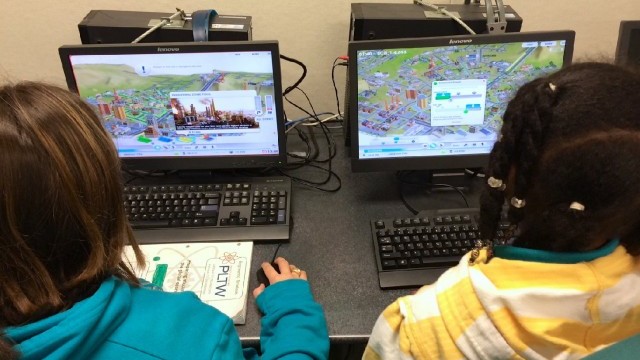
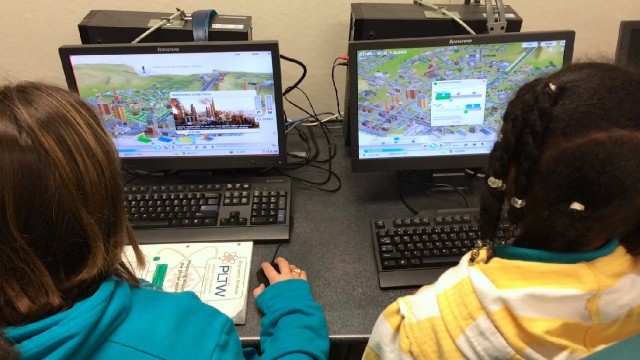
SimCityEDU is a game created to introduce environmental science to middle school students. Through game play, students are asked to conduct interviews, review research, interpret information they’ve gathered, draw conclusions, graph data, and make decisions about how to best protect the environment in a prototype city, and with each step, the game assesses every choice.

The goal is to move beyond tests that give little meaningful information about how or what students have learned, instead using data gathered from actions in a game to paint a picture of growth of knowledge. The report finds that this game-based assessment is a promising new field, but the work is still in its initial phases. The report finds that the close collaboration of all parties is crucial. Psychometricians, game designers, and learning specialists all need to work together to understand how to create the best learning experience. Just as game creators should work closely with teachers when creating the games, rather than just handing off their finished products, psychometricians need to be part of the designing and creating phases, too.

“The tests that we use today in school don’t test for things that are that useful,” said Anya Kamenetz, author of forthcoming book on future of assessment called The Test and author of the GlassLab report’s executive summary, (and a contributing writer to MindShift). “Accountability tests [measure] reading and math,” she said, but students need to know so much more than those subjects in the world outside of school. Games more accurately test those less tangible qualities by building higher order thinking skills into the game play.

“The state of mind that game designers are chasing is similar to what teachers are trying to do, which is get students in the zone of proximal development,” Kamenetz said. That means finding the “sweet spot” where the material isn’t too easy or too hard. It should provide a challenging and thus engaging experience, but not be such a frustrating experience that students quit. Games reach this state naturally by preventing players from moving on until they’ve mastered the skills needed at lower levels.

That’s why psychometricians are so excited about game play as a lens into learning. Psychometrics is an old discipline that tries to quantify intellectual achievement. Its practitioners use statistics to try and figure out what people know and how they think. Psychometricians are often responsible for creating tests.

[contextly_sidebar id=”94bea6c316ca51896f166e8a14436ee2″]

“Psychometrics has something to bring to the table,” Kamenetz said. But at the same time, game-based learning is challenging the psychometric field to move into the 21st century. The data analytics available to educators now are changing the landscape for psychometricians, who need to evolve a new set of tools to measure the principles important to the discipline — reliability, generalizability, comparability and validity — within a new context.

Games are proving to be a good place to start the delicate partnership between the diverse working styles of game developers, educators and psychometricians.

“There’s reading, there’s science involved, there’s strategy and systems thinking and there’s perseverance,” Kamenetz said about SimCityEDU. “You can’t artificially tease those apart, you have to look at them all together.” It’s that holistic view that is so novel. Current tests isolate subjects and skills, rather than testing how a student uses everything he knows to explore, test out ideas, and gain experience.

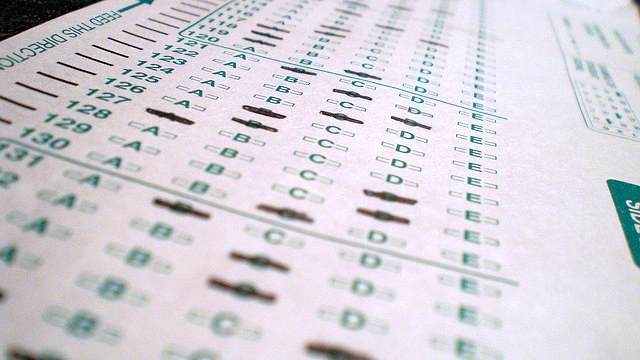
“Clearly this isn’t the kind of test you can drop from the sky in a high stakes context and expect people to perform,” Kamenetz said. Players respond differently to games for many reasons including level of experience and interest in game play, not to mention whether they understand the academic concepts. But, Kamenetz argues that bubble tests take a certain amount of familiarity with the format as well.

“The tests we have don’t do a good job of measuring what’s important to us and they don’t measure what they do measure very well,” Kamenetz said. “So we need a better test.” The game-based assessment work is promising, but still a long way off, and alternatives need to be developed in tandem.

“One thing that might stop this in its tracks is the ability to extract data from naturalistic interactions,” Kamenetz said. Tools are already being tested that eavesdrop on students in unstructured situations that can fairly accurately predict knowledge based on the words used and complexity of thought. If this technology catches on it would allow educators to removing the artificial game world from the assessment, making it a very real test.

Ultimately, the GlassLab report is a call to psychometricians to continue the work on game-based assessments. It questions how tests are currently built and the role psychometricians can have on changing them more than on the impact of game-based assessment in the classroom. Predictive technologies and complex data analytics already exist in the commercial world, so why shouldn’t those techniques be applied to the important work of teaching?

Strategies to Reach Every Student, Regardless of Language Barrier

10726320313_d78289b5f0_z

Helping every student experience meaningful, deep learning is a constant challenge, in no small part because no two learners are alike. To reach students who are particularly challenged — whether because of their ability to speak English or some other reason — educators can find a way in by tapping into students’ interests and passion.

“You don’t have to know how to read and write to think deeply,” said Claire Sylvan, founding executive director of The Internationals Network For Public Schools, schools that serve high school students who have been in the country fewer than four years. Sylvan spoke on a Deeper Learning MOOC panel focused on strategies for helping even the most challenged learners to engage in meaningful work.

Every student at an Internationals school is an English Language Learner, but not all have a common mother tongue. Internationals schools give students projects that involve complex thinking in both English and native languages. “Provide them with on-ramps that allow them to develop literacy in the environment that they now inhabit,” Sylvan said. There’s often a myth that students need to learn English before they can participate in more interesting work, but the Internationals Network has built an entire model on engaging students in learning through work that interests them, giving them a compelling reason to learn English.

“The one context that’s not particularly useful is trying to teach language by itself as isolated words,” Sylvan said. “Mothers don’t put babies in a row and ask them to repeat. Language is learned by using it to describe things that you are experiencing; so if kids are engaged in a project they have a real reason to learn a language,” she said.

Engagement is important for all learners, but especially for those who have extra barriers to success. Connecting learning to the real world can be an easy way to increase classroom engagement because many of the most disaffected learners have a lot of real-life experience they can draw upon.

“Those kids are often really talented in the real world,” said Ron Berger, chief academic officer for Expeditionary Learning, a network of schools that has pioneered the deeper learning movement. “In real life they thrive in many ways, so the more ways that we can make academic work connect to the real world, we let those kids thrive.”

To that end, educators have to move past the idea that learning is a linear process. “It’s crazy to separate basic skills from engaging complex work,” Berger said. Instead, the basic skills should be in service of something exciting to students because few students show their capacity through textbook work.

An example of a project that meets every learner at their skill level was done in a fourth grade Spanish class in which there were students who had never studied Spanish before alongside native speakers. The teacher partnered with a school in Guatemala online that also had Spanish language learners because its students mostly spoke indigenous languages like Mayan. The two classrooms wrote books for one another. Some books had complicated story lines and others were simpler, but the project gave each student the chance to contribute something meaningful. “They all created something beautiful and of quality,” Berger said.

CREATING STRUCTURES FOR SUCCESS

Reaching all learners successfully is a tough job and requires carefully thought-out structures. “There’s a misperception that deeper learning is unstructured,” Berger said. “It’s really just a question about what you’re going to be tight and loose about. In traditional classrooms they are tight about pacing and about kids being quiet. I’d rather be tight about kids being focused and courteous.” Changing the focus might make for a more chaotic classroom, but meaningful learning is often happening between students in that environment. “It’s an active peer-driven sense of working towards quality,” Berger said. “It’s not just sitting passively and letting someone tell you what to think.”

Careful grouping is important to give all learners the best chance at success. “The key thing about deeper learning for the kids we work with is not whether they can do it, but how can we structure classrooms so they can be successful,” said Joe Luft, senior director of programs for the Internationals Network and a former teacher and principal at one of their schools.

[contextly_sidebar id=”e34bf526916a71e3a97c2e9322a32011″]

“You want to be able to support students academically and in terms of literacy,” said Rosemary Milczewski, a math teacher at Flushing International High School. “They are arguing; they are talking to each other; and I’m walking around as a facilitator.” A common way to teach students for whom English isn’t their first language is to group them by proficiency. But Sylvan says that rarely works. Grouping is a delicate balance of English language ability, native language ability, and familiarity with the academic content. “The grouping would differ based on the task you are asking students to do,” Sylvan said.

TEACHER GROUPING

In addition to carefully grouping students for project work, it can be very helpful to group teaching staff to best serve the needs of students. At Internationals High Schools, five teachers all work with the same group of students. They coordinate closely on the literacy goals that cross all classes in addition to developing interesting projects together. For example, all teachers may be working on helping students use language to compare and contrast or to use cause and effect language, no matter what subject they teach.

Creating class structures that support student-self esteem and promote an open culture also help reluctant or traditionally hard-to-reach students. “The first thing that comes to mind for me is changing students’ perceptions of themselves so they don’t see themselves as unable to learn,” said Thabiti Brown, principal of Codman Academy, a Boston charter school in the process of growing to be a K-12 school. “If they are thinking about themselves as students who are exercising that muscle, the brain, then it changes their perception of themselves.” Students also need to feel permission to express themselves and to know that their input is valued.

Milczewski immigrated to the U.S. when she was a teenager and attended an Internationals School. She uses her story to motivate her students and create a community of learners. “Telling them my story, I feel like it gives them some hope,” she said. “They realize they can graduate from high school, go to college and all they’ve got to do is work hard.”

SCHOOL STRUCTURES TO PROMOTE SUCCESS

Teachers working with challenged students need extra time to plan, tutor, and work together. We need a lot of different time to meet in lots of different configurations around a lot of different issues,” said Ben Daley, chief academic officer at High Tech High. At Flushing Internationals School teachers meet for two hours each week to discuss instructional work and ways to support specific students. They plan the language function and outcomes they’ll be working on and talk logistics.

Additionally, each week they meet to talk about social and emotional needs of students, and there’s always a morning meeting for team leaders to report back on the school-wide administrative issues. In addition to all of that, teachers are on committees to help make decisions about the schools. These school-wide structures help teachers feel supported and connected in their difficult work and keep the staff on the same page about learning goals, but they are often built into the school day, not an addition.

This type of group work also mirrors the project-based learning teachers are asking of students. Adults are working on a complex problem together, collaborating with people different from themselves, and bringing their strengths to the table. “High school people think of themselves as subject people,” Sylvan said. “When you group them across subject you allow teachers to focus on students.”

The Maker Movement Finds Its Way Into Urban Classrooms

Pitt-kid300

By Kathleen Costanza, Remake Learning

A school library might not be the most obvious place to find kids building robots. But this year, Miriam Klein, a librarian and English teacher in the Cornell School District outside of Pittsburgh, is planning to use her district’s brand new Hummingbird robotics kits in the classroom to build characters from stories her students read. Using cardboard, pipe cleaners, and whatever else they come up with, along with the equipment in the kit (motors, LED lights, digital sensors), created by Carnegie Mellon’s CREATE lab, the kids will bring their characters to life.

The infectious enthusiasm Klein and hordes of teachers around the country have for hands-on projects echoes that of the maker movement, a growing network of DIY and making enthusiasts building everything from marshmallow cannons to hovercrafts in garages, at Maker Faires, and state-of-the-art makeshops. Leveraging kids’ natural inclination to tinker, the maker movement has found its way into classrooms. In Pittsburgh and around the country, educators are encouraging kids to experiment, building imperative skills in STEAM subjects and spurring lifelong interests that will hopefully one day lead to careers.

Further encouraging Klein’s plans for this year is a two-week professional development camp she attended in July, MobileQuest CoLab, organized by the Institute of Play. The program taught educators and students the basics of game design. But the games weren’t necessarily played on devices—many were hands-on, puzzle-like games such as tossing a ping-pong ball down a flight of stairs into cups. They then often incorporated an element of technology like a stopwatch or QR code scanner.

During MobileQuest, Klein saw students owning their ideas in a way she’d only seen in her creative writing classes. Witnessing that ownership, she says, is what excites her most about the hands-on projects and game design she’s envisioning for her classroom this year.

[RELATED READING: Why We Need to Value Students’ Spatial Creativity]

“My idea of hands-on learning is sort of controlled chaos and then learning to accept chaos,” Klein says. Like proponents of the maker movement, she believes that in an environment conducive to hands-on learning a teacher acts as a facilitator rather than instructor, encouraging collaboration and ensuring everyone’s voices are heard.

Chris Foster, a Business, Computer and Information Technology teacher at Elizabeth Forward Middle School in Elizabeth, Pennsylvania, is also looking ahead and developing ideas for hands-on learning this year. As part of his school’s new program called the Dream Factory, students will have access to a 3D printer. The students get to experiment with digital and physical materials to create the inventions of their dreams. Foster is planning ways to encourage them to think creatively about what they create, for example by having students wear blindfolds while they hold objects in order to use all their senses in brainstorming possible iterations.

“If they don’t reach the goal the first time, after taking suggestions, they try again. I think that’s a change,” Foster says of the difference he’s seen between project-based learning and more traditional pedagogy. He’s seen students dread revising assignments, but an environment and culture embracing hands-on learning and making alters the meaning of “revisions” altogether. “If you build this kind of atmosphere and environment in a class from the very beginning, I think students are more apt to take suggestions from their classmates and teachers and go back to create a better product.”

As maker-expert and educator Gary Stager explains in his new book with co-author Sylvia Libow Martinez, “Invent to Learn: Making, Tinkering, and Engineering in the Classroom,” learning through making and inventing isn’t new. But its use is gaining renewed emphasis among educators, fueled by the tools and technology we can now put into kids’ hands.

Stager and Libow Martinez call these technologies—specifically fabrication, computing and computer science—“game changers.”

[RELATED READING: Before Reading or Watching Videos, Students Should Experiment]

“The excitement about these new technologies will reanimate the best traditions of progressive education in classrooms, of learning by doing, of working on meaningful projects, of developing agency and becoming lost in the flow of something you care about,” Stager writes.

He points to a student in Australia who wrote a computer program that drew complex, geometric shapes and then sporadically teleported them into a black hole. Letting students follow their own interests and creative urges encourages them to be self-directed, Stager says, and prepares them for an outside world where problems are not multiple choice.

“At the core, I think the goal of teachers and schooling in general is to prepare kids to solve problems that teachers and the curriculum never even anticipated,” Stager says.

“[Making] is intrinsic, whereas a lot of traditional, formal school is motivated by extrinsic measures, such as grades,” Dale Dougherty, founder of MAKE Magazine, says in the short documentary “We Are Makers.” “Shifting that control from the teacher or the expert to the participant to the non-expert, the student, that’s the real big difference here.”

Teachers and makers have seen firsthand how kids develop agency by making. Now, researchers are heading out into makerspaces and classrooms to delve into how and why making fosters this kind of agency and excitement.

With support from the National Science Foundation, Erica Halverson, an education professor at the University of Wisconsin-Madison, is embarking on a study of environments that foster creativity and learning. The goal is to understand the difference, if there is any, between the culture of makerspaces and the act of making. What exactly fosters learning? Is the making itself enough to drive learning, or does the culture of a makerspace impart a sense of agency in kids, empowering them to explore and tinker? What Halverson and her team find will have implications for how to further move making into classrooms.

To answer their questions, Halverson’s team is using the Makeshop at the Children’s Museum of Pittsburgh as their laboratory. The Makeshop includes woodworking tools, circuitry, sewing materials, and animation tools, plus experts who can help kids and their families out with projects.

“More than any other children’s museum, they’re committed to the maker culture as a part of their mission,” Halverson said. “I didn’t know much about children’s museums before I started this project, but [Museum Director] Jane Werner is the queen of children’s museums. She’s forward-thinking and has invested so much time in the development of Makeshop as something distinct from the typical arts/crafts space in their museum—it’s an amazing place.”

[RELATED READING: Want to Start a Maker Space at School? Tips to Get Started]

Kylie Peppler, an assistant professor of learning sciences at Indiana University, Bloomington, and the head of the Make to Learn Initiative, is developing a white paper on making and its guiding learning theories.

Peppler said making is so exciting because “the act of construction externalizes what kids know, and allows them to reflect on the designing and action. The externalizing of your ideas is really productive for learning and connecting with other people.”

The interests hands-on learning sparks are sometimes a beeline to a career.

Peppler points out that “Ninety percent of the time you talk to an engineer, the experience of making a boat in eighth grade was what sparked their interest in engineering.”

“We as educators try to make our lectures engaging, but when we allow people to make something, it’s completely transformative. You don’t have to fight for kids’ attention when making,” Peppler said.

Stager echoed Peppler’s belief that making is intrinsically motivating for kids. He recalled a group of three 10-year-old girls who, after Stager charged their fifth grade class with the challenge, came back two days later with a computer program they wrote that drew any fraction as pieces of a circle.

“I’m not surprised when kids do extraordinary things,” Stager said. “I’m surprised when adults are surprised at kids doing extraordinary things.”

Connected Learning: Tying Student Passions to School Subjects

Q2L_1
By Ashley Williams, Youth Radio

What if your extracurricular activities weren’t just extra but a part of your academics too? New thinking on education intends to bring students’ interests into the classroom. It’s called Connected Learning and promotes the idea that students will excel in school if what they are learning is relevant to their lives, experiences, and passions. This plan is spelled out in a new report, by Mimi Ito, the research director of the Digital Media and Learning Hub at the University of California Irvine.

While students would still learn core subjects like math and science, Connected Learning provides ways for students to link their classroom lessons to their lives outside the school. Ito says the objective of Connected Learning is to, “meet young people where they are in terms of their peer culture, their interest in popular culture, social media, rather than say you have to meet us where we are as adults.”

Ito uses the Harry Potter Alliance to demonstrate how Connected Learning’s can be effective. She says, “the HPA connects young people who are inspired by the civic virtues portrayed in the Harry Potter books, and want to apply them to the real world.” This fan network organizes over social media platforms (Facebook, Livestream, Youtube, Twitter) to spread awareness and solutions to issues like, equality, and human rights, and to support of charitable causes. Literacy has been a central focus of the group. Their annual book drive has brought 85,000 donations since 2009 and contributions have helped build a library for a charter school in NYC.

Ito says another prime example of Connected Learning is at Youth Radio. The youth-driven media organization channels young peoples’ passions into education and job training. For instance, the poetry group inside Youth Radio, Remix Your Life, helps strengthen students’ writing skills, public speaking  and presentation skills while providing an outlet for us to express what we’re passionate about.

Here’s where Connected Learning could help close the opportunity gap. Ito says, “it’s important to diversify the kinds of entry points for the kinds of pathways that young people have.” She adds that “having their interests, their identities validated in the context of academic achievement, civic engagement” is essential to keeping students engaged. This could lead to better student Continue reading Connected Learning: Tying Student Passions to School Subjects

How to Foster Grit, Tenacity and Perseverance: An Educator’s Guide

157300219

How can we best prepare children and adolescents to thrive in the 21st century? This question is at the heart of what every educator attempts to do on a daily basis. Apart from imparting content of knowledge and facts, however, it’s becoming clear that the “noncognitive competencies” known as grit, perseverance, and tenacity are just as important, if not more so, in preparing kids to be self-sufficient and successful.

To that end, the Department of Education’s Office of Technology has released a report called  Promoting Grit, Tenacity, and Perseverance —Critical Factors for Success in the 21st Century, drafted by research firm SRI International, which addresses how educators can integrate these ideas into their teaching practice: Are these competencies malleable and teachable? How significant a role do they play in students’ success? What are the best learning environments to encourage and foster these attributes?

“The test score accountability movement and conventional educational approaches tend to focus on intellectual aspects of success, such as content knowledge. However, this is not sufficient,” the report states. “If students are to achieve their full potential, they must have opportunities to engage and develop a much richer set of skills.”

The entire report [PDF] is well worth the read. Here are a few noteworthy highlights excerpted from different parts of the report.

What Are Grit, Tenacity, and Perseverance?

Grit, tenacity, and perseverance are multifaceted concepts encompassing goals, challenges, and ways of managing these. We integrate the big ideas from several related definitions in the literature to a broad, multifaceted definition of grit for the purpose of this report: “Perseverance to accomplish long-term or higher-order goals in the face of challenges and setbacks, engaging the student’s psychological resources, such as their academic mindsets, effortful control, and strategies and tactics.”

Sociocultural context plays an important role. It can be a significant determinant of what students value and want to accomplish, the types of challenges they face, and the resources they can access. It is well documented that students from high-poverty backgrounds are particularly likely to face great stress and limited social support for academic achievement— factors which can undermine perseverance toward a wide range of goals. Researchers and educators also highlight concerns about the challenges faced by students from other segments of the socioeconomic Continue reading How to Foster Grit, Tenacity and Perseverance: An Educator’s Guide

What’s Worth Investing In? How to Decide What Technology You Need

Lenny Gonzalez

The promise of technology in the pursuit of learning is vast — and so are the profits. The SIIA valued the ed-tech market at $7.5 billion. With daily launches of new products promising to solve all manner of problems — from managing classrooms to engaging bored students with interactive content to capturing and organizing data, to serving as a one-stop-shop for every necessary service, choosing from the dizzying number of products on the market can be confusing.

But when it comes to the  specific task of helping students, what’s the best app in education? “A web browser,” said Chris Lehmann, Principal of Science Leadership Academy in Philadelphia, a school that’s embraced technology for years. “Or a Google Doc, or anything that gives you the ability to make a film, or to research, to create, to connect or collaborate,” he said.

Lehmann is famous in progressive education circles for his quote: “Technology must be like oxygen: ubiquitous, necessary, and invisible.” His point: The best technology allows students to explore and create “artifacts of their own learning.”

“The question is, how will technology allow students and teachers to network their learning, to collaborate with each other, to extend the reach of what kids can learn beyond the walls of the Continue reading What’s Worth Investing In? How to Decide What Technology You Need

Boredom Busters: 50 Fantastic Play-and-Learn Apps, Sites, and Toys

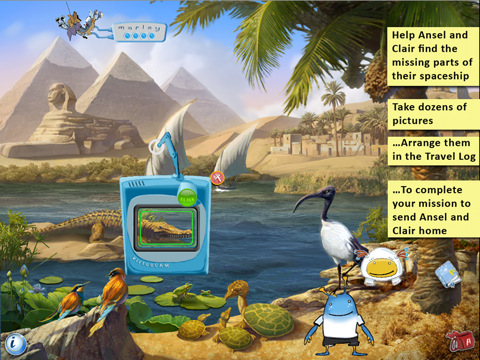
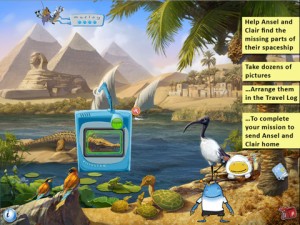
Ansel & Clair's Adventure app features animations, quests, puzzles and games in scenic African locations.

School or no school, there’s a world of learning opportunities for kids. When they’re not exploring outdoors, keep kids engaged in learning throughout the summer months with these enjoyable and educational apps and websites. For kids, playing these games is a cool pastime; for parents, it’s another way to get kids to exercise their thinking muscles.

VIRTUAL WORLDS

  1. MINECRAFT. This online game lets you build entire worlds out of blocks. Minecraft’s visual simplicity belies what is a completely open-ended and therefore terrifically complex world. And the best of that world: it’s up to the player to design. Minecraft is what’s known as a “sandbox” game, giving players almost complete freedom to build within it.
  2. CAESAR III. In this simulation, you begin as a lowly citizen trying to eke out an existence in a virgin landscape. The student begins by learning about the basic needs for survival and graduates to increasingly demanding scenarios. By the end, students will have gained a very sophisticated understanding of the influence played by the environment on the development of a civilization.
  3. ANSEL & CLAIR’S ADVENTURES IN AFRICA. Ansel and Clair are aliens who must recover their lost spaceship parts, and as they travel the continent (the Serengheti, the Nile River Valley, and the Sahara Desert) they not only work on that mission but learn about the geography and history of the area as well. The app takes full advantage of iPad technology — audio, video, the touchscreen, “tilt the iPad” games, and so on.
  4. THINKING WORLDS. Kids enter a virtual world that resides on their personal computer. Their avatar can be somewhat modified, and engage in a wide variety of explorations. In the unit dealing with volcanoes and earthquakes, they not only learn about the details, they visit places such as Herculaneum, subterraneous faults, and the ruins of Kobe in Japan. Continue reading Boredom Busters: 50 Fantastic Play-and-Learn Apps, Sites, and Toys

Educator: Lifelong Learner, Advocate for Progress

I recently came across this article in Kappan Magazine that covers some of what I’ve talked about in the School Day of the Future series. It perfectly encapsulates the themes of the series, and of this website. The authors have given me permission to run the article, which is an excerpt of Living on the Future Edge: Windows on Tomorrow (Corwin Press, 2010).

Education and the Role of the Educator in the Future

Envision a shift from textbooks, brick-and-mortar classrooms, lectures, worksheets, standardized tests, bells — in fact, everything we grew up expecting of school — to learning whenever and wherever it can best happen.
By Ian Jukes, Ted McCain, and Lee Crockett

We must look at education the same way a quarterback looks at the football field. We must perceive where things are headed so we can respond appropriately. We must accept that we have a paradigm for how we expect life to unfold; that in times of radical change, we all suffer from some degree of paradigm paralysis; and that change requires us to let go of ideas and ways of doing things that we hold dear. Keep this in mind as we outline the future goals for education.

We envision a shift from textbooks, brick-and-mortar classrooms, lectures, worksheets, standardized tests, bells — in fact, everything we grew up expecting of school — to learning whenever and wherever it can best happen.

A shift of this magnitude will force teachers to examine their role in student learning. Without a doubt, how educators do their daily tasks will change. We must identify the broader roles that will endure as the world continues to change dramatically. The essence of what educators must do in the future is the very same as it’s always been: to help students learn the relevant skills, knowledge, attitudes, attributes, and behaviors that they’ll need to be good and productive citizens, parents, and workers. As we outline the goals of education in the 21st century, let’s also consider some of the new functions and responsibilities of teachers.

Young children learn intuitively. Learning in school, however, is quite a different matter. The problem is that the school system is designed for handling large numbers of young people rather than individual students. Our entire educational system is created around a 30:1 approach to instruction, which necessitates teaching to a group rather than teaching to individuals. Students are grouped by classes, grades, and geography. This has a real cost in terms of meeting the needs of all of the students in any of these groups. A typical group of 30 students has a wide range of abilities, interests, maturity, and learning styles, and for the sheer sanity of the teacher, he or she must teach to the middle in terms of student ability.

The major casualty in this approach is engagement for the individual student. This is a problem of immense proportions; any teacher will tell you that engagement is the key ingredient to real learning. By not addressing the individual abilities and interests of each student, we’ve created an educational system that works against the ultimate goal of fostering a love for learning in each student. In fact, the design of the current system goes against what we know about learning from brain research. John Medina has this to say in his book, Brain Rules:

Every student’s brain . . . is wired differently. That’s the Brain Rule. You can either accede to it or ignore it. The current system of education chooses the latter, to our detriment. It needs to be torn down and newly envisioned, in a Manhattan Project-size commitment to individualizing instruction. We might, among other things, dismantle altogether grade structures based on age. (Medina 2008: 69)

Technology will empower individual students to master course material at their own pace. With individualized instruction, the delivery of course content can be adjusted to the individual abilities of the student. When this occurs, the focus of schooling will shift away from achievement based on age and grade level to the mastery of content and skills. Continue reading Educator: Lifelong Learner, Advocate for Progress