
This post originally appeared on California Watch, a KQED content partner and a project of the Center for Investigative Reporting.
By Susanna Rust
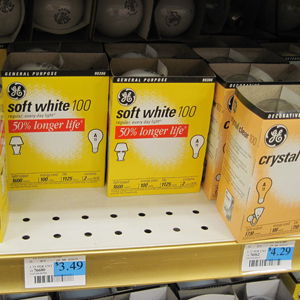
Say goodbye to your 100-watt incandescent light bulbs. On Jan. 1, it’ll become increasingly challenging to find one on a store shelf in California.
That’s because the state has ordered a phaseout of the high energy-consuming light bulb.
The state is pressing to have the old incandescents replaced with newer, more efficient bulbs, such as compact fluorescents, halogens and light-emitting diode light bulbs, or LEDs.
And beginning in 2012, 100-watt incandescents will be off the shelves completely.
As is typical, California is getting a jump-start on a trend that will begin nationwide in a few years. Three years ago, the federal government enacted legislation to phase out the old bulbs. National phaseout will begin in 2014. Other countries, such as Australia, Ireland and Cuba have already banned them.
There are drawbacks to the new bulbs, however.
Fluorescent bulbs, or CFLs, contain mercury, which can be harmful to the environment and to human health. Therefore, the bulbs must be handled differently than other household waste.
Local hazardous waste centers, and some hardware stores, will take spent fluorescent bulbs for recycling. The other bulbs contain chemicals such as bromine and iodine. These do not require special recycling.
Consumers looking to find a replacement for the old 100-watt bulb will likely choose the energy-efficient 72-watt bulb, which will provide an equal amount of light but uses less power.
“The consumer will still be able to use the product and have the same results to light an office, a desk lamp, a hallway. A 72-watt light bulb will still provide the same service as the old 100-watt bulb,” Adam Gottlieb, a spokesman for the California Energy Commission, told the Scripps Howard news service. “Consumers really need to know they won’t see any difference. The difference they’ll see is a more energy-efficient bulb.”
The California Energy Commission website has a user-friendly FAQ page about the new light bulb standards and how the rules affect consumers.