

Tag Archives: California Air Resources Board

Big Journeys Begin with Small Steps

kayla-c-headshotSaturday is an “International Day of Action” organized by Greenpeace, which claims 4,800 events are scheduled around the world toward “a safe climate future.”

This seems like a good time to check in with one of our 2009 California Climate Champions. In this post, Kayla Clark of Atascadero describes her efforts to reduce greenhouse gases by targeting those ubiquitous disposable water bottles  at her school.

In my observation, sometimes when faced with the reality of climate change, we’re frightened. It can be a normal reaction to run back to our previous habits, jump in the large SUV, leave the lights on, and plead ignorance.  It’s indisputable that there is a serious issue that must be dealt with, but only through breaking down the problem to approachable and accessible goals can we hope to improve the situation.

My name is Kayla Clark, and I am a California Climate Champion and a junior at Templeton High School.  California Climate Champions is a program sponsored by the British Council in partnership with California Air Resources Board that selects young people throughout the state who are leaders in communicating about climate change to their communities.  There are 25 of us all together and the program enables us to work with one another to discuss climate change with a wider audience.

Each California Climate Champion is responsible for completing an individual project to communicate about climate change to his or her own community.  My project is to reduce the number of plastic water bottles purchased at my school and in my community by selling reusable water bottles on campus, as well as coordinating the development of a more attractive water source on campus.  For two years, I have seen hundreds of disposable water bottles purchased daily at Templeton High School. We do have recycling bins on campus but many students don’t utilize these bins. I estimate that maybe twenty students occasionally use reusable water bottles on my campus.

The goal of my project is to use water bottles to share a wider message. We can reduce greenhouse gas emissions by reducing student consumption of disposable water bottles, and we can permanently change behavior–even if that means affecting only the smallest of lifestyle choices.  At the core of these goals has always been communication. For me, that has meant sharing information at my high school, collaboration with my campus environmental club, and committing to speaking engagements and volunteer opportunities.

I realize that I can’t undertake my water bottle task alone. For that reason I’ve contacted and partnered with my school’s environmental club and my school principal so that we can work together on this project, and they have both been extremely supportive. Having a local network is very encouraging.

I’ve also had a couple of great opportunities to speak with different groups about climate change. I have addressed the Air Pollution Control District (APCD) at their July board meeting and the San Luis Obispo Exchange Club.  Both experiences were really interesting, as many of the audience members had basic questions about climate change and the science behind it, so answering their questions was really exciting.

My presentations are also leading to an expanded network with new opportunities.  From my presentation with APCD, I was given the chance to volunteer at my local farmers’ market for the APCD “Food Miles” booth.  We gave out free reusable grocery bags, and educated the community about food transportation and its impact on our climate, as well as the benefits of eating locally to reduce greenhouse gas emissions.

It’s true that as a concerned teenager implementing reusable water bottle usage, my audience isn’t the largest. But my project is more than giving students a new water bottle and telling them to fill it up daily. I am trying to influence behavior.

I feel that my actions are part of a ripple effect and by raising awareness to the pressing issues, more ripples are being made and more students and adults are opening their eyes.

The California Climate Champions program is the U.S. component of the British Council’s International Climate Champions program, which identifies young people around the world who are leaders in communicating about climate change and engaging their communities in action. In the US, the program is co-sponsored with the California Air Resources Board (ARB) and selects 10-15 high school students from across the state each year.

See photos from the International Day of Action event in San Francisco.
Few Surprises as Climate Symposium Opens

A broad spectrum of scientists, entrepreneurs and public officials are meeting in Sacramento this week for the sixth annual Climate Change Research Symposium, sponsored by the California Energy Commission (CEC).

Today and tomorrow are packed with technical lectures on topics ranging from “Decadal Changes in the El Nino Pattern and Impact on the Hydroclimate…” to “Climate and Wine Grape Phenology in Napa Valley.” But yesterday it was up to the policy honchos to set the scene.

There was little in that preamble that hasn’t been heard before. When asked about recently expressed doubts that the state’s utilities can attain a one-third proportion of renewable energy within the next decade, air board chief Mary Nichols said “Not only can we do it, we have to do it.” Nichols, probably the state’s highest-profile point-person on climate policy,  said the the state’s broader, longer-range goal for cutting greenhouse gas emissions simply can’t be achieved without it.

Just as if they’d heard her, legislators tonight passed SB 14 out of committee. The bill requires utilities to meet the 33% renewable portfolio standard (RPS) by 2020 (in other words, to derive a third of their power from low-carbon sources). Green energy activists lamented language in the current version that allows utilities to slip that deadline, if there are delays in bringing new renewable energy sources online.

There was a clear signal from yesterday’s symposium speakers that, as we’ve previously discussed in this space, adaptation is taking center stage on the policy front. California has set targets for “mitigation” of global warming and put some of the wheels in motion. Now attention has turned to preparing for inevitable climate change effects, already in the pipeline.

The CEC’s newest Commissioner, Julia Levin, warned against the onset of “NIMBY” syndrome as measures are implemented across the state, such as the build-out of solar and wind “farms.”

And Stanford scientist Chris Field, who heads the IPCC’s Working Group II, noted that while growing interest in the “other” greenhouse gases (methane, nitrous oxides, etc.) is justified, the focus should remain on controlling carbon dioxide.  “As long as the world maintains an aggressive focus on economic growth,” said Field, “It’s the economic growth that’s the driver of future emissions and that’s why strategies to find ways to grow the economy without increasing carbon emissions are so important.” While some of the other gases are more potent greenhouse gases, Field says they’ll see little or no growth in volume in coming years.

Field previewed some of what he sees as the focal points of the next major IPCC climate report, known as AR5. Field predicted that we’ll see a shift in focus from making the case that global warming is real and human-induced, to providing more and better information that “stakeholders” can act upon. Field cited a recent study projecting that corn yields in Africa could fall 30% by 2040, due to climate forces.

Climate Change: The Next Generation

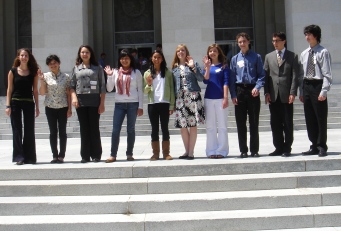
California's 2009 Climate Champions in Sacramento. (April 27, 2009)
California's 2009 Climate Champions in Sacramento (April 27, 2009) Photo by Amanda Dyer

Don’t let anyone convince you that today’s teenagers  are all too busy watching Gossip Girl to notice what’s going on the world.   At least some of them are all too aware that they’ll be inheriting whatever their elders leave them in the way of climate policy–a promising start or a global Gordian knot.

So, in Sacramento on Monday, California Air Resources Board chair Mary Nichols witnessed some thoughtful, engaged, youth-in-action as she fielded sophisticated questions from the newly-inaugurated 2009 California Climate Champions.

Over lunch, these ten high school students asked Nichols about the  future of electric cars in the state, how to help low-income Californians reduce emissions, the availability of renewable energy sources, and how CARB is dealing with political resistance to California’s Global Warming Solutions Act,  AB 32.

Mark Bessen, a 2009 Climate Champion from Palos Verdes High School in Rolling Hills Estates, asked Nichols how society can translate science into political action.

“That is the secret of life,” she replied.

Now in it’s second year, the California Climate Champions program selects high school students from across the state to serve as educators about global warming and to “champion” projects that address climate change issues in their own communities.

This year’s students are planning a diverse set of projects that include alternative fuels, solar power, water conservation, and large-scale composting.  For example, Nicholas Dahlquist  from Rim of the World High School in Lake Arrowhead plans to use chemistry to explore the potential for powering school buses with waste vegetable oil.

“The idea is to take used vegetable oil from deep frying and convert it into a fuel you can use in any diesel engine,” said Dalquist. “The process is relatively straightforward.” Currently, using vegetable oil as a diesel fuel requires some engine modification.

The challenge, he says, is getting people to actually use the fuels, so raising awareness about alternative fuels and working with local transportation authorities to explore possibilities are both aspects of his project plan.

“Biodiesel from waste oil, unlike biodiesel in general, does not require food crops in order to create it.  It’s basically a renewable resource that would otherwise be waste,” he said.

Other champions include Soraya Okuda, a student at Lowell High School in San Francisco, who is working to establish a composting system at San Francisco State University and at the nearby Stonestown Galleria. Another, Jason Bade, from Aragon High School in Foster City,  plans to lobby cities to develop programs that help homeowners purchase and install rooftop solar panels.

Read about the rest of the 2009 Climate Champions and check in on the progress of last year’s Champions and their projects at www.climatechamps.org.

The Battle Over Biomass

This week, the California Air Resources Board is expected to pass a controversial new standard that measures the carbon footprint of transportation fuels. Reporter Marjorie Sun filed a story for Climate Watch on the measure and why the ethanol industry is fighting it. She provides some additional insights here:

The proposed low carbon fuel standard is part of a broad effort by the California regulators to roll greenhouse gas emissions back to 1990 levels by 2020.

biofuel pumpSlashing carbon emissions from cars and trucks is a big part of the state’s game plan. That’s because transportation accounts for 40 percent of the state’s greenhouse gas emissions. A whopping 96 percent of the fuel sources that power our cars and trucks is petroleum-based. Right now, the bulk of ethanol sold in California–and the rest of the United States for that matter—is corn-based. (Brazil makes its ethanol fuel from sugar cane, which has a smaller carbon footprint.) U.S. producers argue that the proposed Low-Carbon Fuel Standard (LCFS) would make corn-based ethanol less competitive in the marketplace because of the way it calculates emissions. Pacific Ethanol was the biggest ethanol producer and marketer in California– until recently. With the drop in gasoline prices over the past year, demand for ethanol has plummeted. Over the past several months the company suspended operations at its two production plants in California and stopped construction of a third facility. In March, it filed for loan extensions with its creditors. So the new fuel standard could deliver yet another blow to the company. Hence, ethanol interests have been putting up a fight. But the Air Resources Board is counting on the proposed standard to spur innovation in the alternative fuels market, to reduce carbon emissions. The state says it’s hoping to “expand the size of the current renewable fuels market in California (already the largest in the nation) by three-to-five times. Instead of today’s corn, over half of the ethanol is likely to be made from extremely low-carbon, cellulosic feedstocks such as agricultural waste and switchgrass. There are numerous startups in California working on cellulosic ethanol. They’re experimenting with a wide range of plants, from switchgrass to algae, as potential sources of ethanol. Getting a new fuel to market, however, requires enormous capital costs. The state is projecting that by 2020, Californians will have bought more than 7 million alternative-fuel and hybrid vehicles. That’s about 20 times greater than today. But in these tight economic times, folks are hanging onto their old cars. So it’s not clear how fast Priuses and plug-ins will replace the carbon-spewing cars on the road today.

Sun’s radio story aired Wednesday on The California Report.

AB 32: It’s All About the Numbers…or Not

3239422267_691b4f3488_m.jpgWith its legal mandate to reduce greenhouse gas emissions approximately 30% by 2020, California leads the nation in plans to combat climate change. But unlike Gov. Schwarzenegger and Al Gore, not everyone thinks reaching 80% of current emissions levels in 11 years is a plausible target.

At a U.S. Fish and Wildlife Service conference this week in San Francisco, Stanford professor Stephen Schneider called the 2020 target “an impossible dream” and argued that setting unrealistic targets such as this one could ultimately hurt the emissions reduction process by reducing credibility, and perhaps, momentum.

Schneider, a member of the U.N.’s Intergovernmental Panel on Climate Change (IPCC) and a senior fellow at Stanford’s Woods Institute for the Environment, said that instead of focusing on specific percentages, policymakers should be focused on investing in the right technologies so that by 2020, our economy will be ready and able to handle a sustainable, long-term reduction in emissions.

“We need to get off the numbers and get on (the) investments,” said Schneider. “We’re not going to be credible if we get focused on something that can’t happen.”

Proponents of AB 32, like Google CEO Eric Schmidt, argue that the goals set by California’s 2006 Global Warming Solutions Act (AB 32) will foster clean energy technology–the type of investment that Schneider advocates. No one denies that reaching the 2020 target will be a challenge. And earlier this month California Air Resources Board Chair Mary Nichols seemed to echo Schneider’s sentiments when she told VerdeXchange News that rather than using the AB 32 as a “counting game,” the the goal “is to achieve real transformation in our energy economy.” She cited the requirement that the law be updated every five years, thus leaving room for a mid-course correction down the road.

Read the full Nichols interview here.

California Lobbies for Early Action on EPA Waiver

cars.jpgWasting no time, California officials sent letters to the Obama Administration on its first day, asking that the EPA approve the state’s request for a Clean Air Act waiver, which would allow California to set stricter standards for passenger vehicle greenhouse gas emissions.

As Sasha Khokha recently reported for The California Report, Sacramento requested the waiver from the EPA in 2005, only to see it denied in March 2008, a move that has blocked the state from enforcing its own laws designed to reduce tailpipe emissions.  The state has been fighting for the waiver for the last year along with several other states that have adopted the same regulations.

If granted, the waiver would allow California to take steps to reduce emissions from passenger cars 30 percent by 2016.

In his written appeal, Gov. Schwarzenegger asked that President Obama “direct the EPA to act promptly and favorably on California’s reconsideration request so that we may continue the critical work of reducing greenhouse gas emissions and their impact on global climate change.”

California Air Resources Board chair Mary Nichols also spoke out Wednesday, in a letter to the new designated EPA head Lisa Jackson, stating that “the decision made by the former adminstrator to deny  California the waiver to enforce our clean air car laws was flawed, factually and legally, in fundamental ways.”

At her confirmation hearing, Jackson said only that she promised a “speedy review” of California’s waiver issue.

This fact sheet from CARB explains more about California’s emissions standards for cars and the agency’s take on the waiver controversy.

AB-32: Now What?

Whew. OK, two years after California’s Global Warming Solutions Act was passed into law, the “solutions” package now has the force of regulation…sort of.

The unanimous vote of the California Air Resources Board yesterday to accept its “scoping plan” for implementation, wasn’t so much the final gun as the second-half kickoff. Don’t get me wrong: the vote was momentous as a kind of intermediate milestone. But there’s a lot to do if the law is really to kick in as scheduled, three years from now.

For instance, there’s that whole cap-and-trade thing. When it comes to putting a market in place for trading carbon credits, the carbon cops in Sacramento have agreed to collaborate with a half-dozen other states and follow the general conventions of the Western Climate Initiative, which are still to be worked out.

Then there’s that pesky EPA waiver to let California put its own regulations for tailpipe emissions in place. The state law enabling that has been on the books for about five years now, stalled by federal EPA officials under the Bush administration. Okay, that’s a gimme. We already know that waiver will finally be granted, sometime shortly after Inauguration Day. But even that signals the start of a complex internal process to get the new regs in place.

In fact, virtually nothing about AB-32 is automatic. As they say, the Devil is in the details. And most details have yet to be laid out, argued about, and worked out, before we can really start marking progress toward the broad goals of cutting greenhouse gas emissions (which are still rising, worldwide).

I sat down with James Goldstene, Executive Officer of the Air Board, and asked him what happens next. You can hear his answer by clicking on the player, below.

[audio:http://kqed03.streamguys.us/anon.kqed/climatewatch/goldstene.mp3|titles=James Golstene on AB-32]

Air Board Responds to LAO Critique

The California Air Resources Board has formulated a written response to the very unflattering report by the state Legislative Analyst (LAO) described here last week. The Air Resources Board is the lead agency in implementation of the state’s attack on climate change, known by its legislative shorthand, AB-32.

The Board admits that most (70%) of the savings in AB-32 flow from one measure, the so-called Pavley regulations on vehicle emissions. But it insists that even without those, the overall plan still pencils, economically.

The Air Board also concedes that its economic analysis was not complete when it issued its “scoping plan” for implementation, but counters that it has since done some more number-crunching and that the bottom line is still a net benefit of about $300 million per year, as the first phase of the plan is unfolding. After 2012, the Board says, annual savings to Californians ramp up to nearly $3 billion.

State Climate Strategy Hits a Sustainability Snag

3060242318_80122bcff7_m.jpgIs AB-32 sustainable? The state’s Legislative Analyst seems to think it’s a valid question.

A series of reports from the Legislative Analyst’s Office (California’s version of the federal GAO) casts doubt on the long-term viability of the nation’s most ambitious attack on climate change.

Just as the Governor was tuning up for his Climate Summit last week, the LAO released a report questioning the economics of California’s Global Warming Solutions Act, aka AB-32. The report assails the assumptions and projections made by the Air Resources Board, in estimating the effect of AB-32’s implementation on the state’s economy. The board’s “scoping plan” projects net annual savings of $16 billion.

Among the LAO’s conclusions:

– The [ARB] plan’s evaluation of the costs and savings of some recommended measures is inconsistent and incomplete. The plan does not reflect the costs and savings of all of the emissions reduction measures that it recommends.

– Macroeconomic modeling results show a slight net economic benefit to the plan, but ARB failed to demonstrate the analytical rigor of its findings. Despite its findings—slight, eventual overall benefit to the economy—the macroeconomic analysis conducted by ARB provides little insight.

– The findings are highly dependent upon key assumptions, and ARB has not performed an analysis to determine how sensitive the macroeconomic findings are to changes in the key assumptions.

– The plan fails to lay out an “investment pathway.” Despite its prediction of eventual net economic benefit, the scoping plan fails to lay out an investment pathway to reach its goals for GHG emissions levels in 2020.

The LAO found that the lion’s share of the economic benefit from AB-32 is presumed to spring from one emissions control measure, that’s actually part of a separate law (AB 1493, passed in 2002). According to the analysis, implementation of the “Pavley regulations” would account for 18% of the greenhouse gas reductions and 70% of savings and benefits attributed to AB-32 in the air board’s scoping plan. That plan is likely scheduled for formal sign-off by the board in the next few weeks.

The report was not widely distributed but was contained in a letter to Assemblyman Roger Niello (R-Sacramento), who requested the analysis.

All the angst over economic impact of AB-32 may be moot, given the findings of another recent LAO study, which warned that we may not be able to put the darn thing into effect, anyway. The state is presently keeping the program alive by borrowing tens of millions of dollars from the California Beverage Container Recycling Fund. The LAO says the Schwarzenegger administration “has failed to produce a sustainable, long-term funding plan for AB-32 implementation.”


Punting the Issue

oil-refinery-300.jpgWhen California creates a cap and trade system to deal with greenhouse gas emissions, as it is planning to do, there’s going to be the question of what to do with the revenue. Actually, first there’s the question of if there will be any revenue, as Mary Nichols, Chair of the California Air Resources Board (CARB), told a roomful of Silicon Valley venture capitalists and green tech leaders this week at the offices of fuel cell innovator Bloom Energy.

California’s cap and trade planning is tied to the Western Climate Initiative, but the consortium is leaving the decisions about how to dispense credits up to each state.

Nichols said that those who would be buyers in the potential cap and trade system are “very resistant” to the idea of an auction. Not exactly surpising.

But many clean energy innovators see the revenue from a cap and trade auction as the perfect opportunity to help new green technologies survive the tenuous period between venture capital funding and commericial viability. Funds from a cap and trade auction could help mitigate the risk private companies take on to develop the innovations that will be needed for a greener future.

Nichols admitted that how much of the credits to auction and where the money should go is the most controversial issue around AB 32. She cited the “cap and dividend” option, a scenario in which all the revenue would go “right back to the public, like in Alaska,” as a politically popular option. She also mentioned using the funds to reduce corporate taxes.

Bloom Energy CEO KR Srindhar likened the “cap and dividend” option to “giving people a fish” (I can only assume as a reference to the old adage about how teaching someone how to fish is better than giving him a fish).

“In the early stages, if we [California] want to be a leader in this field, we need to be seeding it to create jobs. When we do, then, month after month, they’ll be getting that dividend,” Srindhar told Nichols, asserting that money invested in green tech would pay off in the form of job creation and a better economy.

Nichols reponded by saying that she was “thinking about punting the issue for awhile.”

As we have blogged before, CARB is tasked with implementing AB 32, which requires that the state reduce its greenhouse gas emissions to 1990 levels by 2020.

According to rumors, Nichols may be influencing more than just California’s climate policy soon. Unnamed sources in recent reports have cited her as a potential Obama pick for EPA head in the new administration.