Tag Archives: Assembly Bill 32

Governor: RPS Order “Stronger than Law”

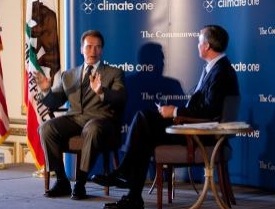
Gov. Schwarzenegger fields questions from Greg Dalton of the Commonwealth Club's Climate One initiative. Photo: Governor's Office

Governor Arnold Schwarzenegger is defending his planned veto of two renewable power bills, saying the executive order he issued instead is “stronger than the law” because it places fewer limitations on electricity imported from other states.

At the tail end of the legislative session, California’s assembly and senate passed separate bills requiring the state’s utilities to draw a third of their energy from renewable sources by 2020. But during a Q&A session at San Francisco’s Commonwealth Club Thursday, the Governor said that the recently passed bills were “for special interests” and that they “represented protectionism,” the latter a reference to limits on how much energy could be imported from neighboring states. The Governor’s own executive order has the same proportional requirement or “renewable portfolio standard” (RPS) as the bills but sets no limits on imported power. Also unlike the legislature’s bills, the order does not exclude particular sources, such as hydro-electric from the definition of “renewables.”

Critics contend that succeeding governors might simply rescind the order, which Governor Schwarzenegger does not deny. He faces an October 11 deadline to veto the bills.

Governor Schwarzenegger’s appearance was designed to mark the third anniversary of the state’s adoption of AB 32, the Global Warming Solutions Act of 2006, a law which has its own detractors.

Meg Whitman, the former CEO of eBay, who is running for governor said last week that she would issue a moratorium on most AB 32-related rules on her first day as Governor.  When asked about  Whitman’s remarks Schwarzenegger dismissed her comments as “just rhetoric.”

“I think she will probably reconsider what she has said and will see that the greatest thing that can happen for California is to move forward. I’m sure she does not want to be counted as one of those Republicans that want to move us back to the Stone Age,” he said.

Touting the state’s achievements in renewable energy innovation, emissions reductions,  and technology, the Governor painted a rosy picture of an invigorated economy, new jobs, and a cleaner environment throughout the state.

“A wave of green innovation is washing over our state right now,” he said.  “In last three years,  scientists and entrepreneurs have pumped more than $6 billion of venture capital into California.  Since 2005, green jobs in California have grown ten times faster than other jobs. California companies hold more than 40% of the nation’s new patents in solar and wind technology, and solar installations this year alone in California have gone up by 120%.”

Focusing largely on projected economic benefits, he made a case for continuing on the path California started three years ago with AB 32 and is continuing under his executive order from earlier this month, saying that the current path offers far more economic opportunity than economic risk.

“I know that it’s possible to protect the environment and the economy at the same time,” he said. “Technology will save us all. It’s all about technology, technology, technology. ”

Not all of the speech was about legislation, green technologies and the economy, however. The Governor did respond to a question from  group of fourth-graders attending the talk, asking what he says to his children about climate change.

“I’ve had major fights with my kids,” he said.

He said he has imposed a five-minute shower rule in his house and that he sometimes “spies” on his children to make sure they are obeying his order.

“If their showers are more than five minutes, there will be consequences.”

He added that other environmental steps his family has taken at home are to install solar panels nearby to provide energy for the family swimming pool and jacuzzi, and that they have converted the regular engines on their Hummers to hydrogen or bio-fuel engines.
California’s EPA Waiver: Does it Still Matter?

Deja vu all over again. Photo: Craig Miller

Today the federal Environmental Protection Agency formally granted the waiver that California has sought since 2002, allowing the state to set its own standards for greenhouse gas emissions from cars.

But wait–didn’t this already happen for practical purposes, last month? That’s when the Obama administration announced its intent to essentially put California’s proposed standards in place nationwide.

Well, yes–and no. Bernadette Del Chiaro, who represents the group Environment California, says that having the waiver is more than a legal technicality. She says it means that the state can get started sooner, cleaning up tailpipe emissions. Del Chiaro explains that: “California’s standards kick in now, through 2016. The federal program that President Obama has extended throughout the entire country, starts in 2013 (also through 2016).”

That gives the states, in effect, a three-year jump-start. In 2013, everybody should be on the same page.

California’s chief air regulator,  Mary Nichols said, in a written statement:
“The waiver affirms California’s authority to set the standards for the cleanest cars in the nation and recognizes the ability of forward-thinking states to continue to adopt them. Now we can begin to work with the manufacturers to make a new generation of cars that deliver all the comfort and power we have come to expect but with improved efficiency and far fewer greenhouse gas emissions. ”

Thirteen other states had also pursued the waiver and can now proceed with their own programs.

While automakers have long argued that the tighter regs will make cars more expensive, Environment California calculates that they’ll “save consumers $36 billion at the pump by 2020.” That projection assumed that gasoline would would average about $2 per gallon over that period. Higher pump prices (which seem a lot more likely) would in turn, increase expected savings, as the underlying premise is that we’ll be driving cars that get better gas mileage.

But of course those cars will cost more than the clunkers we’re wheeling around in now. The state Air Resources Board estimates that the clean car regulations will tack an average of $1,000 onto the price of a new car by 2016. Obviously that would offset some of the pump savings.

AB 32: It’s All About the Numbers…or Not

3239422267_691b4f3488_m.jpgWith its legal mandate to reduce greenhouse gas emissions approximately 30% by 2020, California leads the nation in plans to combat climate change. But unlike Gov. Schwarzenegger and Al Gore, not everyone thinks reaching 80% of current emissions levels in 11 years is a plausible target.

At a U.S. Fish and Wildlife Service conference this week in San Francisco, Stanford professor Stephen Schneider called the 2020 target “an impossible dream” and argued that setting unrealistic targets such as this one could ultimately hurt the emissions reduction process by reducing credibility, and perhaps, momentum.

Schneider, a member of the U.N.’s Intergovernmental Panel on Climate Change (IPCC) and a senior fellow at Stanford’s Woods Institute for the Environment, said that instead of focusing on specific percentages, policymakers should be focused on investing in the right technologies so that by 2020, our economy will be ready and able to handle a sustainable, long-term reduction in emissions.

“We need to get off the numbers and get on (the) investments,” said Schneider. “We’re not going to be credible if we get focused on something that can’t happen.”

Proponents of AB 32, like Google CEO Eric Schmidt, argue that the goals set by California’s 2006 Global Warming Solutions Act (AB 32) will foster clean energy technology–the type of investment that Schneider advocates. No one denies that reaching the 2020 target will be a challenge. And earlier this month California Air Resources Board Chair Mary Nichols seemed to echo Schneider’s sentiments when she told VerdeXchange News that rather than using the AB 32 as a “counting game,” the the goal “is to achieve real transformation in our energy economy.” She cited the requirement that the law be updated every five years, thus leaving room for a mid-course correction down the road.

Read the full Nichols interview here.

AB-32: Now What?

Whew. OK, two years after California’s Global Warming Solutions Act was passed into law, the “solutions” package now has the force of regulation…sort of.

The unanimous vote of the California Air Resources Board yesterday to accept its “scoping plan” for implementation, wasn’t so much the final gun as the second-half kickoff. Don’t get me wrong: the vote was momentous as a kind of intermediate milestone. But there’s a lot to do if the law is really to kick in as scheduled, three years from now.

For instance, there’s that whole cap-and-trade thing. When it comes to putting a market in place for trading carbon credits, the carbon cops in Sacramento have agreed to collaborate with a half-dozen other states and follow the general conventions of the Western Climate Initiative, which are still to be worked out.

Then there’s that pesky EPA waiver to let California put its own regulations for tailpipe emissions in place. The state law enabling that has been on the books for about five years now, stalled by federal EPA officials under the Bush administration. Okay, that’s a gimme. We already know that waiver will finally be granted, sometime shortly after Inauguration Day. But even that signals the start of a complex internal process to get the new regs in place.

In fact, virtually nothing about AB-32 is automatic. As they say, the Devil is in the details. And most details have yet to be laid out, argued about, and worked out, before we can really start marking progress toward the broad goals of cutting greenhouse gas emissions (which are still rising, worldwide).

I sat down with James Goldstene, Executive Officer of the Air Board, and asked him what happens next. You can hear his answer by clicking on the player, below.

[audio:http://kqed03.streamguys.us/anon.kqed/climatewatch/goldstene.mp3|titles=James Golstene on AB-32]

Air Board Responds to LAO Critique

The California Air Resources Board has formulated a written response to the very unflattering report by the state Legislative Analyst (LAO) described here last week. The Air Resources Board is the lead agency in implementation of the state’s attack on climate change, known by its legislative shorthand, AB-32.

The Board admits that most (70%) of the savings in AB-32 flow from one measure, the so-called Pavley regulations on vehicle emissions. But it insists that even without those, the overall plan still pencils, economically.

The Air Board also concedes that its economic analysis was not complete when it issued its “scoping plan” for implementation, but counters that it has since done some more number-crunching and that the bottom line is still a net benefit of about $300 million per year, as the first phase of the plan is unfolding. After 2012, the Board says, annual savings to Californians ramp up to nearly $3 billion.

State Climate Strategy Hits a Sustainability Snag

3060242318_80122bcff7_m.jpgIs AB-32 sustainable? The state’s Legislative Analyst seems to think it’s a valid question.

A series of reports from the Legislative Analyst’s Office (California’s version of the federal GAO) casts doubt on the long-term viability of the nation’s most ambitious attack on climate change.

Just as the Governor was tuning up for his Climate Summit last week, the LAO released a report questioning the economics of California’s Global Warming Solutions Act, aka AB-32. The report assails the assumptions and projections made by the Air Resources Board, in estimating the effect of AB-32’s implementation on the state’s economy. The board’s “scoping plan” projects net annual savings of $16 billion.

Among the LAO’s conclusions:

– The [ARB] plan’s evaluation of the costs and savings of some recommended measures is inconsistent and incomplete. The plan does not reflect the costs and savings of all of the emissions reduction measures that it recommends.

– Macroeconomic modeling results show a slight net economic benefit to the plan, but ARB failed to demonstrate the analytical rigor of its findings. Despite its findings—slight, eventual overall benefit to the economy—the macroeconomic analysis conducted by ARB provides little insight.

– The findings are highly dependent upon key assumptions, and ARB has not performed an analysis to determine how sensitive the macroeconomic findings are to changes in the key assumptions.

– The plan fails to lay out an “investment pathway.” Despite its prediction of eventual net economic benefit, the scoping plan fails to lay out an investment pathway to reach its goals for GHG emissions levels in 2020.

The LAO found that the lion’s share of the economic benefit from AB-32 is presumed to spring from one emissions control measure, that’s actually part of a separate law (AB 1493, passed in 2002). According to the analysis, implementation of the “Pavley regulations” would account for 18% of the greenhouse gas reductions and 70% of savings and benefits attributed to AB-32 in the air board’s scoping plan. That plan is likely scheduled for formal sign-off by the board in the next few weeks.

The report was not widely distributed but was contained in a letter to Assemblyman Roger Niello (R-Sacramento), who requested the analysis.

All the angst over economic impact of AB-32 may be moot, given the findings of another recent LAO study, which warned that we may not be able to put the darn thing into effect, anyway. The state is presently keeping the program alive by borrowing tens of millions of dollars from the California Beverage Container Recycling Fund. The LAO says the Schwarzenegger administration “has failed to produce a sustainable, long-term funding plan for AB-32 implementation.”


Punting the Issue

oil-refinery-300.jpgWhen California creates a cap and trade system to deal with greenhouse gas emissions, as it is planning to do, there’s going to be the question of what to do with the revenue. Actually, first there’s the question of if there will be any revenue, as Mary Nichols, Chair of the California Air Resources Board (CARB), told a roomful of Silicon Valley venture capitalists and green tech leaders this week at the offices of fuel cell innovator Bloom Energy.

California’s cap and trade planning is tied to the Western Climate Initiative, but the consortium is leaving the decisions about how to dispense credits up to each state.

Nichols said that those who would be buyers in the potential cap and trade system are “very resistant” to the idea of an auction. Not exactly surpising.

But many clean energy innovators see the revenue from a cap and trade auction as the perfect opportunity to help new green technologies survive the tenuous period between venture capital funding and commericial viability. Funds from a cap and trade auction could help mitigate the risk private companies take on to develop the innovations that will be needed for a greener future.

Nichols admitted that how much of the credits to auction and where the money should go is the most controversial issue around AB 32. She cited the “cap and dividend” option, a scenario in which all the revenue would go “right back to the public, like in Alaska,” as a politically popular option. She also mentioned using the funds to reduce corporate taxes.

Bloom Energy CEO KR Srindhar likened the “cap and dividend” option to “giving people a fish” (I can only assume as a reference to the old adage about how teaching someone how to fish is better than giving him a fish).

“In the early stages, if we [California] want to be a leader in this field, we need to be seeding it to create jobs. When we do, then, month after month, they’ll be getting that dividend,” Srindhar told Nichols, asserting that money invested in green tech would pay off in the form of job creation and a better economy.

Nichols reponded by saying that she was “thinking about punting the issue for awhile.”

As we have blogged before, CARB is tasked with implementing AB 32, which requires that the state reduce its greenhouse gas emissions to 1990 levels by 2020.

According to rumors, Nichols may be influencing more than just California’s climate policy soon. Unnamed sources in recent reports have cited her as a potential Obama pick for EPA head in the new administration.

Proposed Plan for Reducing Emissions in CA

California is one step closer to implementing the Global Warming Solutions Act of 2006, or AB 32, the law that requires the state to reduce greenhouse gas emissions to 1990 levels by 2020. Today, the California Air Resources Board (CARB) released its proposed scoping plan for how to achieve this goal.  CARB president Mary Nichols said more than 40,000 comments were submitted in response to the draft plan released in June, which we wrote about last month.  Today’s plan will go before the Board for approval in December.

One of the biggest changes to the scoping plan is that the target for reducing Regional Transportation-Related Greenhouse Gas emissions by 2020 was more than doubled from two to five million metric tons. CARB anticipates meeting this goal with a combination of improvements to alternative transportation infrastructure (such as public transit and biking lanes), building sustainable developments, and reducing vehicle trips through incentives and education strategies.

Another change is the addition of a goal for local governments, which was not articulated in the previous version of the plan.  CARB is recommending local governments reduce greenhouse gas emissions by 15 percent below today’s levels by 2020.

A big component of the scoping plan is a cap and trade program that covers 85 percent of the state’s emissions.  The plan is being developed in conjuction with the Western Climate Initiative, which includes seven states and four Canadians provinces that have agreed to work together to cap emissions and create a regional carbon market.  In September, we wrote about the carbon trading market set up by ten eastern states, the Regional Greenhouse Gas Initiative (RGGI). 

Questions still remain about how California’s carbon credits will be divided up and whether they will be handed out, auctioned off, or, more likely, a combination of the two.  WCI has left this decision up the individual states with a recommendation of a minimum auction for 10 percent at the outset of the program increasing to at least 25 percent by 2020, and perhaps higher in the future. Nichols said today that California is considering auctioning 20 percent.  Of course, for many environmentalists, the closer to a 100 percent auction, the better. 

For more information and analysis on the plan, listen to our own Craig Miller, Senior Editor of Climate Watch, on KQED Radio talking with host Sarah Varney. Listen to Miller’s report on AB 32 that aired on the October 16 edition of the The California Report.

Selling the Benefits of AB 32

Well-timed would be one way to describe the pair of rosy forecasts from the state’s Air Resources Board today. For Californians beleaguered by the slumping economy, both reports were choc-a-bloc with good news. The only drawback is that we’ll have to wait a while for the payoff.

The ARB is the “lead agency” for implementing California’s comprehensive plan passed in 2006 to combat climate change, known affectionately as AB32. The primary objective is to get a 30% reduction in greenhouse gases statewide by 2020. The two reports released today attempt to gauge the long-term economic and public health benefits from fully implementing the plan.

Over time, the reports point to creation of more than 100,000  jobs and higher per capita income on the economic front. Estimated health benefits include fewer premature deaths (mostly related to heat waves) and asthma cases.

Some of the touted benefits are relatively small incremental improvements over programs already in place. For instance, ARB anticipates that by 2020, all the provisions of AB32 combined would mean 67 fewer hospital admissions per year (statewide) for respiratory conditions. That compares to the 770 admissions spared in 2020 that would result from existing air quality measures.