All posts by Climate Watch Correspondent

Mister Hatoyama’s Neighborhood

KQED’s Los Angeles Bureau Chief and frequent Climate Watch contributor Rob Schmitz is spending six weeks in Japan, as part of  the Abe Fellowship for Journalists. In the weeks to come he’ll file a series of special reports on Japan’s extraordinary strides in energy efficiency–and what we might learn from them.

Yesterday Japan held a national election. My neighbor won it. Well, technically, his party won it, but it’s assumed that my neighbor, who heads the Democratic Party of Japan, will become Prime Minister within a couple of weeks when the party formally elects him.
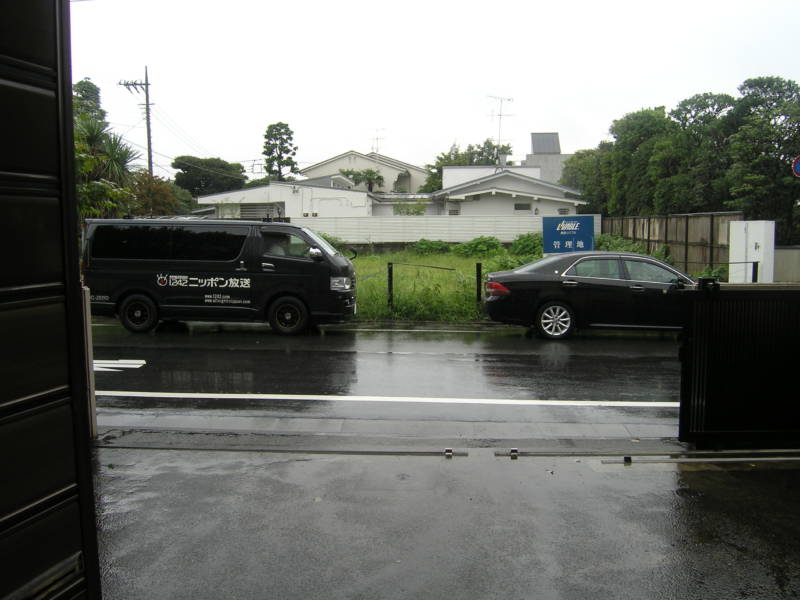
A peek outside my door yesterday revealed media vans and limos outside the house of my new neighbor and Japan’s new prime minister-elect, Yukio Hatoyama.

My neighbor is Yukio Hatoyama. He lives in a large house across the street from the apartment I’m renting here in the tony Tokyo suburb of Denenchofu. Yesterday morning an elderly police officer knocked on my door clutching a map, explaining to me in slow, metered Japanese that his men would be establishing a perimeter around our neighborhood to keep out protesters, non-credentialed journalists, and anyone interested in engaging in general tomfoolery near the Hatoyama residence (an English-speaking neighbor helped translate). I mustered the only Japanese response I knew (“Arigato!”), not having sufficient language skills to explain that I, in fact, was one of those “non-credentialed journalists.” He smiled, bowed, and moved on to the next residence.

As early results on the afternoon television news began to confirm that Hatoyama’s party was on the path to victory, my neighborhood, which was virtually silent for my first few days here, started buzzing with activity. Police officers on foot patrol, random passers-by who somehow got past the perimeter stopping in front of Hatoyama’s house to stand and stare before being ushered away, and members of the “credentialed” Japanese press sitting on the curb in the rain, quietly watched over by the around-the-clock security presence in front of Hatoyama’s home. My wife and I are thinking of baking our neighbor a cake as a congratulations gift–if we could just get by security.

Apart from the amazing coincidence that the apartment I rented happened to be located across the street from the incoming prime minister, my new neighbor has a lot of work ahead of him. Japan is suffering its worst unemployment ever, and many here are fed up with the Liberal Democratic Party, which, despite its name, is the conservative party that has ruled Japan for 50 years.
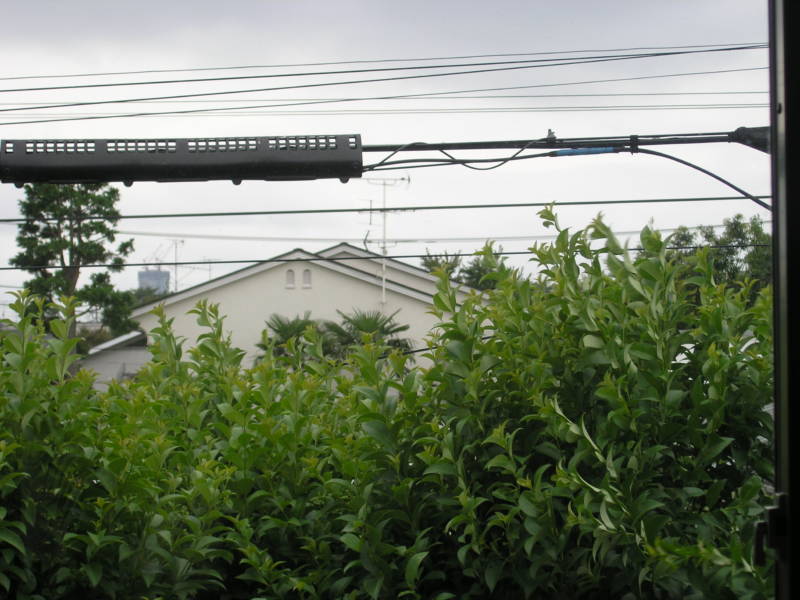
View of Hatoyama’s house from my living room. “May I borrow some sugar, Hatoyama-san? …and perhaps an interview?”

Hatoyama has promised the Japanese more social welfare programs and fewer incentives to big Japanese business but some experts wonder if it’s a good idea to tinker with a system that’s helped Japan become one of the world’s biggest success stories.

Hatoyama has a strong California connection: His doctorate in engineering is from Stanford University, where he met his wife. He speaks English well–well enough to have written a provocative Op-Ed in the New York Times this past weekend; a timely critique of U.S.-led globalism and unbridled capitalism, and a call for Japan to retreat from this system, to a more regional and sustainable economic framework.

More to the purpose of my reporting here, Hatoyama has pledged to make Japan a more prominent world leader in battling climate change. He’s pledged to cut the country’s greenhouse gas emissions by 25% from 1990 levels by 2020, and has promised to generate more jobs for Japanese workers by helping develop the clean-tech industry here.

He also heavily favors on a bigger reliance on nuclear power for Japan; a stance that is not as controversial as you may think in this country. In recent polls, the majority of Japanese respondents say they’re open to a larger reliance on nuclear power. In a country that imports all of its fossil fuels, nuclear power means more energy security and fewer greenhouse gas emissions. On the other hand, it heightens the thorny debate of what to do with radioactive waste–a debate that, despite poll numbers, is of big concern to many Japanese. With all these issues to tackle, it’s likely that my neighbor won’t be spending too much time at home in the coming weeks. Maybe I should offer to house-sit.
Plugged In, in Long Beach

Rob Schmitz heads KQED’s Los Angeles Bureau and is a frequent contributor to Climate Watch.

A Chevy that gets 230 miles to the gallon. A Hummer that gets 100.

Plug-in 2009, the 2nd annual industry conference in Long Beach, was wall-to-wall with such apparent oxymora. Just roving around the exhibition floor on Tuesday, I got the sense that our electric vehicle future is closer than I had originally suspected. I spoke to conference-goers who are already investing millions in what is assured to be an enormous infrastructure that’ll be built around these new cars.

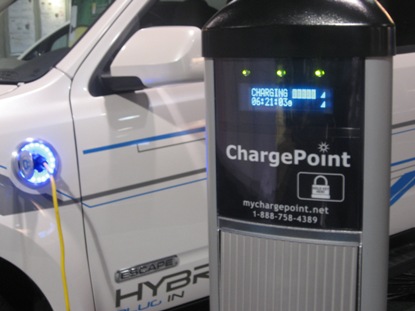
Electric Vehicle Charging Stations that are sold by Coulomb Technologies out of the Silicon Valley. Photo: Rob Schmitz
Electric vehicle charging stations from Campbell-based Coulomb Technologies. Photo: Rob Schmitz

I met Tom Tormey, Vice President of Technology at the Silicon Valley-based Coulomb Technologies. He raised a lot of important questions about where we’d charge these vehicles when we’re not at home. Of course, the answer came in the form of something he could sell you: car-charging stations. His company manufactures automated posts where you can use a credit card to charge up your car when you’re away from home or at work. He’s already sold dozens of these to cities across Europe. The stations will even help calculate taxes for the government through a network that hooks up to Coulomb’s servers here in California: a potentially big business for an electric future.

Speaking of big, check out the electric Hummer. If you thought this beast was nearing extinction (with the sale of Hummer to the Chinese and all), think again. With a new electric version that allegedly gets a 100 miles to the gallon, you may continue to see this American icon on our freeways.

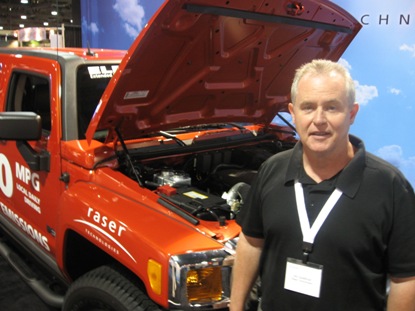
Jim Spellman of Raser Technologies, standing in front of the 100-mpg Electric Hummer. Photo: Rob Schmitz
Jim Spellman of Raser Technologies, standing in front of the 100-mpg electric Hummer. Photo: Rob Schmitz

Jim Spellman of Raser Technologies showed off the Hummer to me, complete with his company’s power train and electric generation system. He says they took it out for a test drive a few weeks ago and it ran 50 miles on electric power with 30% of the battery left to go.

With momentum building among the plug-in players, it’s not surprising that Mike Howard of the Electric Power Research Institute predicts there will be 16 million electric vehicles on the nation’s roads by 2030.

Possible Detour on the “Electron Superhighway”

electwr_blog

It appears that almost 200,000 acres of Mojave Desert will be under federal wilderness protection now that Congress passed the Omnibus Land Management Act of 2009.

Much more was set aside throughout California, as I report in my radio story for The California Report.

Now, Senator Dianne Feinstein is eyeing almost a million additional acres in the Mojave off of old Route 66 between Ludlow and Needles.

There are currently 163 proposed renewable energy projects for federal lands in the Mojave Desert region. Nineteen of them are slated for the land Senator Feinstein wants to set aside. If energy companies can’t build on that land, it follows that they’ll try to build it in the land that’s left.

And that’s got a lot of people who live in the unprotected areas of the Mojave worried. Not only are most of the state’s large-scale renewable energy projects planned for this region, but as I explored in a recent two-part series for Climate Watch, there’s also a transmission corridor in the works to carry that power to Los Angeles.

Use the player below to listen to my conversation with Jim Harvey, who heads the Alliance for Responsible Energy Policy, about what all of this new land protection means for environmentalists like him.

[audio:http://ww2.kqed.org/climatewatch/wp-content/uploads/sites/54/2009/03/jimharvey-blog2.mp3]