Can the Maker Movement Infiltrate Mainstream Classrooms?

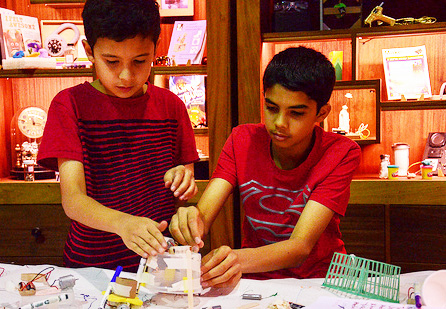
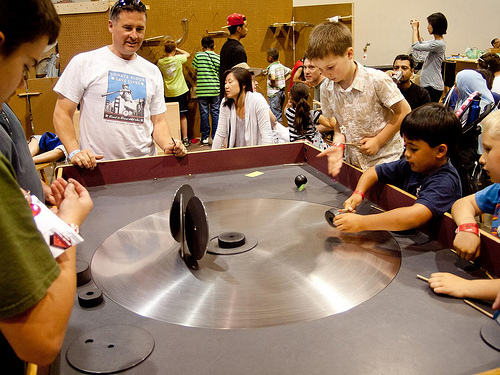
New York Hall of Science/Maker Faire

At the White House Maker Faire recently, where President Obama invited “makers” of all ages to display their creations, the  President investigated a robotic giraffe, a red weather balloon and shot a marshmallow cannon made by a student. With so much fanfare and media attention on the event, some educators are hopeful that the idea of tinkering as a way of learning might finally have made it back to the mainstream. But will the same philosophy of discovery and hands-on learning make it into classrooms?

“Most of the people that I know who got into science and technology benefited from a set of informal experiences before they had much formal training,” said Dale Dougherty, editor of Make Magazine and founder of Maker Faire on KQED’s Forum program. “And I mean, like building rockets in the backyard, tinkering, playing with things. And that created the interest and motivation to pursue science.”

That spirit of play and discovery of knowledge is missing from much of formal education, Dougherty said. Students not only have no experience with making or the tools needed to build things, they’re often at a tactile deficit. “Schools haven’t changed, but the students have,” Dougherty said. “They don’t come with these experiences.”

Dougherty often watches kids as they interact with hands-on experiments or materials at Maker Faire events. “It’s almost aggressively manipulating and touching things because they’re not used to it,” he said, which is unfortunate because that kind of work is in high demand in doing engineering or mechanical jobs.

[contextly_sidebar id=”e75b7d98784f5ac31111ad057c30cd59″]

“Even at the university level we’re choosing talent based on math scores, not on capabilities and demonstrated abilities,” Dougherty said. He thinks engineering programs could learn something from art schools when it comes to the application process. No art school accepts a student without examining a portfolio of work that demonstrates the student can do the work required required of them and has the potential to grow. Dougherty helped lobby MIT to begin accepting “maker portfolios” along with other application materials to ensure the things kids make are considered alongside test scores, essays and recommendations.

STUDENTS WILL DRIVE THE MOVEMENT

Dougherty is hopeful that events like the White House Maker Faire will help catalyze a movement that accepts maker-style self-directed learning in schools. He sees a lot of interest in affluent communities, but a lot less involvement in low-income areas. Incorporating the maker movement into public schools would reach help reach all students, perhaps sparking a life long interest in kids that might not otherwise be exposed.

“The context of making is playful,” Dougherty said. “At the high school level that’s when it stops being fun.” It’s that playful spirit that gets kids engaged, not a set curriculum or even access to technology. Kids have to feel invested and passionate about something to care about it for the long term. “If we are really about STEM, how do we make it fun, how do we make it engaging, how do we keep it playful?” Dougherty asked.

Parents are even starting to recognize the motivating power that this movement has on kids. “I think kids are going to be the drivers of change in this,” Dougherty said. “They’re going to be the ones asking for this, and asking if their parents can support them in this.” Dougherty knows many young people ready to go to high school who don’t see their passions being supported there. A lot of high schools got rid of classes like shop and metal work that were the “maker spaces” of a previous era. Parents didn’t see a use for those skills and they were gradually phased out.

“The key idea here that I’ve promoted is I want people to see themselves as producers, not just consumers,” Dougherty said. “I’d like to see it become a capability that we use in home life and at work and that we’re proud of it, where we see ourselves as having these powers to do stuff.”

Dougherty hopes that if students raise their voices, parents demonstrate support and passionate teachers are willing to champion the cause at individual school sites, maker spaces could become a fixture of school. They don’t have to include the fanciest 3D printer, they just have to be spaces for exploration, hands-on learning and a playful attitude towards discovery.

The Maker Movement Finds Its Way Into Urban Classrooms

Pitt-kid300

By Kathleen Costanza, Remake Learning

A school library might not be the most obvious place to find kids building robots. But this year, Miriam Klein, a librarian and English teacher in the Cornell School District outside of Pittsburgh, is planning to use her district’s brand new Hummingbird robotics kits in the classroom to build characters from stories her students read. Using cardboard, pipe cleaners, and whatever else they come up with, along with the equipment in the kit (motors, LED lights, digital sensors), created by Carnegie Mellon’s CREATE lab, the kids will bring their characters to life.

The infectious enthusiasm Klein and hordes of teachers around the country have for hands-on projects echoes that of the maker movement, a growing network of DIY and making enthusiasts building everything from marshmallow cannons to hovercrafts in garages, at Maker Faires, and state-of-the-art makeshops. Leveraging kids’ natural inclination to tinker, the maker movement has found its way into classrooms. In Pittsburgh and around the country, educators are encouraging kids to experiment, building imperative skills in STEAM subjects and spurring lifelong interests that will hopefully one day lead to careers.

Further encouraging Klein’s plans for this year is a two-week professional development camp she attended in July, MobileQuest CoLab, organized by the Institute of Play. The program taught educators and students the basics of game design. But the games weren’t necessarily played on devices—many were hands-on, puzzle-like games such as tossing a ping-pong ball down a flight of stairs into cups. They then often incorporated an element of technology like a stopwatch or QR code scanner.

During MobileQuest, Klein saw students owning their ideas in a way she’d only seen in her creative writing classes. Witnessing that ownership, she says, is what excites her most about the hands-on projects and game design she’s envisioning for her classroom this year.

[RELATED READING: Why We Need to Value Students’ Spatial Creativity]

“My idea of hands-on learning is sort of controlled chaos and then learning to accept chaos,” Klein says. Like proponents of the maker movement, she believes that in an environment conducive to hands-on learning a teacher acts as a facilitator rather than instructor, encouraging collaboration and ensuring everyone’s voices are heard.

Chris Foster, a Business, Computer and Information Technology teacher at Elizabeth Forward Middle School in Elizabeth, Pennsylvania, is also looking ahead and developing ideas for hands-on learning this year. As part of his school’s new program called the Dream Factory, students will have access to a 3D printer. The students get to experiment with digital and physical materials to create the inventions of their dreams. Foster is planning ways to encourage them to think creatively about what they create, for example by having students wear blindfolds while they hold objects in order to use all their senses in brainstorming possible iterations.

“If they don’t reach the goal the first time, after taking suggestions, they try again. I think that’s a change,” Foster says of the difference he’s seen between project-based learning and more traditional pedagogy. He’s seen students dread revising assignments, but an environment and culture embracing hands-on learning and making alters the meaning of “revisions” altogether. “If you build this kind of atmosphere and environment in a class from the very beginning, I think students are more apt to take suggestions from their classmates and teachers and go back to create a better product.”

As maker-expert and educator Gary Stager explains in his new book with co-author Sylvia Libow Martinez, “Invent to Learn: Making, Tinkering, and Engineering in the Classroom,” learning through making and inventing isn’t new. But its use is gaining renewed emphasis among educators, fueled by the tools and technology we can now put into kids’ hands.

Stager and Libow Martinez call these technologies—specifically fabrication, computing and computer science—“game changers.”

[RELATED READING: Before Reading or Watching Videos, Students Should Experiment]

“The excitement about these new technologies will reanimate the best traditions of progressive education in classrooms, of learning by doing, of working on meaningful projects, of developing agency and becoming lost in the flow of something you care about,” Stager writes.

He points to a student in Australia who wrote a computer program that drew complex, geometric shapes and then sporadically teleported them into a black hole. Letting students follow their own interests and creative urges encourages them to be self-directed, Stager says, and prepares them for an outside world where problems are not multiple choice.

“At the core, I think the goal of teachers and schooling in general is to prepare kids to solve problems that teachers and the curriculum never even anticipated,” Stager says.

“[Making] is intrinsic, whereas a lot of traditional, formal school is motivated by extrinsic measures, such as grades,” Dale Dougherty, founder of MAKE Magazine, says in the short documentary “We Are Makers.” “Shifting that control from the teacher or the expert to the participant to the non-expert, the student, that’s the real big difference here.”

Teachers and makers have seen firsthand how kids develop agency by making. Now, researchers are heading out into makerspaces and classrooms to delve into how and why making fosters this kind of agency and excitement.

With support from the National Science Foundation, Erica Halverson, an education professor at the University of Wisconsin-Madison, is embarking on a study of environments that foster creativity and learning. The goal is to understand the difference, if there is any, between the culture of makerspaces and the act of making. What exactly fosters learning? Is the making itself enough to drive learning, or does the culture of a makerspace impart a sense of agency in kids, empowering them to explore and tinker? What Halverson and her team find will have implications for how to further move making into classrooms.

To answer their questions, Halverson’s team is using the Makeshop at the Children’s Museum of Pittsburgh as their laboratory. The Makeshop includes woodworking tools, circuitry, sewing materials, and animation tools, plus experts who can help kids and their families out with projects.

“More than any other children’s museum, they’re committed to the maker culture as a part of their mission,” Halverson said. “I didn’t know much about children’s museums before I started this project, but [Museum Director] Jane Werner is the queen of children’s museums. She’s forward-thinking and has invested so much time in the development of Makeshop as something distinct from the typical arts/crafts space in their museum—it’s an amazing place.”

[RELATED READING: Want to Start a Maker Space at School? Tips to Get Started]

Kylie Peppler, an assistant professor of learning sciences at Indiana University, Bloomington, and the head of the Make to Learn Initiative, is developing a white paper on making and its guiding learning theories.

Peppler said making is so exciting because “the act of construction externalizes what kids know, and allows them to reflect on the designing and action. The externalizing of your ideas is really productive for learning and connecting with other people.”

The interests hands-on learning sparks are sometimes a beeline to a career.

Peppler points out that “Ninety percent of the time you talk to an engineer, the experience of making a boat in eighth grade was what sparked their interest in engineering.”

“We as educators try to make our lectures engaging, but when we allow people to make something, it’s completely transformative. You don’t have to fight for kids’ attention when making,” Peppler said.

Stager echoed Peppler’s belief that making is intrinsically motivating for kids. He recalled a group of three 10-year-old girls who, after Stager charged their fifth grade class with the challenge, came back two days later with a computer program they wrote that drew any fraction as pieces of a circle.

“I’m not surprised when kids do extraordinary things,” Stager said. “I’m surprised when adults are surprised at kids doing extraordinary things.”

The Maker Movement Goes Global

Courtesy: Exploratorium

In step with the popularity and growing momentum of Maker Faire, the “maker movement” is going global with the help of the Exploratorium museum’s Global Studios.

After 40 plus years of work in this field, the Exploratorium, which is based in San Francisco, is stepping up its involvement in hands-on, informal science and technology education by working with groups across the world to spread and grow the movement. In addition to participating in all the Maker Faire events, bringing mini Tinkering Studios™ where visitors can experiment with the activities freely, the museum has also been called on to teach these ideas in far-reaching spots like Saudi Arabia and Italy.

“Tinkering is not something we invented or anyone invented,” said Luigi Anzivino, scientific content developer for the Tinkering Studio in the museum. “I think it’s a fundamental way that human beings have of being in the world. There’s nothing that we’ve discovered about this. So, it belongs to everyone. All we are trying to do is reveal that and allow people to let that come to the surface.”

The group’s goal is to leave a lasting impression on the sites they visit — what they call a tinkering disposition. “A tinkering disposition is something that tells you that the world is knowable; you can find out something about the world by yourself and you don’t have to be an expert in any one Continue reading The Maker Movement Goes Global

Searching for Numbers: a Powerful Tool for Makers and Students

Mark Anderson "For those about to rock..."
Flickr: Mark Anderson

At a recent conference, professor Kristin Fontichiaro described watching a seven-year-old work his way through do-it-yourself resources online. Because he was comparing  concrete items (e.g., his circuit versus that in the tutorial), and not abstract concepts, the student immediately understood what was a credible resource and what was not.

Although the task was about building a circuit, the student was also demonstrating meaningful, informed judgments about the quality of a given source, and understanding clearly what the impact of a quality resource would be on his final project.

In the same way, using advanced operators when searching online can help students and makers zero in on exactly what they’re searching for. For example, when a student finds a great project on one of many DIY community sites, such as making a multi-color LED bracelet on Instructables, and wants to see what similar ideas that specific website offers, the site: operator makes it possible.

Another powerful operator for making and other pursuits comes from placing two dots between two numbers.

Take a look at these search results for the query [makerfaire 2006..2010]. What are those two little dots between the numbers telling Google to do? Continue reading Searching for Numbers: a Powerful Tool for Makers and Students

Innovation, Education, and Makers

A couple of years ago, I had the pleasure of working for O’Reilly Media as the editor-in-chief of Craft Magazine. Even before I’d started working there, I attended the first two Maker Faire events, and was amazed by what I saw: part county fair, part science fair, part craft fair, a huge gathering of folks who were brought together with the simple connection of their love of making things. As a part of the staff, I got to work on two Maker Faires and saw first-hand the incredible amount of thought, energy, and hard work that goes into putting on such a large-scale event.

Last week, the event debuted in New York as World Maker Faire. It was always the vision of Dale Dougherty, who founded Maker Media and the Maker Faire, to incorporate education into the world of science, technology, and innovation. In conjunction with that, Dougherty published the following talk given by Thomas Kalil, the Deputy Director for Policy for the White House Office of Science and Technology Policy. Among other points he makes, Kalil talks about the importance of communication between makers, innovators, and tinkerers, and the STEM education communities.

Innovation, Education and Makers
Thomas Kalil: What would education look like after a Maker make-over?

by Dale Dougherty

On the Monday following Maker Faire New York, the National Science Foundation (NSF) sponsored a workshop titled “Innovation, Education and the Maker Movement.” It was organized by Margaret Honey of the New York Hall of Science, Thomas Kalil of the White House Office of Science and Technology Policy, and myself. I asked Tom if we could publish his talk, which opened the workshop. Continue reading Innovation, Education, and Makers

Getting Excited About Engineering with Super-Awesome Sylvia

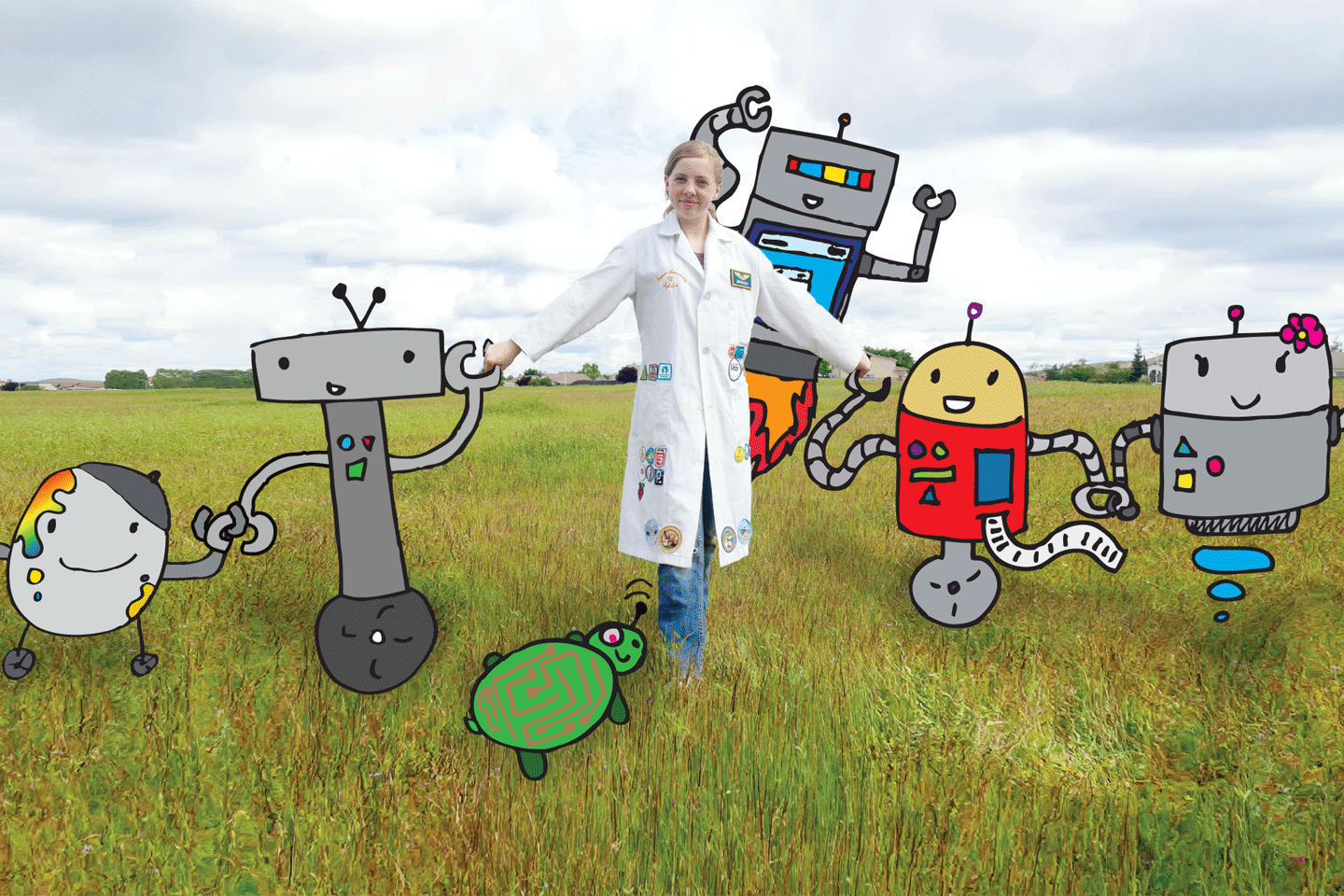
Super-Awesome Sylvia and her friendly robots.

The following excerpt is from “Sylvia’s Super-Awesome Project Book (Volume 2): Super-Simple Arduino” by “Super Awesome” Sylvia Todd.

What’s an Arduino??

The Arduino is an awesome programmable prototyping platform. It’s a little computer that acts like a brain for robots, sensors, or other machines that connect to the real world. It’s pretty inexpensive, too! For less than the cost of a tank of gas, you can get yourself this little blue open-source brain board and start creating something incredible. With just a little bit of code (that you don’t even have to write), it can do almost any crazy thing you want.

Courtesy of Sylvia Todd

Not to mention, Arduino boards now come in all shapes and sizes (some of them are shown above) with tons more processing power, and a variety of inputs and outputs. Only the blue Arduino boards are officially called “Arduino”, offshoot boards like the RedBoard above are called Arduino-compatible. They can do everything an official blue Arduino can do, but look different and are made by someone else. For our experiments, we recommend the Arduino Uno or the Redboard, which are easy to get and simple to use.

When you get an Arduino, it’s not always clear what you should do. I’ve heard of some people who get one, and then just leave it on the shelf — what a waste! With just a quick search online, you can find literally thousands of incredibly creative Arduino-based projects, like walking robots, musical instruments, or even video games.
Thanks to the awesome Arduino community, most projects can be built at home with the parts listed and open-source code you simply copy-and-paste. Once your invention is working, you can change the code, add functionality, and make the machine your own.

Sylvia’s Super-Awesome Maker Show on YouTube

[youtube http://www.youtube.com/watch?v=3xCY2K9kQz4&w=560&h=315]

Understanding Code

When you want to tell a computer what to do, you quickly learn that it doesn’t speak your language. That’s why 
a bunch of smart peeps came up with programming languages that computers can understand. Arduino uses
 a pretty old but very good language called “C”. Every Arduino program is a list of instructions written in the C language that tells the Arduino to do something exactly same way, every time the program runs. It’s mostly English, with a bit of syntax to make it more standard. It can be a little hard to read at first, but just pick out stuff you know, and the rest will start making sense.

The Arduino may be small, but it’s very fast. It can do things faster than a millionth of a second, and we’re going to use that to our advantage for this project. Once your simple strobe is assembled, you need to teach it to work by programming it. We do so by writing a program (or changing someone else’s program). Today, lots of people call their computer programs, “code,” and the programming process, “coding.”

Every Arduino sketch has at least two functions: setup and loop. The setup function is triggered ONLY when the Arduino starts up. Then, the loop function runs and when it’s done, it runs again, forever! Using just these two functions, you can make the Arduino do almost anything you want.

“Super Awesome” Sylvia Todd has been making and tinkering since she was 7 years old. She hosts her DIY web show “Sylvia’s Super-Awesome Maker Show” with the help of her father James Todd. She has demonstrated her projects to President Obama at the White House and at Maker Faires around the country.

What Makes an ‘Extreme Learner’?

By Jane Mount/MindShift

When Mollie Cueva-Dabkoski was dissecting a sheep’s heart during an eighth-grade science class, she had an epiphany that changed her life. “That heart told the story of anatomy and physiology!” she said.

Realizing that science is best communicated through stories, Cueva-Dabkoski, now just 19 years old, went on to explore beetles in China. She’s now at Johns Hopkins University, and continues to do research during breaks.

Cueva-Dabkoski is considered an “Extreme Learner,” a designation applied to just 12 individuals by the Institute for the Future, for her radical and gutsy approach to learning. Extreme Learners are self-directed, wide-ranging in their interests, comfortable with technology, and adept at building communities around their interests.

“Extreme learners aren’t so different from everybody else,” said Milton Chen, a fellow at the Institute for the Future and advocate for education reform. “We picked people who are extreme in their passion for learning.” They are also willing to go their own way when traditional educational institutions interfere with their pursuits.

Thomas Hunt, for example, another designated “extreme learner,” dropped out of high school when he was 14 to work on cancer research. Always interested in science, he found high school stultifying and needlessly time-consuming. Kids of varied interests were thrown together and taught in “the cookie-cutter method,” he said. After he left, Hunt found like-minded learners when he became one of 20 Thiel Fellows, formerly known as “20 Under 20,” which paid him $100,000 to drop out of school for two years and pursue his studies. “For some kids who have a vision of what they’re interested in, high school is not for them,” he said.

This was also true for Marc Roth, another extreme learner who dropped out of high school three times and never finished his community college education. (He earned his high school equivalency degree in three weeks.) Today, Roth is the founder of the Learning Shelter, a 90-day training program that teaches homeless people high-tech manufacturing skills. Roth is 40, and his improbable path to the Learning Shelter included delivering pizzas, programming and consulting in IT, sailing the seas on a cruise ship, and starting his own business. When that business collapsed, and Roth’s net worth fell from $21 million to nothing, he moved to San Francisco and lived in his car. When his car was broken into, Roth decamped to a homeless shelter for five months.

Roth reversed his fortune — and earned his bona fides as an Extreme Learner — when he was broke and living in the shelter.  He heard others talking about a nearby TechShop, and decided to scrape up the $59 membership fee and give it a try. TechShops are stand-alone buildings with staffs and million-dollar tools that train high-tech skills to anyone interested and able to afford the modest fee; set up with laser cutters and plastics labs, among other tools, they are meant to promote creativity and skill-development. Roth devoured the learning opportunities at the TechShop in San Francisco, starting with sewing and vinyl cutting, and within two months moved from pupil to teacher. “When I only had pennies to my name, I turned everything I had into education instead of comforts or niceties,” he said.

INSATIABLE NEED FOR LEARNING

It’s the hunger for learning rather than raw intellect that distinguishes Extreme Learners from the gifted. Intensely motivated and harboring a breadth of interests, they also consider ignorance a temporary and reparable condition.

Lenore Edman, for example, who along with her husband designs and produces robotic kits for their company Evil Mad Scientist, is motivated by what she doesn’t know. “I’ve recognized that this is what makes me different: I may not know it, but I don’t see it has a barrier,” she said, reflecting the premise behind the growth mindset disposition. “The most extreme thing is not being afraid to learn new things,” she added.

In her work, Edman erases boundaries between math and food, electricity and paper crafts. Recently, she sewed what she called a “missile command skirt,” styled after a vintage video game, and built a “circuitry snack” out of candy. “It was a fun project because we got to eat the candy at the end,” she said. She’s most interested in what happens when different fields intersect, and looks for ways to take the tools of one field and apply them to another.

What’s the lesson here for schools? In short, standardization, repetition, and rigidity are deadly for the curious. “Nothing bores me more than seeing a list of redundant facts I have to memorize,” Mollie Cueva-Dabkoski said. Biology class dragged for Thomas Hunt, but the school turned him down when he tried to replace a few classes with work in a lab outside school. “High school is a big day care system,” Roth said.

Mollie Cueva-Dabkoski

But some schools have figured out how to engage their inquisitive students. Mollie Cueva-Dabkoski attended Ruth Asawa San Francisco School of the Arts, an arts-based school that rewarded exploration and free choice. “We were given a ridiculous amount of time to read and explore,” she said, which allowed her to discover her genuine interests. The school also encouraged creativity through arts, which Cueva-Dabkoski credits with stimulating her enthusiasm for the Brazilian arts. Outside school, she joined an Afro-Brazilian dance troupe and taught dance to kids in Oakland.

“Of all the places in school, in art kids can create exactly what they want,” she said. And in a conflict between depth and breadth of learning, the school rewarded depth. Rather than memorize the dates and key figures in World War II, for example, students were encouraged to go deep on one particular person or event. Time, freedom, and space to make art crystalized for Cueva-Dabkoski, who is scurrying to publish her extracurricular research on beetles before the summer ends and Johns Hopkins beckons.

“If you put the pieces together, you see a movement,” Chen said. Along with MakerLabs, Maker Faires, and TechShops, all of which foster independent learning and creativity, Extreme Learners have indulged their intellectual passions in their own time and on their own terms. Formal educational institutions have little to do with it.

“The main takeaway for teachers is, give students more flexibility and choice over what they’re working on,” Milton Chen said. “Give kids the tools to identify their interests and gather information. And help them find like-minded people to work with.”

The Rise of Educator-Entrepreneurs: Bringing Classroom Experience to Ed-Tech

By Katrina Schwartz

Most teachers are happy doing their job — helping kids understand and make sense of the world around them. But there’s a growing number of educators who are wading into entrepreneurship, frustrated at the lack of tools they need, and wanting to extend their sphere of influence. As technology becomes more widely used and accepted in the classroom, teachers are taking their ideas about how to improve learning environments, sharing them online, and creating web-based tools to benefit teachers and students.

At the same time, the fact that the multi-billion dollar ed-tech space is exploding has not gone unnoticed by investors. Programs like Imagine K12 run crash courses in ed-tech entrepreneurship, connecting fledgling companies to Silicon Valley venture capital firms (and staking out a six percent equity).

But, as most educators know, while tech entrepreneurs can sometimes hit gold, not every newly minted site or software is useful to teachers. That’s what sets educator entrepreneurs apart — they have relevant classroom experience that can’t be gained any other way than by doing the hard work of teaching.

CASE STUDIES

Jack West has taught for 16 years and has been at Sequoia High School in Redwood City for most of that time. He’s a physics teacher and is naturally inclined to innovate, even if his students aren’t as enthusiastic about his non-traditional teaching style. West returned to traditional teaching for eight years until he figured out how to use his innovative techniques not only to spice things up, but to actually help his students do better. That’s what led to the launch this year of Braincandy, a tool to help students understand the underlying concepts behind their misperceptions.

West and his co-founders wrote trick-questions on physics concepts that many kids get wrong. The answer choices are all the common misperceptions. The goal is for students to be completely sure that they’re choosing the right answer, the obvious answer, only to find out that most got it wrong. “These aren’t test questions. They are instructional questions,” explained West. “So what we’re trying to do is create a discrepancy event, a shocking event to open the door for a teachable Continue reading The Rise of Educator-Entrepreneurs: Bringing Classroom Experience to Ed-Tech

Adam Savage: Permission to Make

MythBusters host Adam Savage has a thing or two to say about the importance of tinkering — even if that means it gets messy.

“If you don’t get a chance to fail, if you don’t get a chance to try things and not get them right the first time, and you keep on doing it until you do get that specific kind of success, then you become so risk-averse that you in fact get an allergy to trying new things. And that is the worst thing we can do to kids.”

At Maker Faire last weekend, Savage spoke about how the “maker culture” is the engine that will fuel kids’ love for — and excelling in — math and science.

Here’s to that maker spirit!

[Produced by Joanne Elgart Jennings and Matthew Williams. Photos in the video by Patrick Giblin.]

Quick Look: Motivating the Next Generation to Design and Build

Next year, high schools students in California schools will have the opportunity to design and build projects thanks to the Makerspace program developed by O’Reilly’s MAKE division, the folks who brought us Maker Faire. One of the goals of Makerspace, which was just granted an award from the federal Defense Advanced Research Projects Agency (DARPA), … Continue reading Quick Look: Motivating the Next Generation to Design and Build