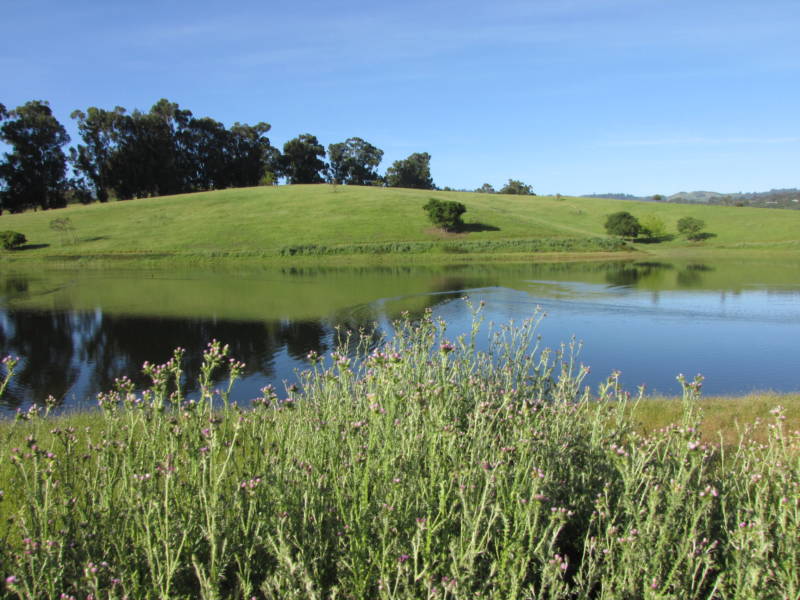
Felt Reservoir, Stanford University (photo: Gretchen Weber)
On a recent weekend, a couple of dozen hearty souls hiked more than 20 miles across the sprawling lands of Stanford University, to learn about global warming and see first-hand how the changing climate is affecting the campus. It was the fourth annual “Walk the Farm” outing, a trek organized by the Bill Lane Center for the American West and led by its Executive Director, Jon Christensen. Each year, the hike takes a different route through Stanford’s more than 8,000 acres, and is designed to use the university as a microcosm for a different global theme. This year’s was climate change.
Throughout the 12-hour day, Stanford researchers joined the hikers to talk about the effects of climate change on the campus and region, as well as the related research taking place at the university. Biology professor Carol Boggs spoke about her research on the Bay checkerspot butterfly, its extirpation in the region, and plans for a possible future reintroduction of the species on campus. Other presenters included climate scientists Chris Field and Steven Schneider, and biologist Scott Loarie.
Watch this six-minute video for an overview of this year’s Walk the Farm hike and highlights from some of the talks along the way:
Hear more from Carol Boggs about the Bay checkerspot butterfly:
Scott Loarie explains how a rapidly changing climate is posing challenges for species migration in the video below:
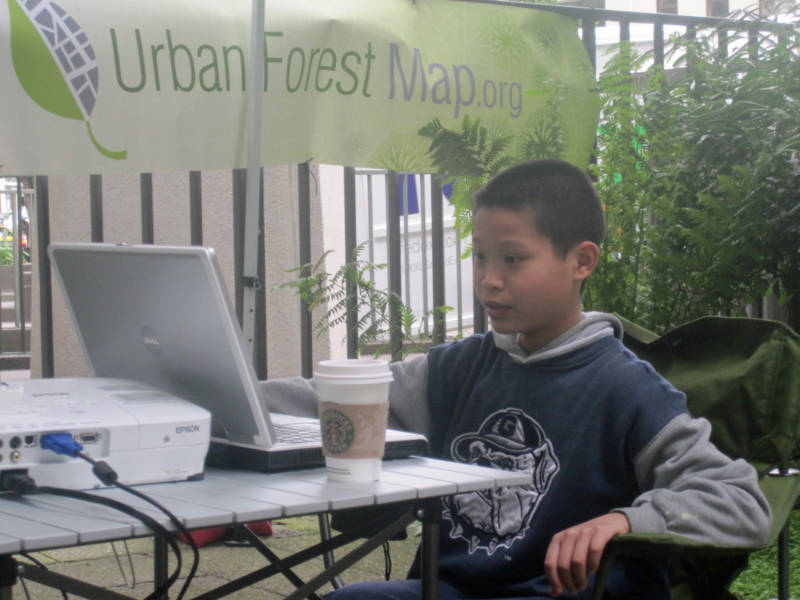
San Francisco 5th-grader Benton Liang demonstrates how to add a tree to the Urban Forest Map (photo: Gretchen Weber)
A new online tool launched this week aims to enlist citizens to help catalog San Francisco’s trees. The Urban Forest Map relies on the public, or “citizen scientists,” to observe their yards and neighborhoods and to add information to an online database that tracks tree location, species, size, and health, throughout San Francisco.
The project’s creator, Amber Bieg, said that 17 different organizations and agencies in the city manage and track trees, but until now, they had no organized way to share information. “This map provides the ability to aggregate data in a new way,” said Bieg. “And it’s an affordable way to do an inventory because it uses citizen participation.”
Bieg developed the program with funding from the California Department of Forestry and Fire Prevention (CAL FIRE). Created in cooperation with Friends of the Urban Forest and the City and County of San Francisco, the Urban Forest Map is designed to serve as a publicly accessible, centralized database that will help urban foresters and city planners better manage trees in specific areas, track and combat tree pests and diseases, and plan future tree plantings.
Creators also hope that climatologists will use to the tool to better understand the effects of urban forests on climate, and that students will get involved and use the map to learn about the role trees play in the urban ecosystem. “If you can’t count it, you can’t manage it,” said CAL FIRE urban forester John Melvin. “If the state is going to adapt to climate change, we’re going to have to expand and better manage our urban forests, and that starts with knowing what we have.”
Urban trees can help cities adapt to climate change by providing shade cover and by both mitigating and purifying storm water runoff, Melvin said. Studies have shown that a robust tree canopy can reduce the “urban heat island” effect by several degrees.
To underscore how easy the tool is to use, on Wednesday morning San Francisco 5th-grader Benton Liang demonstrated how to use to the software for a small crowd gathered in a small park at the foot of the Transamerica Building. In addition to providing an inventory, Bieg said, the map is also an educational tool. The Urban Tree Key is a related interactive tool that helps citizen scientists identify common Northern California urban trees. The map’s software also allows users to calculate the benefits, such as energy savings and air quality, that a specific tree or category of trees provide using data from the Center for Urban Forests Research, said Bieg.
To learn more about the Urban Forest Map, watch a video from 2007 that KQED’s Quest made about the project.
Saturday is an “International Day of Action” organized by Greenpeace, which claims 4,800 events are scheduled around the world toward “a safe climate future.”
This seems like a good time to check in with one of our 2009 California Climate Champions. In this post, Kayla Clark of Atascadero describes her efforts to reduce greenhouse gases by targeting those ubiquitous disposable water bottles at her school.
In my observation, sometimes when faced with the reality of climate change, we’re frightened. It can be a normal reaction to run back to our previous habits, jump in the large SUV, leave the lights on, and plead ignorance. It’s indisputable that there is a serious issue that must be dealt with, but only through breaking down the problem to approachable and accessible goals can we hope to improve the situation.
My name is Kayla Clark, and I am a California Climate Champion and a junior at Templeton High School. California Climate Champions is a program sponsored by the British Council in partnership with California Air Resources Board that selects young people throughout the state who are leaders in communicating about climate change to their communities. There are 25 of us all together and the program enables us to work with one another to discuss climate change with a wider audience.
Each California Climate Champion is responsible for completing an individual project to communicate about climate change to his or her own community. My project is to reduce the number of plastic water bottles purchased at my school and in my community by selling reusable water bottles on campus, as well as coordinating the development of a more attractive water source on campus. For two years, I have seen hundreds of disposable water bottles purchased daily at Templeton High School. We do have recycling bins on campus but many students don’t utilize these bins. I estimate that maybe twenty students occasionally use reusable water bottles on my campus.
The goal of my project is to use water bottles to share a wider message. We can reduce greenhouse gas emissions by reducing student consumption of disposable water bottles, and we can permanently change behavior–even if that means affecting only the smallest of lifestyle choices. At the core of these goals has always been communication. For me, that has meant sharing information at my high school, collaboration with my campus environmental club, and committing to speaking engagements and volunteer opportunities.
I realize that I can’t undertake my water bottle task alone. For that reason I’ve contacted and partnered with my school’s environmental club and my school principal so that we can work together on this project, and they have both been extremely supportive. Having a local network is very encouraging.
I’ve also had a couple of great opportunities to speak with different groups about climate change. I have addressed the Air Pollution Control District (APCD) at their July board meeting and the San Luis Obispo Exchange Club. Both experiences were really interesting, as many of the audience members had basic questions about climate change and the science behind it, so answering their questions was really exciting.
My presentations are also leading to an expanded network with new opportunities. From my presentation with APCD, I was given the chance to volunteer at my local farmers’ market for the APCD “Food Miles” booth. We gave out free reusable grocery bags, and educated the community about food transportation and its impact on our climate, as well as the benefits of eating locally to reduce greenhouse gas emissions.
It’s true that as a concerned teenager implementing reusable water bottle usage, my audience isn’t the largest. But my project is more than giving students a new water bottle and telling them to fill it up daily. I am trying to influence behavior.
I feel that my actions are part of a ripple effect and by raising awareness to the pressing issues, more ripples are being made and more students and adults are opening their eyes.
The California Climate Champions program is the U.S. component of the British Council’s International Climate Champions program, which identifies young people around the world who are leaders in communicating about climate change and engaging their communities in action. In the US, the program is co-sponsored with the California Air Resources Board (ARB) and selects 10-15 high school students from across the state each year.
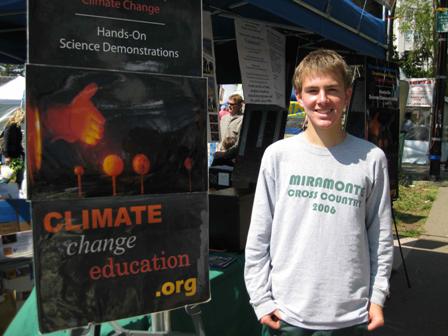
Devin Finzer is a 2008 California Climate Champion from Orinda who graduated from Miramonte High School in June. In this guest post for the Climate Watch blog, he describes how he and fellow Champion Patrick Ouziel were able to start a carpooling program at his school.
Walking to my high school each morning, I trekked past long lines of backed-up traffic. Driver after driver waited anxiously for his or her chance to round the corner into the Miramonte High School lot and hunt for a coveted parking spot. For the most part, each car contained just one person. The passenger seats of large SUVs and mini-vans were often left completely empty. The early-morning situation involved stress, traffic congestion, and unnecessary pollution. Fellow student Patrick Ouziel and I decided we could do something about it.
As California Climate Champions sponsored by the California Air Resources Board and the British Council, Patrick and I are engaged in local and international efforts to take action and spread awareness about climate change. One of the main environmental issues we noticed at our high school was the way students get around. With after-school sports and club activities, juniors and seniors take advantage of their newly earned driver’s license, but by driving only themselves, they often missed out on easy, cost-beneficial, and eco-friendly ways to group together with other students traveling their same route.
Patrick and I are proud to have lobbied for the expansion of our school’s carpool system, which provides carpoolers with designated parking spots each morning. During the school year, we produced several videos promoting eco-friendly transportation and climate awareness, and linked these videos to a web site where students could demonstrate their support for increasing the percentage of carpool spots at our school. We also provided an option where students could sign up as “potential carpoolers” in order to find other ride-sharers who lived close by.
The result? With the support of students and the administration, we transformed our parking lot reserved for high school seniors into a lot exclusively for carpoolers. Now 80 spots, about 30% of our entire lot, are reserved exclusively for carpoolers.
What are the environmental benefits for the new program? While differing gas mileages and travel distances make exact calculations difficult, we do know that carpooling with just one other person already cuts per-person emissions, as well as gas costs, in half, and we can estimate that our carpool system inspired about 40 additional carpool groups.
While deciding to carpool almost seems almost like a no-brainer, Patrick and I did face significant barriers when we emphasized the importance of ridesharing. From the get-go, one of the main obstacles we had to address was the relationship between driving and teenage independence. Every sixteen-year-old remembers the day he earns his license: the fresh feeling of the driver’s seat and the thrill of taking the wheel, free from parental supervision. Americans clearly love to drive, and apparently, many of us love to do it by ourselves — a 2005 U.S. Census Bureau survey says 77 percent of American workers drive to and from work alone.
In our awareness videos, Patrick and I emphasized that carpooling doesn’t have to be a sacrifice of this independence. Rather, it can be an effective symbol of collaboration: sharing a ride is an opportunity to spend time with friends, or to get to know new people. Teenagers are social beings who feel most content when they are connected with their peers. That’s why we emphasized the importance of a collective carpool movement built on the strong sense of community at our school.
Advocating carpooling can be a great way to start a green movement at your own school or workplace. There are a number of web sites that match potential carpoolers and make ridesharing easy. I’ve reviewed a few of the better-known ride-matching sites on my blog.
Patrick and I will both be going to school on the East Coast next year, Patrick at Yale and myself at Brown. We plan to continue our climate change activism. In particular, I’d like to encourage the installation of solar panels on the roofs of high schools and universities. Our continued environmental efforts will be documented on my blog.
Special thanks to Climate Watch intern Kristine Wong for help with this post.
 Saturday is an “International Day of Action” organized by Greenpeace, which claims 4,800 events are scheduled around the world toward “a safe climate future.”